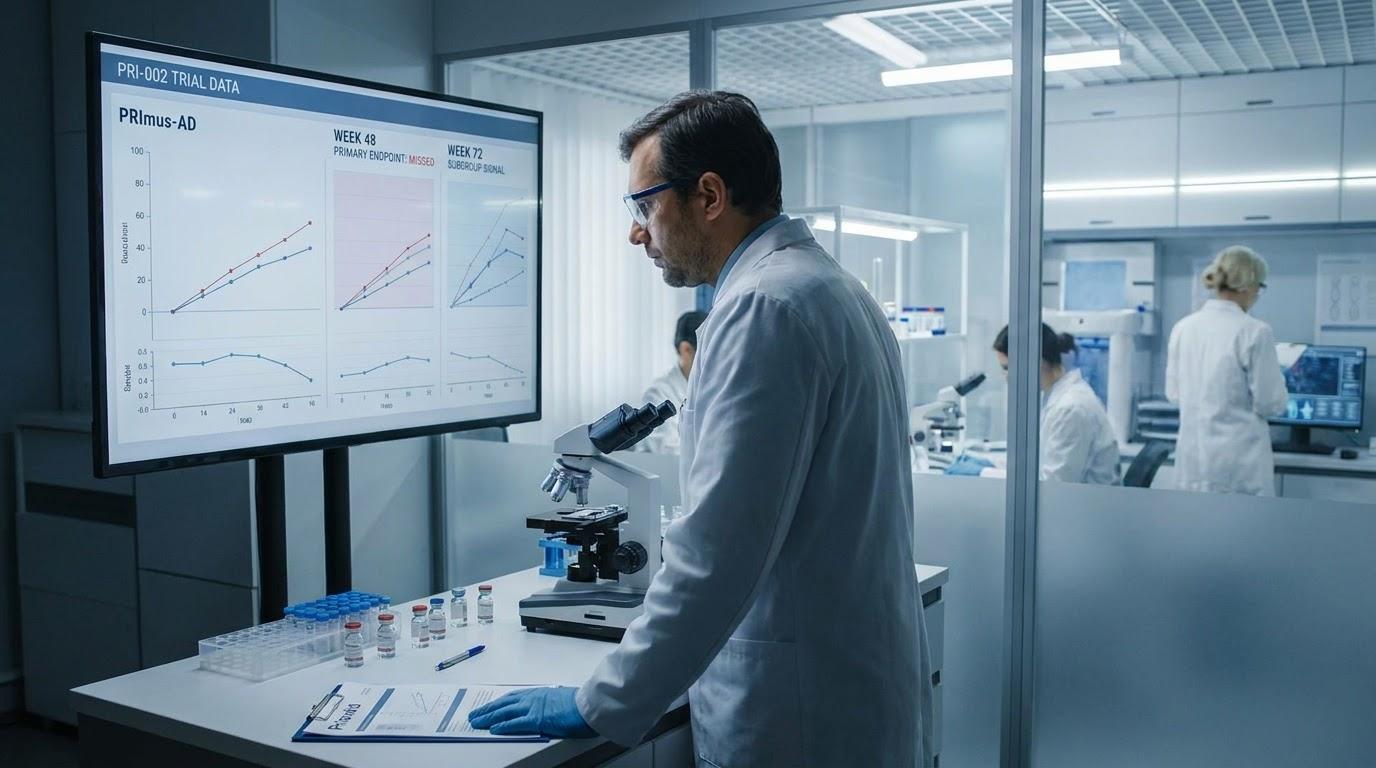
Priavoid’s phase 2 PRImus-AD trial failed on its main efficacy measure, leaving the biotech to lean on longer-term and per-protocol findings to support continued development of its oral Alzheimer’s candidate PRI-002.
The Düsseldorf-based company studied two doses of the all-D-peptide in 304 patients aged 55 to 80 years with mild cognitive impairment or mild dementia due to Alzheimer’s. The trial missed its primary endpoint, failing to show a change from baseline at Week 48 on a clinical dementia rating scale.
The data
Priavoid said there were numerical differences favoring PRI-002 across key measures of cognition and daily functioning, but the more favorable result it highlighted came from the per-protocol population rather than the primary analysis. In that group, consisting of patients who followed the study protocol without major deviations, the company reported a statistically significant 35.9% slowing of cognitive decline at Week 72 versus placebo on a separate Alzheimer’s assessment scale.
The company also pointed to an early biomarker read. According to Priavoid, p-tau181 levels were consistent with PRI-002’s proposed biological activity, with differentiation starting at 24 weeks. It said further evaluation of Alzheimer’s disease-related biomarkers and brain volumetric measurements will be needed to clarify the relationship between the proposed mechanism and the clinical findings.
On safety, Priavoid said the study met its other primary endpoint. The most common adverse events were headache, nausea and dizziness. ARIA-H was seen in 8% of patients on the 300 mg dose, 11.7% of the 600 mg cohort and 5% of the placebo group. ARIA-E rates were 2%, 0% and 1%.
Why it matters
The result leaves PRI-002 in a familiar Alzheimer’s development position: an overall miss paired with signals the company argues justify more work. That is a harder package to advance commercially and clinically than a clean primary endpoint win, especially in a field where investors and partners increasingly distinguish between exploratory support and trial-defining evidence.
Priavoid’s scientific angle remains differentiated from approved anti-amyloid monoclonal antibodies. Rather than clearing plaques, PRI-002 is intended to bind neurotoxic Aβ oligomers and disassemble them into non-toxic monomers. But for the program to matter beyond mechanistic novelty, future development will need to show that those biological ideas can translate into clear efficacy in the main trial population, not only in later or narrower analyses.