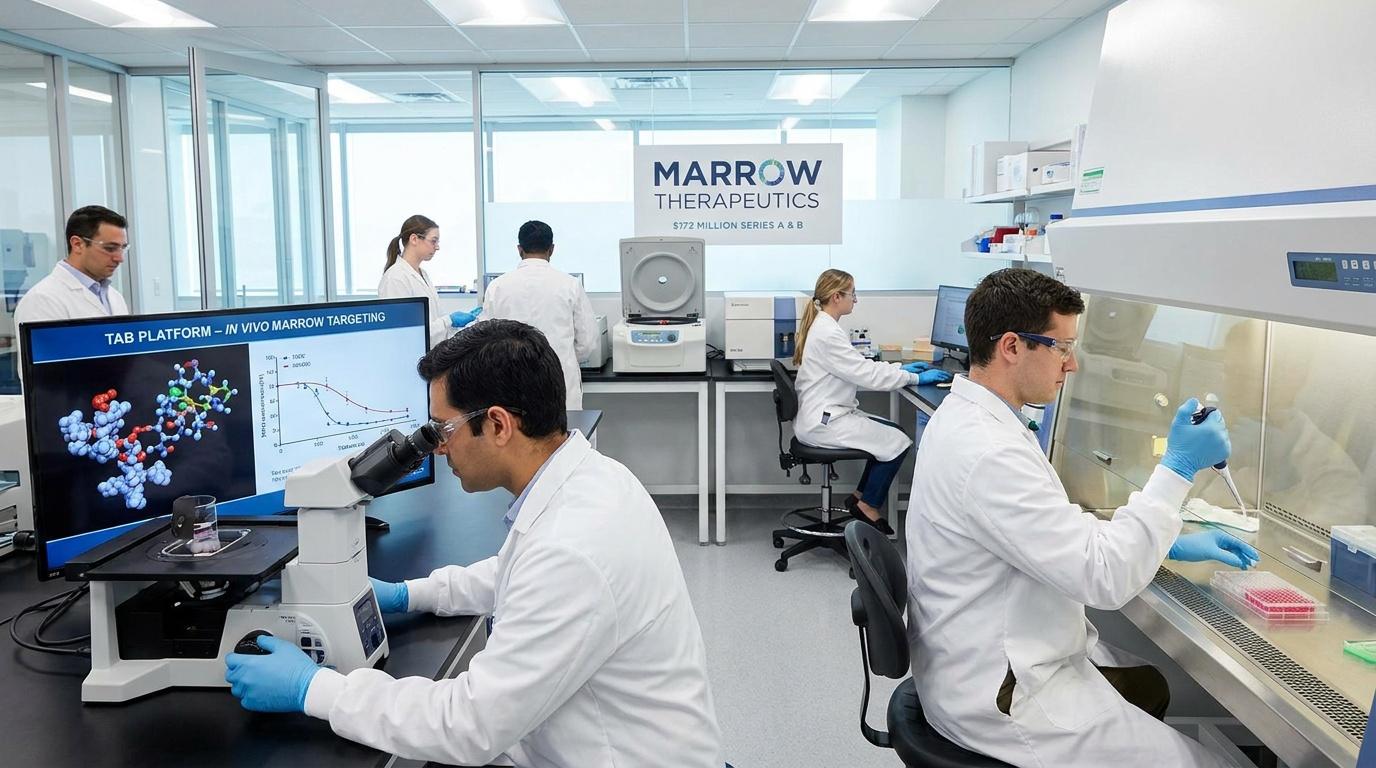
Marrow Therapeutics has launched with $173 million in combined series A and B financing to develop in vivo treatments for severe blood disorders, entering a field where the biology is increasingly validated but the delivery model remains the bottleneck.
The company’s pitch is not that sickle cell disease and beta thalassemia lack proven targets. It is that current genetic medicines have shown what is possible while still carrying safety, manufacturing and access constraints that leave room for a different approach.
The Platform Bet
According to BioSpace, Marrow’s $53 million series A was co-led by founder Scion Life Sciences and venBio, while the remaining $120 million came from a series B led by OrbiMed. The company said it will use the funding to strengthen its bone marrow-targeted platform for severe blood disorders.
That platform, called Transferrin Antibody Bioconjugate, or TAB, is designed to deliver therapeutic payloads directly to bone marrow cells. Marrow said this approach aims to overcome limitations of traditional genetic medicines, including safety, manufacturing and accessibility concerns.
The strategic implication is straightforward: after ex vivo therapies helped validate gene modification in blood disorders, a company that can shift treatment in vivo could compete on simplicity and reach, not just efficacy. That makes delivery the product thesis.
The Lead Program
Marrow’s lead candidate, MAR-101, is in preclinical studies to enable in-human testing. The program is designed to treat both sickle cell disease and beta thalassemia by reducing the protein-coding gene BCL11a and reactivating fetal hemoglobin production.
Those targets come into a market with established proof of concept. BioSpace noted that Vertex Pharmaceuticals and CRISPR Therapeutics’ Casgevy and Genetix Biotherapeutics’ Lyfgenia won landmark approvals for sickle cell disease in December 2023, validating genetic modification as a successful treatment approach. A month later, Casgevy was also cleared to treat beta thalassemia.
But the same source also described the commercial and clinical opening Marrow is trying to exploit. Both approved products are ex vivo therapies that require an intensive administration process, and Lyfgenia carries a boxed warning for hematologic cancers with lifelong monitoring recommended.
Why The Financing Matters
For an early company, $173 million is enough to signal investor willingness to fund platform-heavy execution before human data, provided the therapeutic rationale is already de-risked by the field. Marrow is not trying to prove that fetal hemoglobin reactivation matters in these diseases. It is trying to prove that direct bone marrow targeting can make genetic medicine safer and more accessible.
Chief Executive Officer Romesh Subramanian said the field has validated key targets and shown that genetic approaches can work, but still needs to solve safety and accessibility challenges. He is joined by Chief Scientific Officer Tim Weeden and Chief Operating and Technology Officer John Najim, both formerly of Dyne Therapeutics.
That framing gives Marrow a clear benchmark. If MAR-101 reaches the clinic and preserves the benefit expected from BCL11a reduction while easing the burden of treatment, the company could have a differentiated position in a market where the first products proved the science but not yet the easiest delivery model.