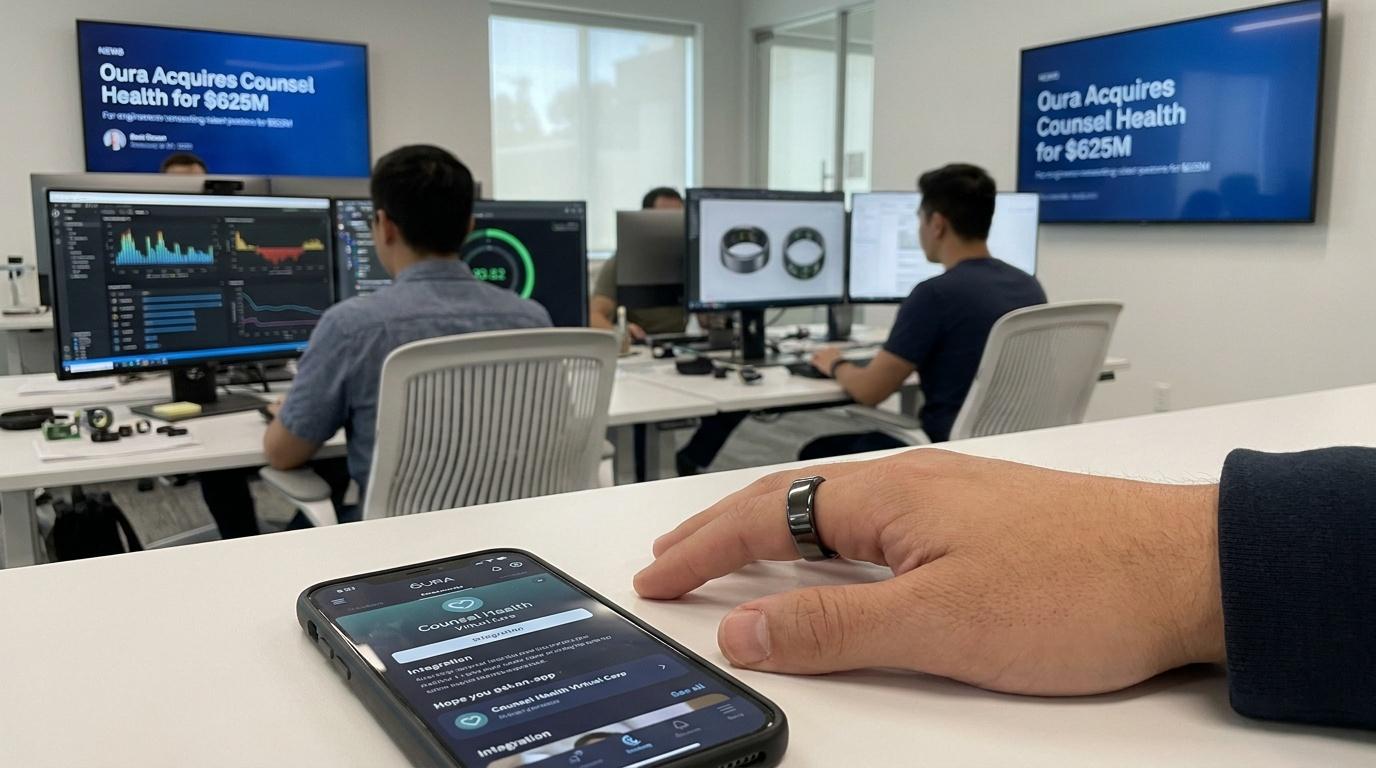
Oura plans to acquire AI virtual primary care company Counsel Health for $625 million, with the companies saying the all-cash deal is expected to close before the end of this year pending customary closing conditions. The buyer is taking in a company it already knows well: Oura and Counsel have partnered since June, and in September announced a tighter collaboration centered on the Centers for Medicare and Medicaid Services’ ACCESS Model, set to begin early next year.
The strategic logic is straightforward. Oura already has 5.7 million paid members and collects ongoing biometric data through its smart ring platform. By bringing Counsel in-house, it is trying to turn that stream of physiology data into a care workflow inside the same app, rather than stopping at tracking and interpretation.
What Oura Is Buying
Counsel uses text-based, records-informed medical AI encounters to field and triage users, then routes people to telehealth visits with the company’s in-house physicians when needed. Those physicians are supported by a proprietary Clinician Cockpit that surfaces relevant clinical data for the encounter.
That setup matters because it frames AI here as an intake and decision-support layer wrapped around physician-led care, not as a stand-alone clinical endpoint. Counsel founder and CEO Muthu Alagappan said the company built its medical AI around trust, safety and responsibility while keeping physicians in the loop for clinical decisions.
The two-year-old company also brings an enterprise business that extends beyond Oura’s direct-to-consumer base. Counsel says it has partnerships with health plans, provider organizations, employers and other consumer health organizations, and under Oura it will continue serving existing enterprise partners while expanding to new customers and broadening clinical capacity.
The Commercial Signal
Oura said it is profitable and “growing meaningfully,” reporting 92% year-over-year revenue growth to nearly $1.8 billion for the fiscal year ended Sept. 30. In its most recent fiscal quarter, also ended Sept. 30, the company reported 153% year-over-year revenue growth and adjusted EBITDA of $87 million. It had recently postponed an IPO that was targeting a $15.6 billion valuation, citing “uncertainty” in the market.
Against that backdrop, buying Counsel suggests Oura sees more value in deepening member utility than in remaining a hardware-and-subscription business tied mainly to monitoring. Executive Chairman David Shuman said the combination expands Oura’s addressable market, deepens the value delivered to each member and opens the door to millions of people through Counsel’s enterprise relationships.
The companies said they plan to build out preventive care through continuous monitoring and proactive guidance, acute care through timely intervention for episodic health issues, and specialty and chronic care management in areas including reproductive health, cardiometabolic health and aging. Early data from the partnership, according to the companies, showed a 4.6 out of 5 average care rating among those who saw a physician, 90% agreement among Counsel members that use of their Oura data helped improve care, and 70% satisfaction among Oura members with onboarding to Counsel’s services.
The broader signal is that device companies with large engaged user bases are still searching for durable healthcare economics beyond data visibility alone. Oura’s move indicates one answer is to own more of the care pathway so that biometric monitoring can feed directly into triage, telehealth and chronic care management, creating a tighter commercial link between member engagement and clinical services.