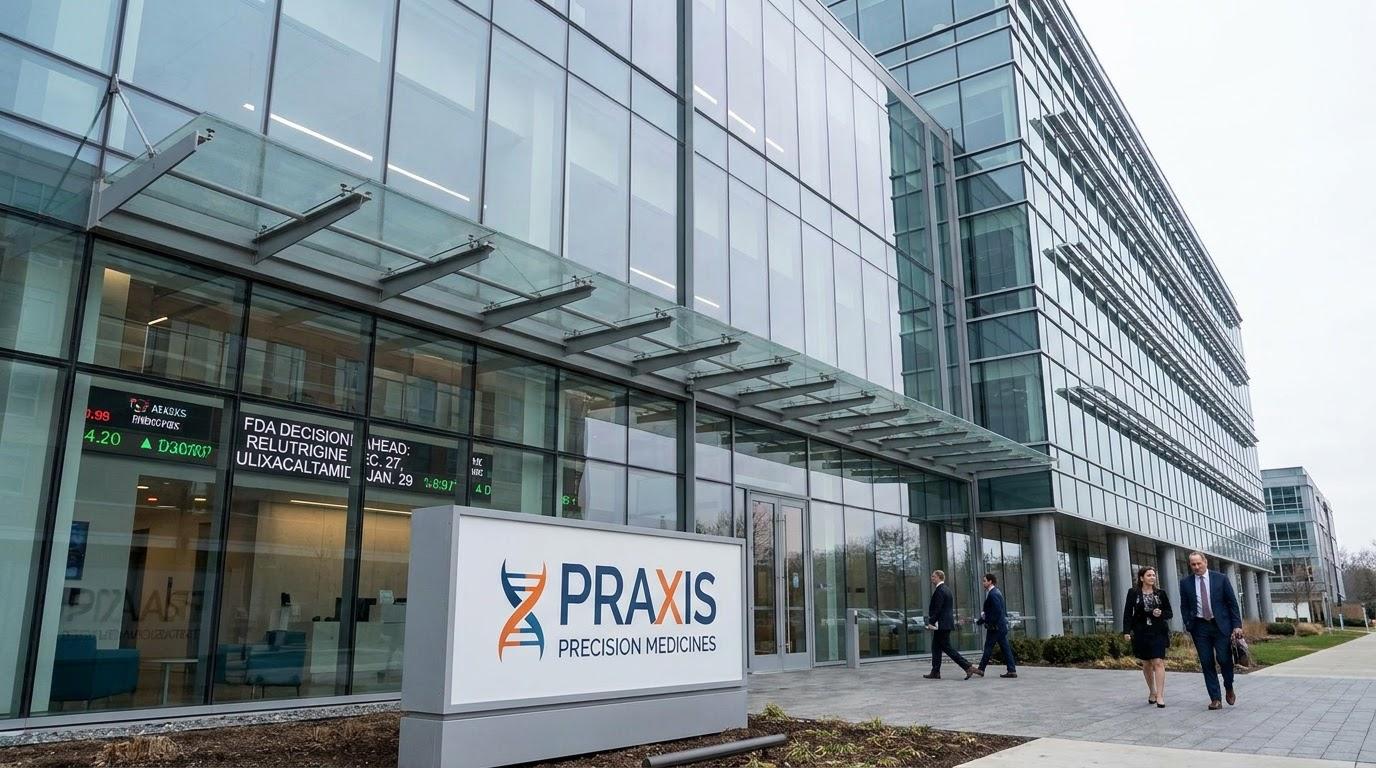
Praxis Precision Medicines is approaching two FDA action dates that could define its shift from R&D-stage biotech to commercial company. The first decision, on or before Dec. 27, covers relutrigine for SCN2A and SCN8A developmental and epileptic encephalopathies, or DEE. The second, on or before Jan. 29, 2027, covers ulixacaltamide in essential tremor.
That pairing is central to Praxis’ strategy. CEO Marcio Souza described the company to BioSpace as a self-described “oddball” because its pipeline spans both ultrarare and more common central nervous system diseases, rather than concentrating on one end of the market. If both drugs are approved, Praxis would not just gain its first products; it would enter commercialization with assets aimed at two very different patient populations.
The Data
Relutrigine is an oral drug that blocks the persistent flow of current across sodium channels, which Souza said is a key driver of seizures in patients with DEE when left unchecked. In the Phase 2 EMBOLD study, Praxis reported in December 2025 that 51 patients on relutrigine achieved a 53% placebo-adjusted reduction in seizures over 16 weeks. Treated patients also recorded a 66% increase in motor seizure-free days.
Praxis said the EMBOLD results were strong enough that a Data Monitoring Committee recommended the study be stopped early for efficacy. On Nov. 12, the company also presented open-label extension data showing benefit through 18 months, including an 86% reduction in seizures from baseline. Jefferies said after that update that the new open-label extension results support relutrigine’s durable effects.
For ulixacaltamide, Praxis shared an early analysis from the Phase 3 Essential3 long-term safety study in its Nov. 12 update. According to the company, patients with essential tremor who completed efficacy assessments after receiving the drug for around 95 weeks showed durable and improving response over time on an activities of daily living scale, which Praxis said further supports ulixacaltamide’s use as a chronic therapy.
The Road Here
Relutrigine had originally been headed for a Sept. 27 FDA decision, but the agency classified additional sensitivity analyses of existing clinical data as a major amendment to the original application, extending the review by three months. Praxis said at the time that the FDA did not request additional trials and did not identify safety or manufacturing concerns. Jefferies described the extension as a “fairly benign delay.”
Souza told BioSpace that there has never been a drug developed for DEE, adding that many companies “shy away from problems like this.” He also credited leadership in the FDA’s Office of Neuroscience and its neurology divisions for pushing the program forward and for caring about patients.
Praxis has tried to position that rare-disease work within a broader development philosophy. Souza said the company starts with how patients experience disease and then designs studies to answer those questions, even when that approach is “at odds” with established practices. He linked that approach to the FDA’s Rare Disease Framework Initiative, announced on October 15, which includes a commitment to embed the patient’s voice early and at clearly defined milestones in development and review. Souza called the framework “fantastic” but said he was not sure there is yet enough alignment and momentum for that vision to fully become reality.
The Commercial Picture
The two pending decisions present different kinds of opportunity. Relutrigine addresses SCN2A and SCN8A DEE, which Souza described as devastating conditions involving “unrelenting seizures,” 24-hour care needs and very high mortality risk. Ulixacaltamide, by contrast, targets what Souza called the most common movement disorder in the U.S., putting Praxis into a larger-market indication at the same time it pursues ultrarare neurology.
Jefferies said ulixacaltamide “seems likely to be FDA-approved” by the Jan. 29 PDUFA date. Truist Securities wrote on Nov. 13 that Praxis’ Investor Day reinforced confidence in the near-term essential tremor opportunity while also highlighting a more compelling longer-term pipeline story. That matters because the company is trying to show investors it is not built around a single binary event: relutrigine and ulixacaltamide both come from its Cerebrum small molecule platform, while elsunersen leads its Solidus antisense oligonucleotide platform in Phase 3 for early onset SCN2A DEE and received FDA Breakthrough Therapy Designation in June.
Praxis also plans to launch studies of ulixacaltamide next year in Parkinson’s disease, restless legs syndrome and autism spectrum disorder. The broader signal is that the next two FDA decisions are about more than near-term revenue. They test whether Praxis can use two launches, if approved, to establish a wider CNS franchise across rare and common disorders rather than remain a single-asset story.