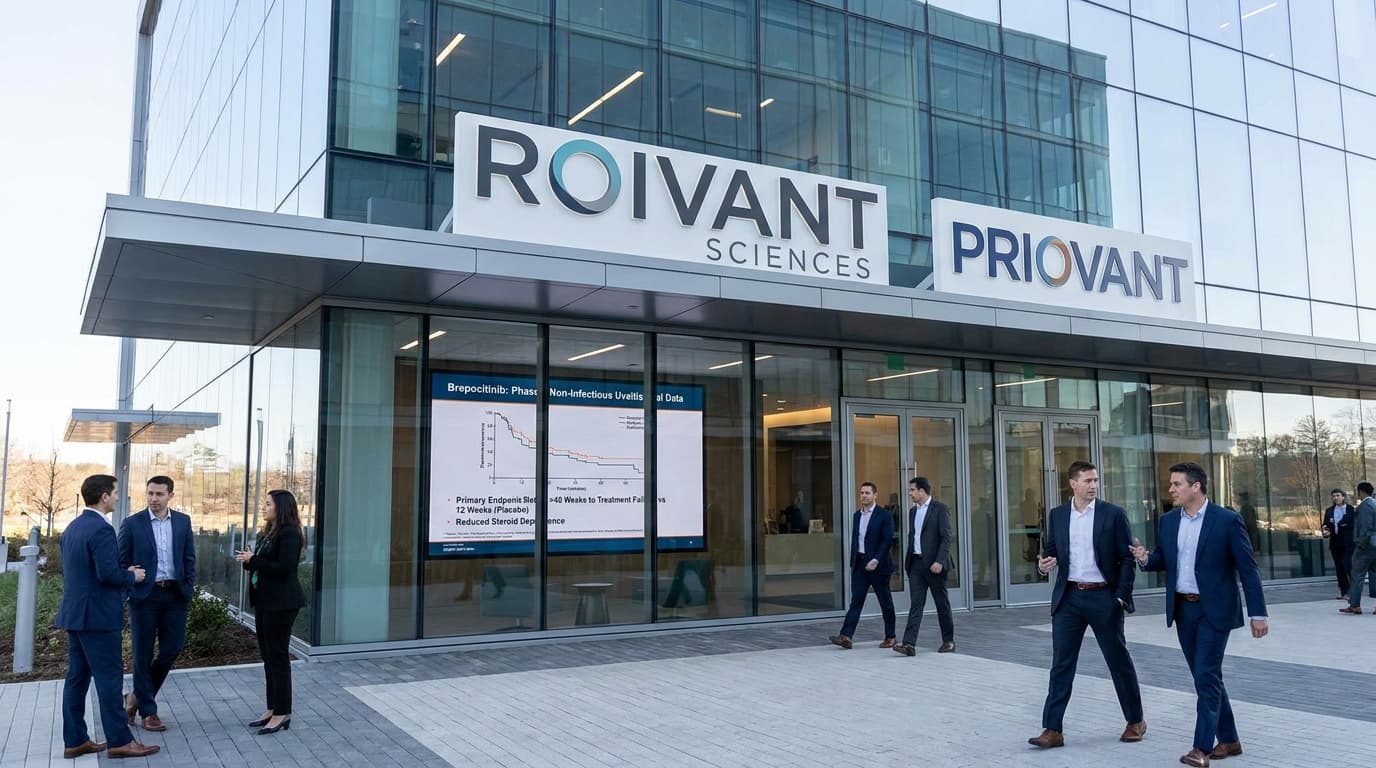
Roivant Sciences and its subsidiary Priovant reported phase 3 results showing that brepocitinib significantly reduced steroid dependence in patients with non-infectious uveitis, giving the company a potential expansion path beyond the drug’s August approval in dermatomyositis. The oral TYK2/JAK inhibitor, marketed as Lisraya in dermatomyositis, is now headed toward a supplemental filing in the first half of 2027.
The result matters commercially because non-infectious uveitis has only one approved non-steroid treatment, AbbVie’s Humira. Roivant and Priovant are now arguing that brepocitinib could support a broader rare disease immunology franchise, while Leerink Partners said in a note that the efficacy looked stronger than Humira on a cross-trial basis even though the studies did not directly compare the two drugs.
The data
The Clarity-1 and Clarity-2 trials were identical phase 3 studies. In both, patients taking brepocitinib went more than 48 weeks before treatment failure, compared with 12 weeks for placebo, meeting the primary endpoints.
Roivant said treatment failure captures both tolerability and efficacy by measuring the time until patients stop taking the drug for any reason. The company also said patients in the treatment arm went 40 weeks without requiring steroids, which it described as a new bar for non-infectious uveitis therapies.
In pooled analysis across the Clarity program, 62% of patients on brepocitinib remained steroid-free at 48 weeks versus 20% on placebo. Brepocitinib also met all secondary endpoints, including sustained steroid-free disease inactivity, chorioretinal vascular leakage and patient-reported visual aptitude.
The drug’s activity extended across multiple subgroups, including patients with or without prior tumor necrosis factor inhibitor use and patients with idiopathic disease, birdshot chorioretinopathy and sarcoidosis. Among eyes in patients who had macular edema in addition to uveitis, brepocitinib resolved the condition in 42% compared with 4.8% on placebo.
On safety, Roivant said 3% of participants discontinued brepocitinib because of an adverse event, most of which were mild or moderate.
The commercial picture
Leerink noted that 50% of patients fail on Humira within six months and said brepocitinib appeared superior on a cross-trial basis with a much more aggressive steroid tapering schedule. That is not head-to-head evidence, but it frames the strategic opportunity: Priovant may be able to position an oral medicine as an earlier treatment option in a disease where steroid sparing is central to care.
The firm modeled $2.3 billion in unadjusted sales for non-infectious uveitis by the end of 2029, with higher potential if the drug receives a label favorable to patients who have not taken a tumor necrosis factor inhibitor such as Humira. It also projected $54 million for Lisraya in dermatomyositis and $559 million in fiscal year 2028.
For Roivant, that would make brepocitinib more than a single-indication product. It would become one of the main commercial supports alongside mosliciguat and IMVT-1402 in what CEO Matt Gline described earlier this month as a “three-legged stool.”