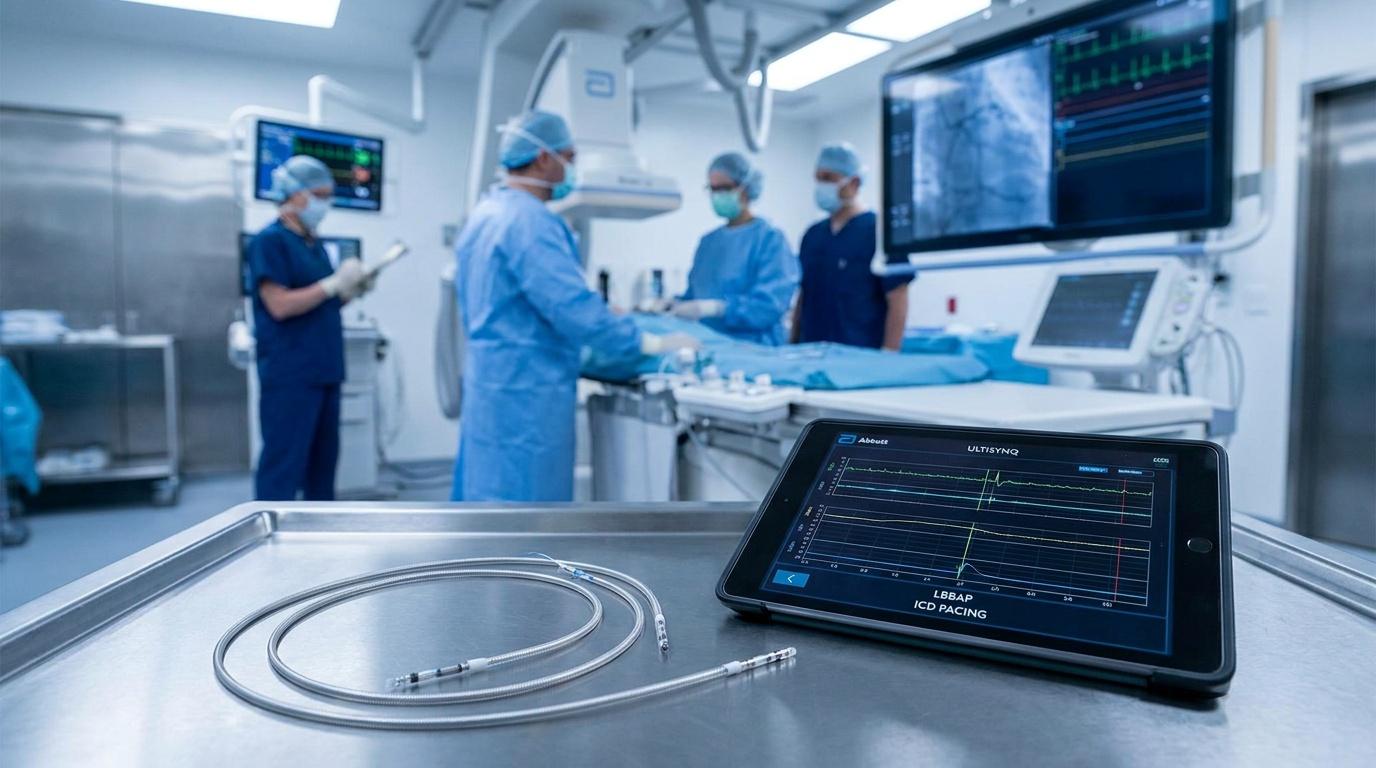
Abbott has received both FDA approval and CE Mark for its UltiSynq defibrillation lead, giving the company clearance in the U.S. and Europe for a device designed to deliver both conduction system pacing and defibrillation therapy.
That combination is the commercial and clinical distinction in the launch. Abbott said U.S. and EU patients who are candidates for both conduction system pacing and defibrillation protection now have an additional lead option, in a market where roughly 150,000 implantable cardioverter-defibrillators are implanted in the U.S. and 140,000 in Europe annually.
The data
UltiSynq is designed for implantation in the left bundle branch area of the heart. Abbott said left bundle branch area pacing, or LBBAP, is intended to restore the heart’s natural pattern of electrical activation, and the lead is built to provide both cardiac pacing and defibrillation therapy through that approach.
The FDA approval and CE Mark were supported by results from the ASCEND CSP IDE trial in patients indicated for ICD or cardiac resynchronization therapy defibrillator, or CRT-D, therapy. In that study, lead implantation was successful in 98.5% of the 205 patients tested. Abbott also said 86% of patients achieved LBBP or likely LBBP, meaning the lead stimulated or likely stimulated the heart’s natural conduction pathway.
Abbott said the device is built on an ICD lead platform with distinct, true bipolar sensing that uses two closely spaced electrodes within the lead to detect ventricular signals.
The commercial picture
Abbott’s pitch is not simply that conduction system pacing is available, but that it can be paired with defibrillation in the same lead category. Products including Medtronic’s SelectSecure 3830 and others offer LBBAP treatment, but Abbott said UltiSynq is unique in its ability to support both defibrillation therapy and LBBAP.
That matters because pacing performance can shape long-term outcomes in a large ICD population. If physicians view the trial results as sufficient to support broader use, Abbott’s differentiation is less about opening a new ICD market than about taking share with a more specialized lead design.
Pugazhendhi Vijayaraman, MD, system director of Cardiac Electrophysiology at Geisinger Heart Institute, said in a statement that the observed implant success, LBBAP capture results and defibrillation testing outcomes give physicians data on a lead option for patients who require defibrillation protection and are candidates for conduction system pacing.