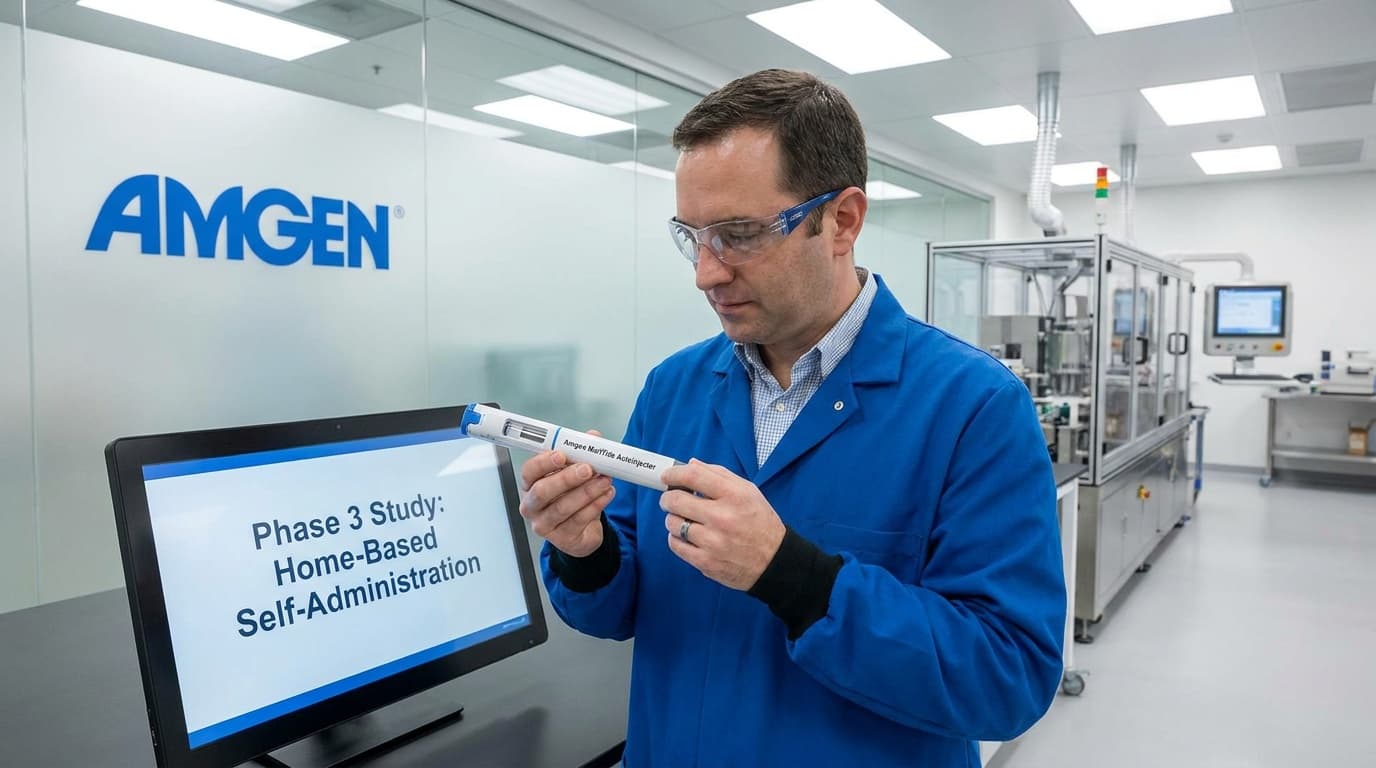
Amgen has started another Phase 3 study for MariTide, this time testing home-based self-administration of the subcutaneous obesity candidate with an autoinjector. The new trial begins as the company reaffirms plans for its GLP-1 program in third quarter earnings and moves toward first Phase 3 data next year.
The timing matters because MariTide’s commercial argument depends not only on efficacy but also on whether Amgen can translate its proposed dosing profile into a product patients can use conveniently. The company has said MariTide’s half-life could support dosing as infrequently as four times per year, although management has emphasized monthly dosing with the potential to extend to four or six annual doses.
The development question
BMO Capital Markets said in a Nov. 3 note that MariTide differentiation is still “more of a show-me story.” The firm said management described gastrointestinal symptoms as generally short-lived despite prolonged pharmacologic activity, but added that these observations do not substitute for Phase 3 tolerability data.
Truist Securities similarly argued in a Nov. 3 note that tolerability and maintenance, rather than weight loss, are driving the debate as the readouts approach. The firm said dose-escalation tolerability, durability and maintenance are the key factors for validating differentiation.
That framing helps explain why the autoinjector study is relevant before top-line Phase 3 efficacy data arrive. If MariTide’s profile is meant to support less frequent dosing than incumbent GLP-1 products from Eli Lilly and Novo, the delivery format becomes part of the product thesis rather than a packaging detail.
Launch preparation is already visible
The autoinjector study has a primary completion date in June 2027, according to ClinicalTrials.gov, and TD Cowen said in a Nov. 3 note that the trial could enable Amgen to launch MariTide as an autoinjector. Jay Bradner, Amgen’s executive vice president of R&D, said on the third quarter earnings call that the company has been “pretty consistent” in saying MariTide is expected ultimately to be delivered in a patient-friendly single-chamber handheld autoinjector.
Amgen is also spending ahead of any approval decision. CFO Thomas Dittrich reaffirmed that the company expects capital expenditures of about $2.6 billion this year to scale manufacturing capacity for commercial growth and to prepare for a potential MariTide launch. CEO Robert Bradway said Amgen is considering all options on production capacity and remains confident it can continue to be a reliable biosimilar supplier.
The broader MARITIME program includes 10 Phase 3 trials, with two more studies scheduled to start this year. Amgen recently completed enrollment in two Phase 3 sleep apnea studies and a cardiovascular outcome trial. The signal from the new autoinjector trial is that Amgen is no longer preparing only for a data event; it is building the operational pieces needed if the clinical package supports a launch.