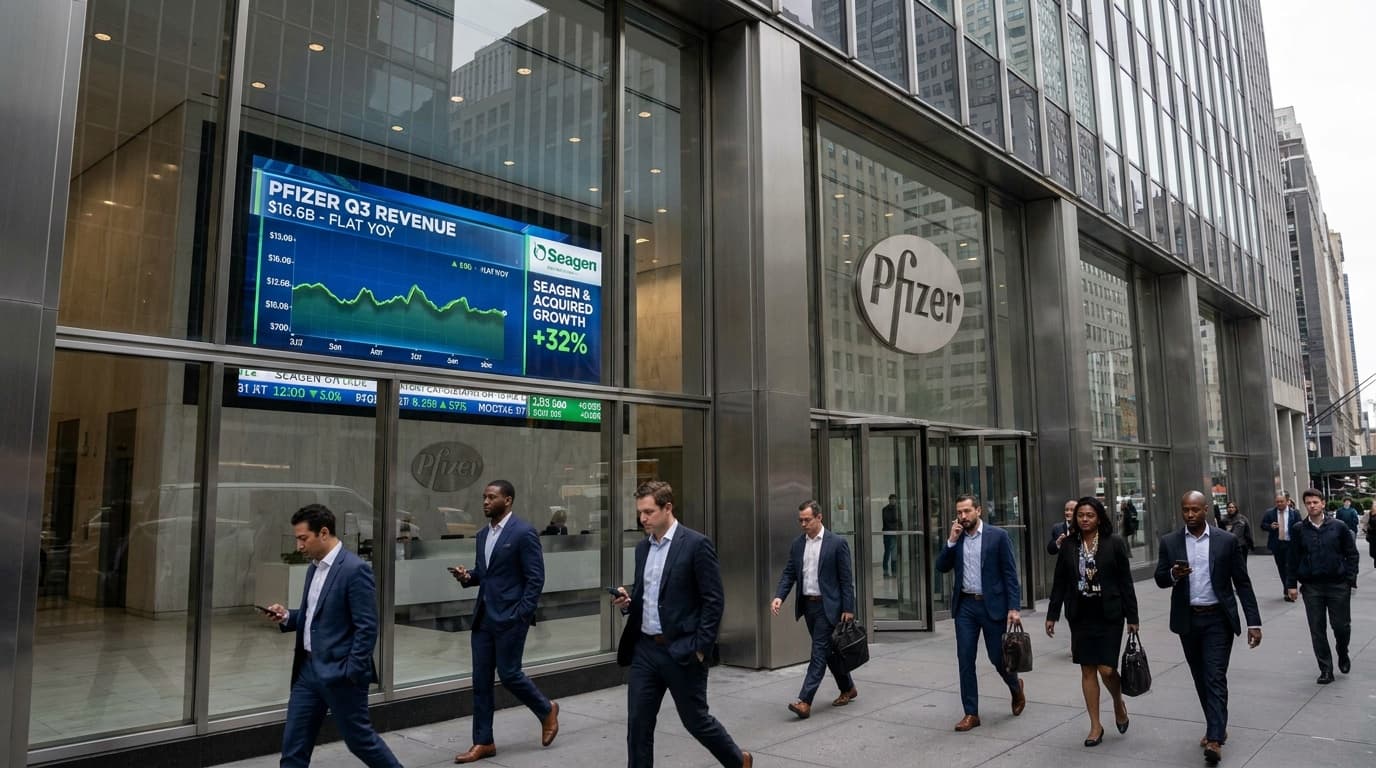
Pfizer reported third-quarter revenue of $16.6 billion, compared with $16.7 billion in the same period a year ago, leaving the top line largely flat. The company’s argument for growth rested on what happened beneath that headline number: excluding COVID products, revenue grew 7% operationally, and launched and acquired products grew 32% year over year on the same basis.
That split is the central issue in the Pfizer story. COVID products are still shrinking, but management is trying to show that the rest of the portfolio is now strong enough to offset that drag and support a higher full-year outlook. Pfizer raised its revenue guidance by $1.5 billion, taking the range to $62–64 billion from $60.5–$62.5 billion previously.
The commercial picture
Products from Seagen, which Pfizer acquired in a 2023 deal valued at $43 billion, grew 39% year over year. Padcev contributed $255 million globally, up 55%, which Pfizer attributed to increased market share in first-line locally advanced or metastatic urothelial cancer and a launch in muscle-invasive bladder cancer.
Nurtec, from the 2022 Biohaven acquisition, delivered 33% revenue growth to $135 million in the quarter. Pfizer also highlighted progress from Metsera, though it has not yet added to earnings because it has no approved products; the company said 10 pivotal studies have been advanced so far this year for lead asset berobenatide.
Among Pfizer’s in-house brands, Eliquis grew 25% to $513 million even as the product moves closer to its patent cliff. Taken together, those figures support management’s case that recent dealmaking and internal launches are doing more of the heavy lifting.
The offset from older franchises
COVID remained the biggest drag. Paxlovid revenue fell by $771 million, or 63%, as infections slowed in the U.S. and globally. BioNTech-partnered vaccine Comirnaty declined by $339 million, or 29%.
Prevnar also weakened, with the pneumococcal vaccine family down $180 million, or 10%, as U.S. vaccination rates fell and competitors approached. BMO Capital Markets said both COVID products were still modest contributors to Pfizer’s overall 5% topline beat, outperforming consensus estimates by 1% and 22%, respectively.
Guggenheim called the quarter solid because revenue exceeded expectations of $16.15 billion, but said the main investor focus remains the evolution of Pfizer’s pipeline. That framing fits the quarter: the numbers were good enough to support a higher outlook, but the longer-term investment case still depends on whether obesity, oncology, immunology and vaccines can produce growth that lasts after the COVID reset and beyond looming patent pressure.