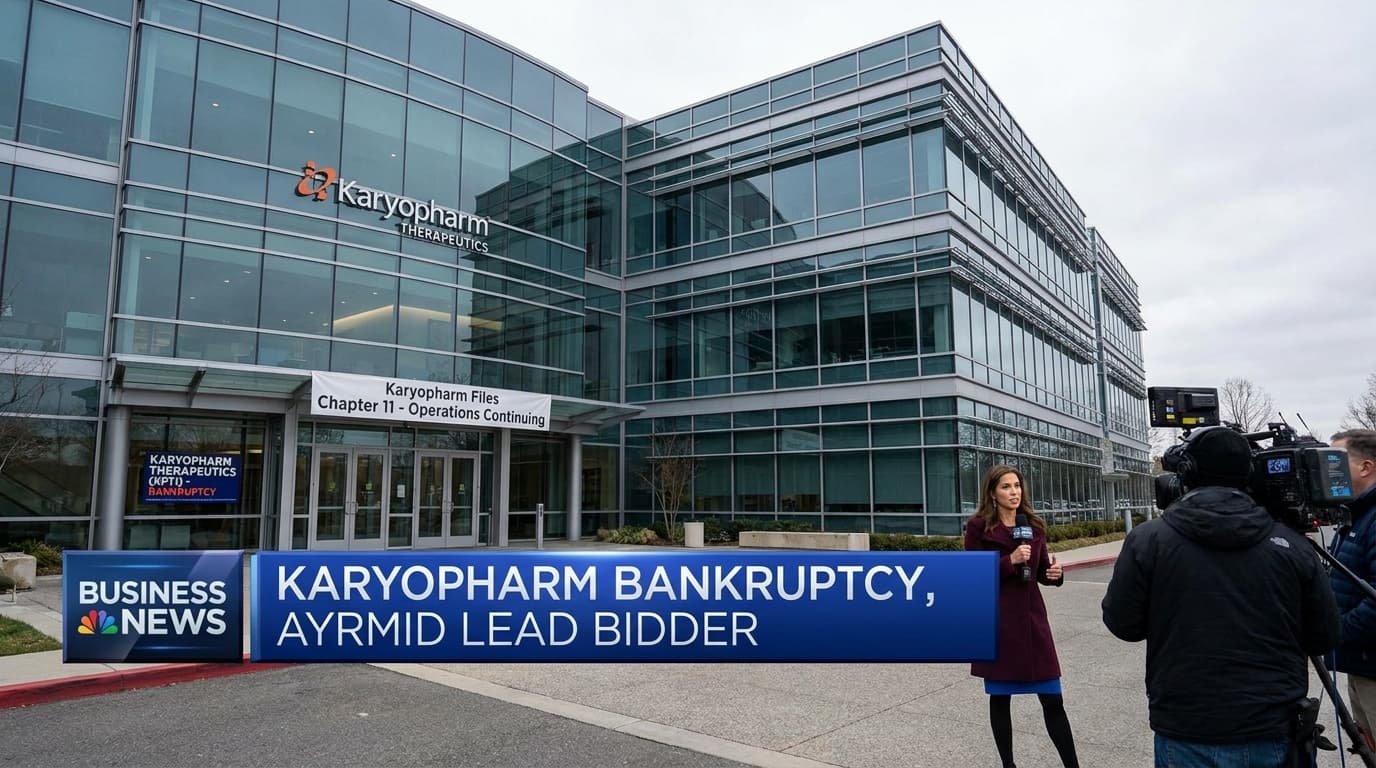
Karyopharm Therapeutics has filed for Chapter 11 bankruptcy as part of a plan to merge with Irish hematology biotech Ayrmid, moving one of biotech’s long-running commercial-stage stress stories into a court-supervised sale process.
The company said Ayrmid, the parent company of blood cancer biotech Gamida Cell, has agreed to serve as the lead bidder for Karyopharm’s assets. The merger is not final, the offer terms were not disclosed, and the proposed structure would still allow other parties to submit competing bids if the court approves the process. Karyopharm said the transaction is expected to close in the first quarter of 2027.
The restructuring plan
Karyopharm said it has secured commitments for up to $55 million in debtor-in-possession financing from existing lenders. The loans still require court approval, but the company said that financing, together with revenue from Xpovio, should be enough to continue operations during Chapter 11.
That combination is central to the strategy. This is not a simple liquidation announcement; it is an attempt to preserve the multiple myeloma business and the myelofibrosis program long enough to transfer them through a sale. Karyopharm said it remains focused on advancing its multiple myeloma and myelofibrosis programs during the restructuring.
Ayrmid’s interest reflects that there is still asset value despite the bankruptcy filing. Ayrmid currently has two FDA-approved products, according to Fierce Biotech: Omisirge, approved for patients 12 and older with blood cancers to reduce the risk of infection with umbilical cord transplantation and for patients 6 years and older with severe aplastic anemia, and Aphexda, which won approval in 2023 for patients with multiple myeloma to help with stem cell retrieval. The strategic logic is a hematology combination rather than a broad turnaround.
The road here
Karyopharm’s financial position had already become acute by August, when second-quarter earnings showed the company was still burning cash despite Xpovio revenue. At the time, management said its cash runway was sufficient for only another month.
The business then entered Chapter 11 after a sequence of blows across development, regulation and commercial performance. In March, Xpovio met only one of two primary endpoints in a phase 3 trial in myelofibrosis. In May, the FDA rescinded Xpovio’s accelerated approval in relapsed or refractory diffuse large B-cell lymphoma. Two months later, a second attempt at a phase 3 trial in endometrial cancer failed to meet its primary endpoint of progression-free survival.
Those setbacks hit a company that had already been cutting costs. Karyopharm reduced staff by 20% in 2023 because Xpovio revenue came in lower than expected, and another 20% reduction followed last year.
Xpovio itself has remained commercially active but stagnant. Fierce Biotech reported second-quarter sales of $30.8 million, up slightly from $29.7 million in the same period in 2025, while annual sales have stayed between $112 million and $115 million since 2023. For a company trying to finance continued pipeline development, that is survivable revenue but not enough to offset repeated clinical and regulatory misses.
In August, Karyopharm applied for FDA accelerated approval for Xpovio in combination with Incyte’s Jakafi in myelofibrosis. That filing now becomes part of the sale thesis. The signal from the bankruptcy is that approved products and late-stage assets can retain strategic value even when the originating company can no longer finance itself, but the value capture shifts from equity holders to a restructuring process designed to maximize returns for stakeholders.