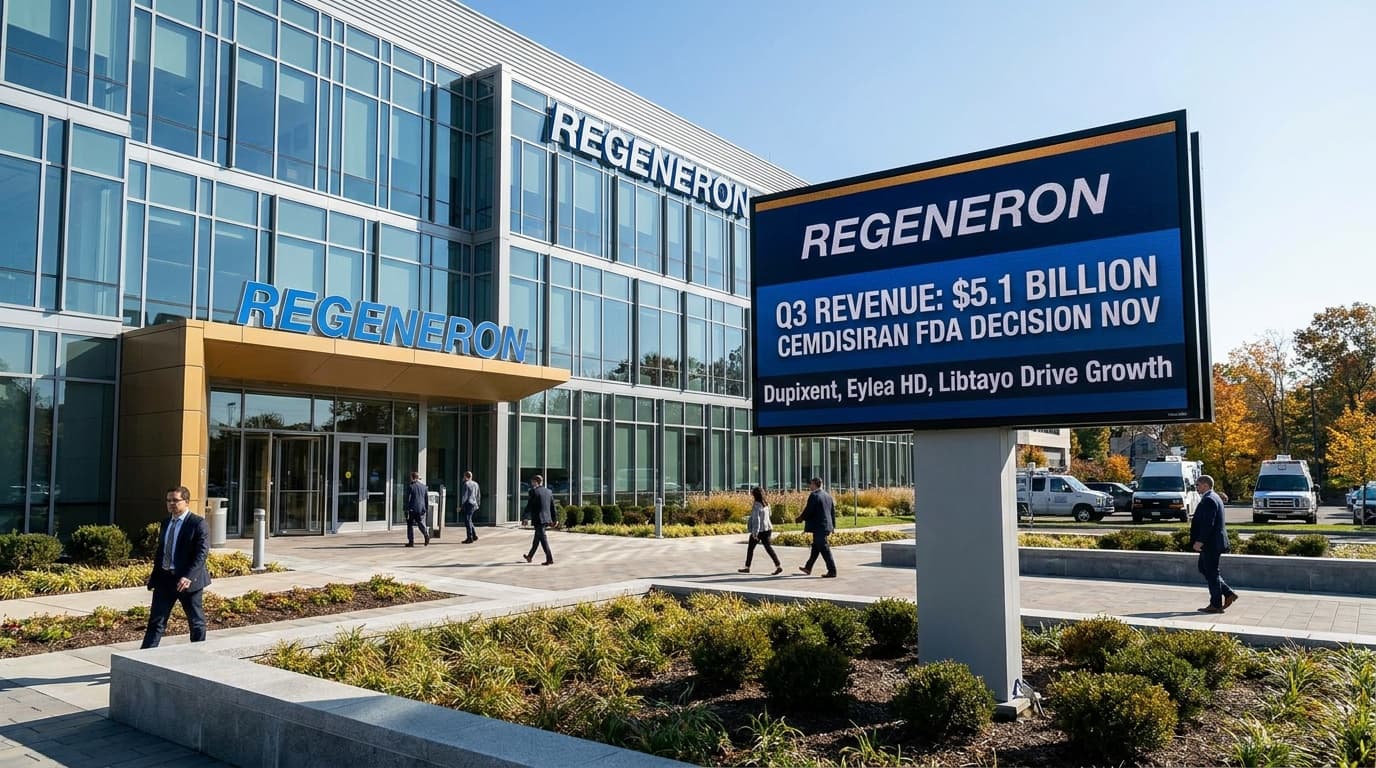
Regeneron used its third-quarter report to make a familiar argument in stronger numbers: its existing growth drivers are still accelerating, and that cash generation gives it flexibility to keep expanding the pipeline and pursue deals. Revenue reached $5.1 billion in Q3, up 36% from the same period in 2025 and well above the $4.61 billion to $4.65 billion range cited by RBC Capital Markets.
Management tied the quarter to record performances from Dupixent, Eylea HD and Libtayo. CEO Leonard Schleifer said those three core brands are performing at record levels, while sell-side commentary from RBC Capital Markets and BMO Capital Markets described the period as a "clean sweep" and a "clean quarter," respectively.
The commercial picture
Dupixent remained the central earnings engine. Regeneron and Sanofi recorded $6.5 billion in global sales for the biologic, up 35% year over year and, according to Schleifer, the first time the product has exceeded the $5 billion mark in a quarter.
Regeneron also highlighted continued momentum from newer or expanding franchises. U.S. sales of Eylea HD rose 62% to $699 million, and Libtayo more than doubled from a year earlier to $550 million. Taken together, those numbers support the company's argument that growth is broadening beyond a single asset, which matters if Regeneron wants to stay aggressive in external dealmaking rather than rely only on internal R&D.
That optionality came through directly on the earnings call. In response to a question about business development, Schleifer said Regeneron is open to opportunities at all stages and is "agnostic" between platforms, advanced products and early-stage assets. For investors, that is a notable signal because the company is speaking from a quarter of commercial strength rather than from a need to patch a near-term gap.
The road here
One other strategic shift in the quarter was the reset in Regeneron's relationship with Sanofi. The companies recently updated their partnership, with Sanofi paying $1 billion upfront to advance four long-acting, next-generation antibodies for immune-mediated conditions. Beyond that upfront payment, the deal could bring Regeneron up to $7 billion more in development, regulatory and commercial milestones.
The warmer tone matters because the partnership had been under visible strain. BMO Capital Markets described the alliance as "sometimes contentious," and last year Regeneron sued Sanofi, alleging the French pharma did not provide "full access to material information" about Dupixent sales. Schleifer said the companies now have a very good relationship and are back on a very strong track, adding that new Sanofi CEO Belén Garijo has been clear about continuing to build on Dupixent for a long time.
What to watch
The nearest regulatory catalyst is cemdisiran, a subcutaneous siRNA therapy targeting C5. Regeneron said it expects an FDA decision in November for myasthenia gravis. Chief Scientific Officer George Yancopoulos said an approval would make cemdisiran the first siRNA therapy for myasthenia gravis, while Schleifer said it would also be the only treatment with quarterly subcutaneous dosing.
Regeneron also pointed to longer-range pipeline value. Executives emphasized four-year follow-up data from the Phase 3 C-POST study of Libtayo as an adjuvant treatment in high-risk cutaneous squamous cell carcinoma, where the company said the PD-1 inhibitor showed a 37% reduction in the risk of death at a median follow-up of 44 months, versus 22% at a median follow-up of 30 months. Libtayo was approved by the FDA in October 2025 as the first and only immunotherapy for that indication.
In obesity, Yancopoulos highlighted Phase 3 data from olatorepatide, the dual GLP-1/GIP receptor agonist Regeneron licensed from Hansoh Pharmaceuticals in June 2025 for close to $2 billion in biobucks. In a China-based Phase 3 trial, the drug produced up to 19% weight reduction at 48 weeks. Management framed that program less as an effort to join a crowded class and more as a search for a differentiated agent that could address muscle loss concerns associated with other drugs. That sets a higher bar than simply entering the market, but Regeneron's Q3 performance gives it more room to pursue that strategy.