Alnylam's third quarter showed strong franchise growth on paper and rising concern underneath it. The company's transthyretin franchise, which includes Amvuttra and Onpattro, generated $1.15 billion in Q3, up 59% from the same period a year earlier, but executives and analysts spent much of the discussion on why the next quarter could be harder than that headline suggests.
The immediate issue is execution in transthyretin amyloid cardiomyopathy. CEO Yvonne Greenstreet said Alnylam is not satisfied with the pace of future demand growth for Amvuttra, even after a substantial commercial buildout. Her message was not that the launch thesis has changed, but that physician familiarity still has to catch up with the company's investment.
The commercial picture
Amvuttra was first approved by the FDA in 2022 for ATTR with polyneuropathy and then cleared for ATTR-CM in March 2025. That second launch has been uneven. Alnylam cut guidance earlier this year after sales missed analyst expectations, and Greenstreet acknowledged on the earnings call that the company needs to do better.
Management's explanation is that demand expansion now depends on converting the large share of potential prescribers who have not yet written a prescription. Greenstreet said Alnylam has been targeting the two-thirds of potential prescribers who have yet to try the drug, arguing that physicians who do use Amvuttra prefer it with their patients. The strategic bet, then, is on adoption depth rather than on another major increase in commercial infrastructure.
That approach is colliding with several external pressures at once. BridgeBio Pharma and Pfizer are taking market share in the same franchise area. At the same time, the upcoming 340B drug pricing rule update is creating uncertainty around provider economics for products offered through Medicare, including Amvuttra. CFO Jeffrey Poulton said the proposed rule would not become effective until January 1, 2027, but that Alnylam's recent interactions with health systems suggest it could still create Q4 ordering volatility as providers assess the implications for their economics and site-of-care choices.
Alnylam has declined to quantify how much Amvuttra volume will be affected. Truist Securities estimated in a Thursday note that about 15% to 20% could be directly exposed. That kind of exposure does not just threaten near-term revenue timing; it makes it harder for investors to separate underlying prescription demand from channel behavior.
What to watch
The company reiterated full-year net product revenue guidance of $4.7 billion to $5.1 billion, with the TTR franchise expected to contribute $4.2 billion to $4.5 billion. But Poulton said full-year revenue will likely come in at the low end of that range. Greenstreet also warned analysts not to expect growth in the fourth quarter while the company continues the work of building familiarity and adoption.
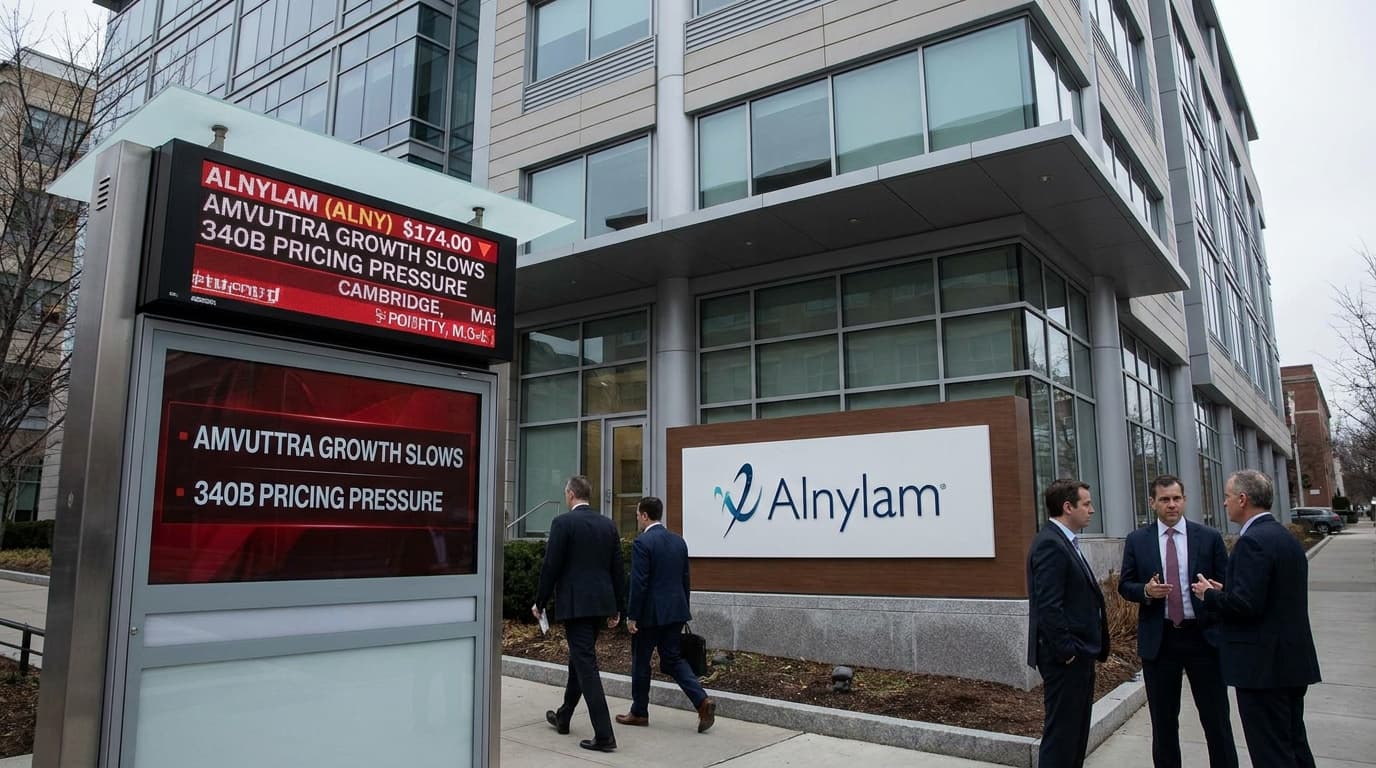
That has changed the market's framing of the story. BMO Capital Markets wrote that a "trifecta of uncertainties" is placing significant pressure on the stock, despite its positive long-term view of the TTR franchise and Alnylam overall. Shares fell by a quarter at market close to $174, leaving the stock down 56% year to date and the company with a market cap of $23.3 billion.
The uncertainty is also affecting strategic speculation. Oppenheimer said the stock decline has strengthened the case for a potential takeover, naming Sanofi as the most likely buyer. Alnylam did not provide 2027 guidance, and analysts noted that management has pushed that update to February 2027 rather than its usual timing before the J.P. Morgan Healthcare Conference in mid-January. Truist said that departure from historical practice is another indication of heightened uncertainty entering 2027. For now, that means the key test for Alnylam is less about the clinical profile of Amvuttra, which Greenstreet defended by pointing to reductions in death and cardiovascular events, and more about whether commercial execution can become stable before policy and competitive pressures intensify further.