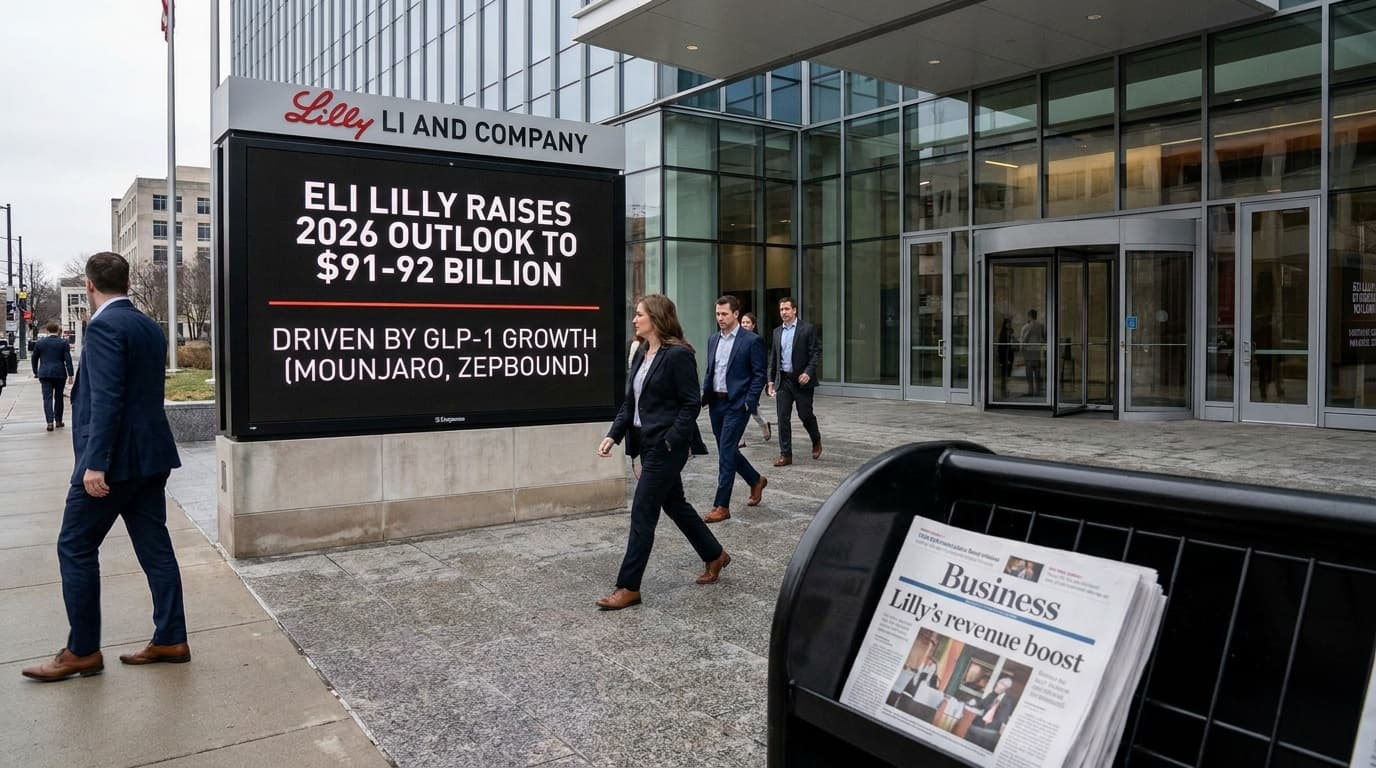
Eli Lilly again raised its 2026 revenue outlook after third-quarter sales climbed 39% year over year to $24.4 billion, well above the $22.6 billion consensus cited in one of the company’s earnings-day reports. The new full-year range is $91–92 billion, up from $85–87 billion previously and far above the $80–83 billion range Lilly had expected at the end of 2025.
The repeated upward revisions have become a story of their own. On Lilly’s Thursday earnings call, analysts pressed management on why guidance has consistently come in low. CEO David Ricks said the company is trying to give investors a range they can rely on rather than a more speculative forecast, arguing that incretin demand is expanding through several variables that have not had clear historical precedents.
That explanation matters beyond one quarter. Lilly is showing that the central commercial challenge in GLP-1s is no longer only manufacturing or launch sequencing, but forecasting demand in a market that is broadening faster than traditional pharma planning tools were built to handle.
The Commercial Picture
The quarter was driven by tirzepatide products Mounjaro and Zepbound, which together contributed $17.1 billion in revenue. Lilly said the outperformance came with a 53% increase in volume, even as lower prices weighed on sales. In the U.S., revenue increased 34% to $15.1 billion as volume rose 41%, with Zepbound and Mounjaro as the main contributors despite a decline in Zepbound’s price.
Outside the U.S., revenue increased 47% to $9.3 billion on a 76% increase in volume, mainly because of Mounjaro. One source noted that this growth came even though Mounjaro was added to China’s National Reimbursement Drug List and its price was lowered.
Lilly also highlighted traction for Foundayo, its oral weight loss drug. By the end of the third quarter, prescriptions had reached more than 45,000 patients. As of the end of September, Lilly said it had captured 40% of new patients starting an oral GLP-1 therapy. The company attributed that performance to broad commercial formulary and Medicare access, growing brand awareness and new launches in the United Arab Emirates, Mexico, Saudi Arabia and the U.K., while the product remains under regulatory review in more than 40 other countries.
Across incretin analogs, Lilly said it now holds 63% of the overall market, ahead of Novo.
A major factor in the guidance reset was the Medicare GLP-1 Bridge program launched by the Centers for Medicare and Medicaid Services in July. Lilly said 500,000 patients are now using the program to access its obesity medicines, with 80% of those patients new to incretins. Ricks said programs like Bridge, along with uncertainty earlier in the year about how far GLP-1 uptake would spread beyond high-net-worth consumers into the middle class, help explain why prior forecasts proved conservative.
The Road Here
Ricks acknowledged on the call that Lilly’s guidance has missed on the low side, with actual results arriving above consensus. His defense was straightforward: exceeding expectations is preferable to missing them. That stance may not remove investor frustration with wide forecast revisions, but it does clarify management’s bias toward conservatism while the category is still finding its demand ceiling.
The pattern also suggests Lilly’s revenue base is becoming more exposed to access decisions and consumer adoption dynamics that behave differently from traditional specialty-drug launches. When a government-backed access program can move hundreds of thousands of patients into treatment quickly, guidance becomes a commercial read on market formation as much as on prescription demand.
What To Watch
Lilly’s earnings call also pointed to what the company plans to do with the cash generated by this growth. The company has executed 11 new pacts this year, and executive vice president and president of Lilly Oncology and head of Corporate Business Development Jacob Van Naarden said more deals are coming. After the acquisitions of AtaiBeckley and Merida Biosciences, he said Lilly has shifted toward earlier bets aimed at the next decade and beyond, while the incretin portfolio supports the rest of the business.
That is the broader signal from the quarter. GLP-1 revenue is not only lifting near-term guidance; it is giving Lilly room to reshape its pipeline across cardiometabolic disease, immunology, oncology and neuroscience from a position of unusual financial strength.