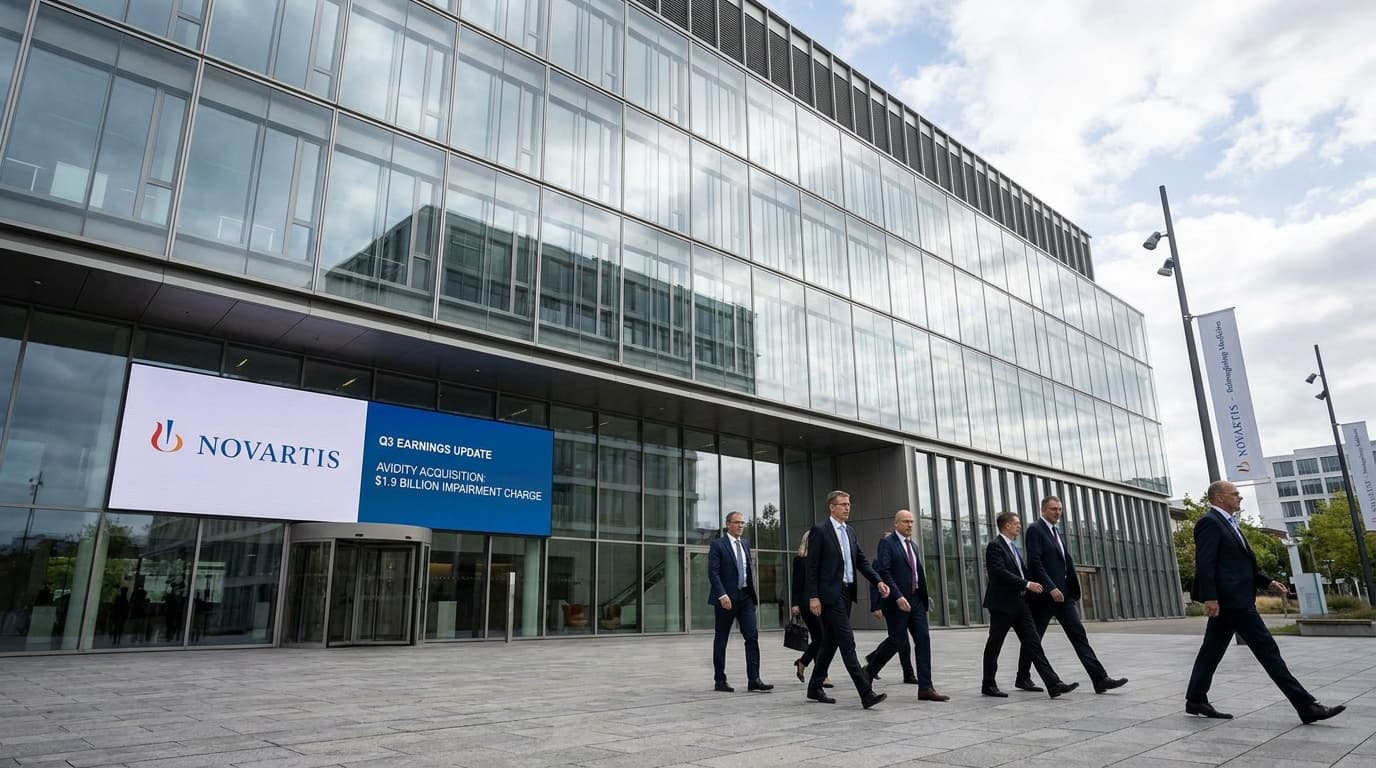
Novartis is trying to contain the strategic fallout from del-desiran’s phase 3 failure in myotonic dystrophy type 1 by arguing that the setback changes the timing of value creation, not the rationale for last year’s $12 billion acquisition of Avidity Biosciences. On a third-quarter earnings call with journalists, CEO Vas Narasimhan described the miss as a “bump” and said the acquisition “remains absolutely on track,” even as the company took a partial impairment charge of $1.9 billion tied to the program.
That distinction matters because del-desiran was a major asset in the Avidity takeover, and the write-down arrived after a second high-profile clinical setback for Novartis in recent weeks. Management’s message is that one failed readout does not alter its underlying belief in antibody-oligonucleotide conjugates for neuromuscular disease, but it does reset the economics around what it will take to keep del-desiran alive.
The Road Here
Narasimhan said Novartis still sees “significant potential” in del-desiran, citing evidence of clinical activity in secondary and exploratory endpoints. The company has kept the drug in its pipeline for now. He told Fierce that the $1.9 billion charge was a “valuation adjustment” reflecting the added time and resources needed to run another study capable of proving the drug’s value.
Novartis is also pointing to the rest of the former Avidity portfolio to support the deal thesis. Delpacibart braxlosiran is in a phase 3 trial for facioscapulohumeral muscular dystrophy, while delpacibart zotadirsen is under priority review by the FDA for Duchenne muscular dystrophy. The implication is that the transaction should be judged as a platform and portfolio acquisition rather than as a single-asset wager on del-desiran.
What To Watch
The more revealing part of Narasimhan’s response may be what he did not change. Asked whether the del-desiran failure and the recent disappointment around pelacarsen put pressure on Novartis to step up M&A, he said the company does not need to alter a strategy “primarily to focus on bolt-ons under $2 billion.” He tied that confidence to other programs, including remibrutinib, which he said has the potential to be a “$4 billion-plus medicine,” plus pelabresib and the company’s growth drivers more broadly.
Novartis is also dealing with a separate risk signal in cell therapy. Over the summer, the company paused development of rapcabtagene autoleucel in several autoimmune diseases in immunology and neuroscience after three deaths from complications caused by serious immune effector cell-associated hemophagocytic syndrome. The program remains on clinical hold in the U.S. and Europe, although Narasimhan said there has been “no further … death or any other significant adverse events” and that Novartis wants to restart the trials once it identifies the root cause and the best path to patient safety.
For investors, the immediate test is whether Novartis can keep the Avidity acquisition framed as intact while one of its marquee assets now appears to require another expensive and time-consuming attempt at validation. The company’s refusal to broaden its deal appetite suggests management still believes internal pipeline breadth can absorb the shock, but that case now depends more heavily on other neuromuscular and late-stage assets delivering.