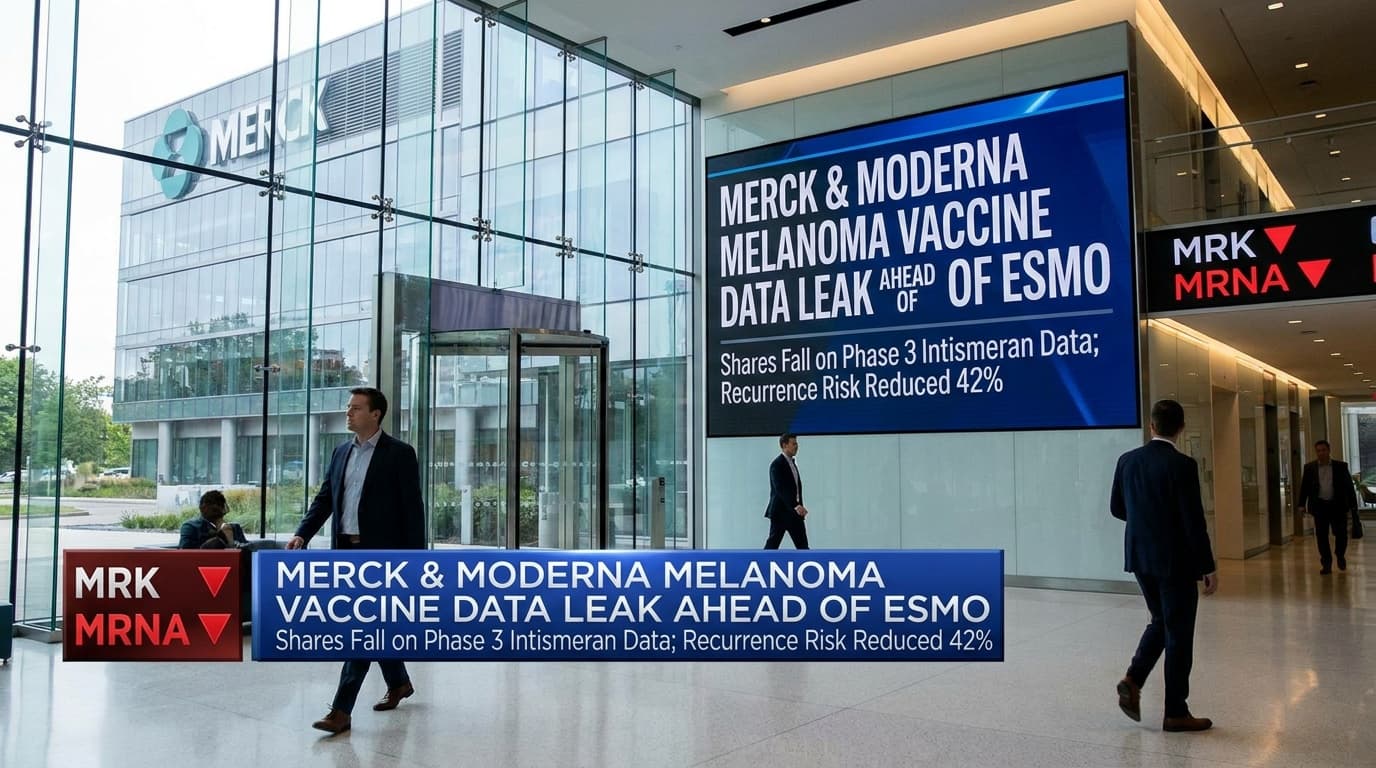
Merck & Co. and Moderna were headed into the European Society for Medical Oncology Congress expecting a high-profile presentation of detailed phase 3 melanoma data for their investigational cancer vaccine intismeran autogene. Instead, an unexpected leak of the ESMO data on Thursday forced the companies to release their findings two days before the scheduled Saturday Presidential Symposium presentation in Madrid.
The abrupt timing shift mattered because the program had become one of the meeting's most anticipated readouts. Investors reacted quickly, and both companies' shares fell as the market parsed a dataset that largely met expectations on recurrence-free survival but looked less dramatic on distant metastasis-free survival than some had expected after phase 2.
The Data
At 24 months, patients receiving intismeran plus Merck's Keytruda had a recurrence-free survival rate of 82.2%, compared with 70% for patients receiving Keytruda alone in certain patients with melanoma. The hazard ratio was 0.58, which the companies said indicated a 42% reduction in the risk of recurrence or death.
The more debated part of the release was distant metastasis-free survival. At 24 months, the DMFS rate was 88.5% in the intismeran cohort and 80.2% in the Keytruda control arm. The hazard ratio was 0.62, indicating a 38% reduction in the risk of distant metastasis or death.
That result was still positive, but it did not match the elevated expectations that had built after the phase 2 readout. Shweta Jain, vice president of global clinical development and oncology clinical research at Merck, acknowledged to Fierce that phase 2 had amplified expectations for phase 3. Her defense of the dataset was that the relevant question is whether the regimen improved outcomes for patients, and on that measure Merck views the effect as real.
Jain described the reduction in the risk of distant metastasis or death as "quite significant." She argued that preventing distant recurrence matters because distant metastasis means cancer cells have broken away from the primary tumor and formed new tumors in other organs. In her account, the value of the regimen is not limited to reducing local recurrence.
The strategic point for Merck and Moderna is that the phase 3 package still gives them a positive efficacy story in a high-visibility setting, but the market is applying a higher standard to mRNA cancer vaccine programs than to a conventional late-stage win. Once phase 2 set a more aggressive reference point, merely strong phase 3 data became vulnerable to being judged as a moderation rather than as a success.
The Presentation Problem
Jain called the leak "unfortunate," saying scientific exchange at a major congress is supposed to happen through an engaged presentation and discussion rather than through an uncontrolled early disclosure. Her public posture was notably unruffled, however. "It is what it is," she said, while maintaining that the companies remain confident in the data.
That response reflects a practical limit on how much damage control either company can do once efficacy tables are circulating ahead of schedule. The issue for the partnership is less the breach itself than the fact that leaked conference data reaches investors without the framing that management had planned to provide from the Presidential Symposium stage.
For Merck and Moderna, the leak also exposed a tension common to heavily watched oncology programs: the more a company succeeds in building anticipation, the harder it becomes to manage reactions to nuance. In this case, a dataset that appears clinically meaningful on both reported measures still prompted disappointment because the phase 2 narrative had left little room for anything short of an emphatic phase 3 outperformance.
What To Watch
The immediate question is how durable the companies' argument proves with clinicians and investors after the formal ESMO discussion. Merck's case rests on the totality of the package: a phase 3 win, an 82.2% recurrence-free survival rate at 24 months, and a 38% reduction in the risk of distant metastasis or death against Keytruda alone.
The broader signal for the field is that late-stage success may not be enough on its own for personalized cancer vaccine programs. Merck and Moderna now have supportive numbers in melanoma, but the commercial and scientific conversation appears likely to hinge on whether stakeholders treat the DMFS result as still significant, as Jain argued, or as evidence that expectations ran ahead of what phase 3 would realistically deliver.