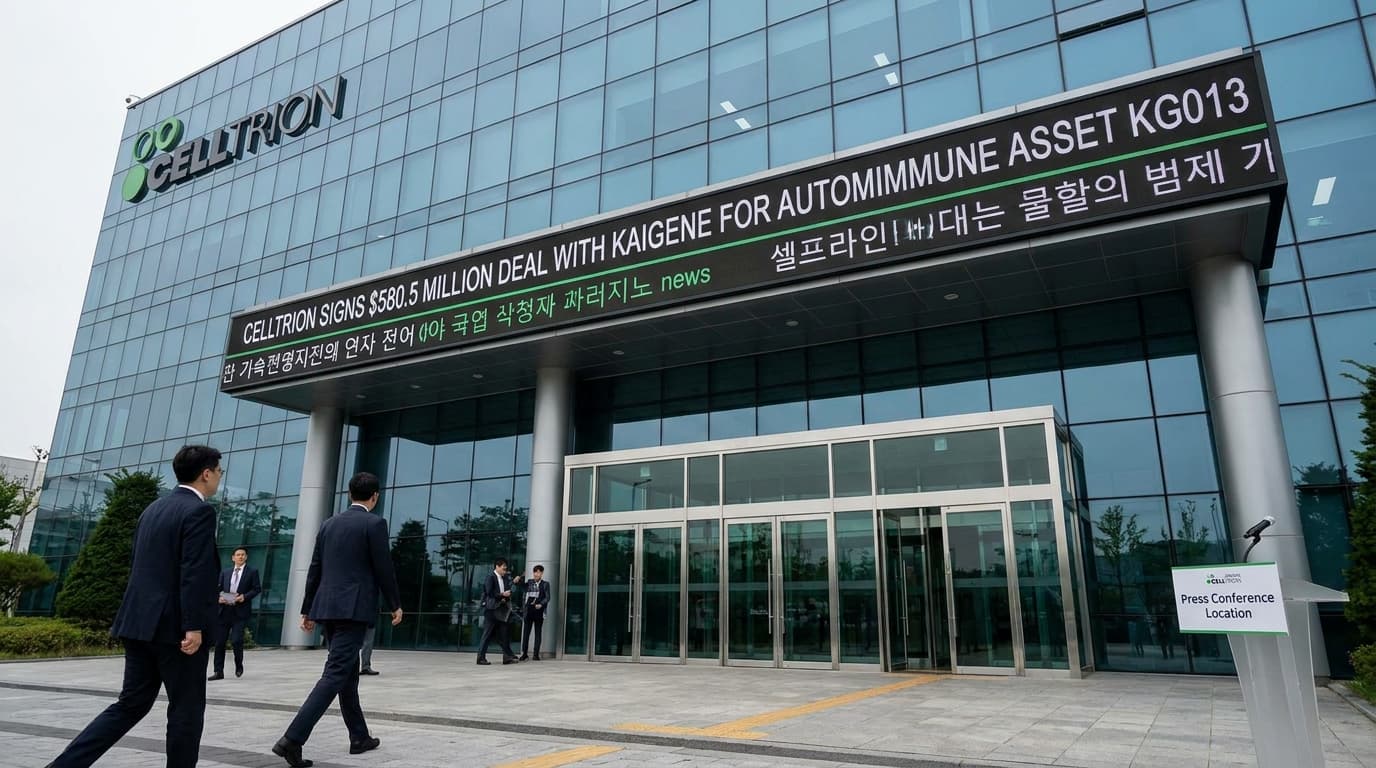
Celltrion has licensed KG013, a preclinical monoclonal antibody for autoimmune conditions, from Maryland-based Kaigene in a deal worth up to $580.5 million plus royalties on net sales. Kaigene will receive an undisclosed upfront payment and remains eligible for milestone payments under the agreement, while retaining an option to co-market the drug in South Korea.
The asset is aimed at a proliferation-inducing ligand, a signaling protein involved in plasma cell survival and immunoglobulin production. According to the company release cited in the source, blocking that pathway is intended to suppress production of disease-causing antibodies associated with autoimmune conditions, with IgA nephropathy, also known as Berger's disease, as the initial indication.
Why This Deal Fits Celltrion’s Strategy
The agreement adds another early antibody program to a company historically known for biosimilars such as copycat versions of Remicade, Rituxan and Humira. In recent years, Celltrion has moved further into innovative medicines through licensing deals centered on antibodies, and KG013 fits that pattern.
This is also not the first pairing between the two companies. Last November, Celltrion agreed to pay up to $744 million for two other preclinical autoimmune candidates from Kaigene, including the next-generation FcRn inhibitor KG006 and the dual-acting antibody KG002. Kaigene received $8 million upfront in that earlier deal.
The repeat business is the clearest signal here. Rather than simply broadening beyond biosimilars in theory, Celltrion is using licensing to assemble a pipeline of externally sourced autoimmune assets from a partner it already knows.
The Initial Market Focus
Kaigene said IgA nephropathy affects about 160,000 diagnosed patients in the U.S. and is particularly common in Asian populations, including about 30,000 patients in South Korea alone. That population profile helps explain both the South Korea co-marketing option and Celltrion’s interest in an asset whose first indication aligns with a disease burden that is meaningful in its home market as well as abroad.
Kaigene CEO Minjae Shin said the company believes KG013 has the potential to become a best-in-class treatment for IgA- and IgM-mediated diseases. For Celltrion, the more immediate takeaway is strategic: the company is continuing to buy into antibody-mediated autoimmune biology at the preclinical stage, accepting development risk in exchange for a larger role in novel drug development.