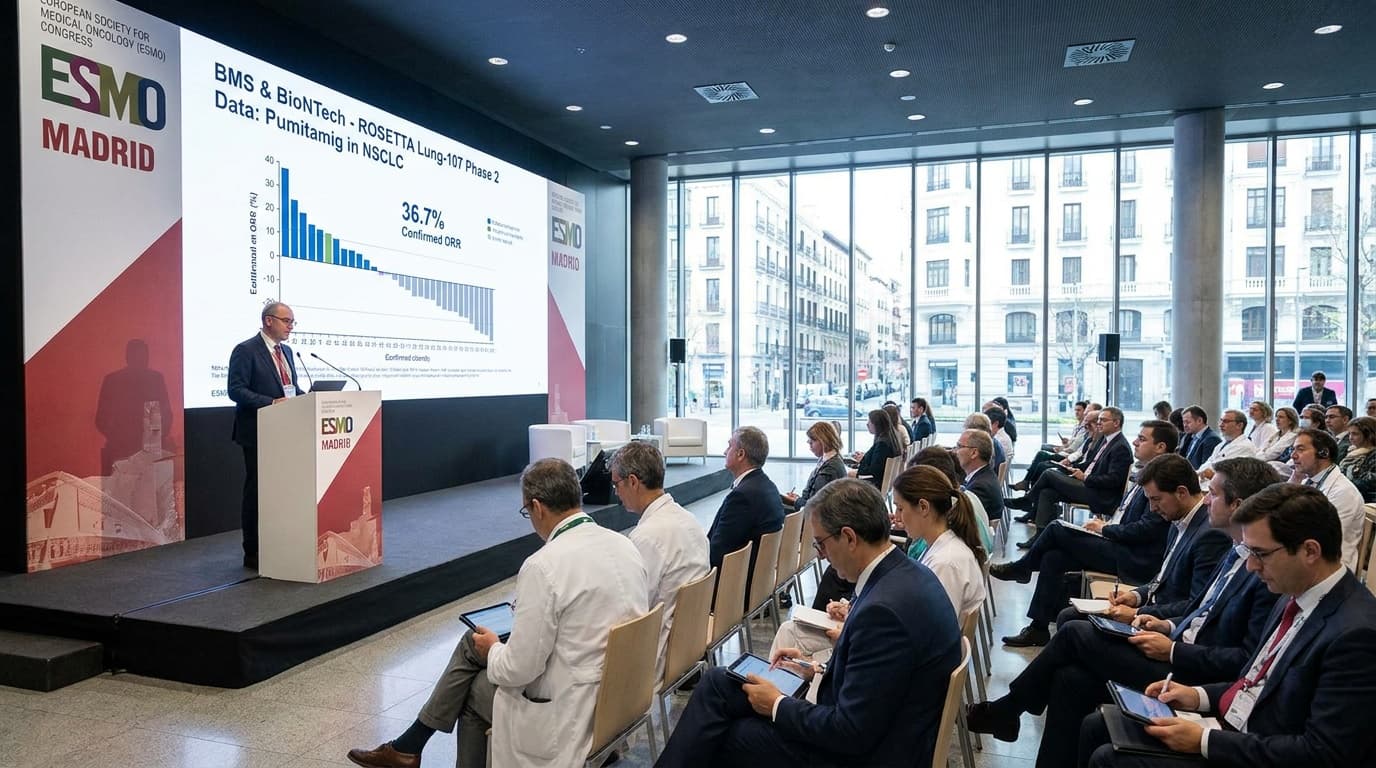
Bristol Myers Squibb and BioNTech have added another midstage data point to their case for pumitamig, reporting a confirmed objective response rate of 36.7% in 30 evaluable patients with metastatic non-small cell lung cancer whose disease had progressed on or after first-line immunotherapy plus chemotherapy. The companies presented the results from the global phase 2 ROSETTA Lung-107 study at the European Society for Medical Oncology Congress in Madrid.
The regimen paired the PD-L1xVEGF-A bispecific immunomodulator with docetaxel and enrolled patients regardless of PD-L1 expression levels. Across the overall treated population of 50 patients, the companies reported median progression-free survival of 6.9 months and a six-month progression-free survival rate of 63.3%. They also said disease control reached 90% among the 30 evaluable patients, with disease control rates above 80% across PD-L1 subgroups.
The Data
BMS Chief Medical Officer Cristian Massacesi told Fierce that the latest results are “very promising.” He argued the concept behind pumitamig could extend beyond replacing PD1 inhibitors, saying the drug may expand the patient populations where that class is used because it could work in tumors such as colon cancer, where PD-1 inhibitors are not approved.
Safety remains an important part of that argument because VEGF biology can introduce tolerability concerns. The companies said 18% of patients experienced a grade 3 or higher pumitamig-related adverse event, and four patients discontinued treatment. VEGF-related events occurred in 26% of patients, with two grade 3 events. The companies reported no pumitamig-related deaths or dose-limiting toxicities. Massacesi described the profile as manageable and noted that bleeding events occurred in 16% of patients and were limited to grades 1 and 2.
The Road Here
This is the third global phase 2 readout that the companies can use to support pumitamig, following data in small cell lung cancer and a China study that both read out last year. The development posture already goes well beyond exploratory testing: Fierce reports that the partners have taken the therapy into seven phase 3 trials across lung, breast, colorectal and gastric cancers.
Pumitamig is also being studied in more than 10 combination trials with other drugs, including antibody-drug conjugates. That breadth suggests the companies are not treating this as a single-indication asset but as a platform candidate that could be layered into multiple solid-tumor regimens if the risk-benefit profile continues to hold.
What To Watch
Massacesi said BMS and BioNTech are considering the next steps together to eventually run what he called a second-line project. The strategic backdrop is large: BioNTech gained full control of pumitamig through an $800 million-plus acquisition of Biotheus in 2024, then brought in BMS the following year under a co-development and co-commercialization deal worth up to $11.1 billion.
That means the question is no longer whether the asset merits broad investment. It is whether these phase 2 signals are strong and durable enough to support the increasingly ambitious late-stage plan now forming around it.