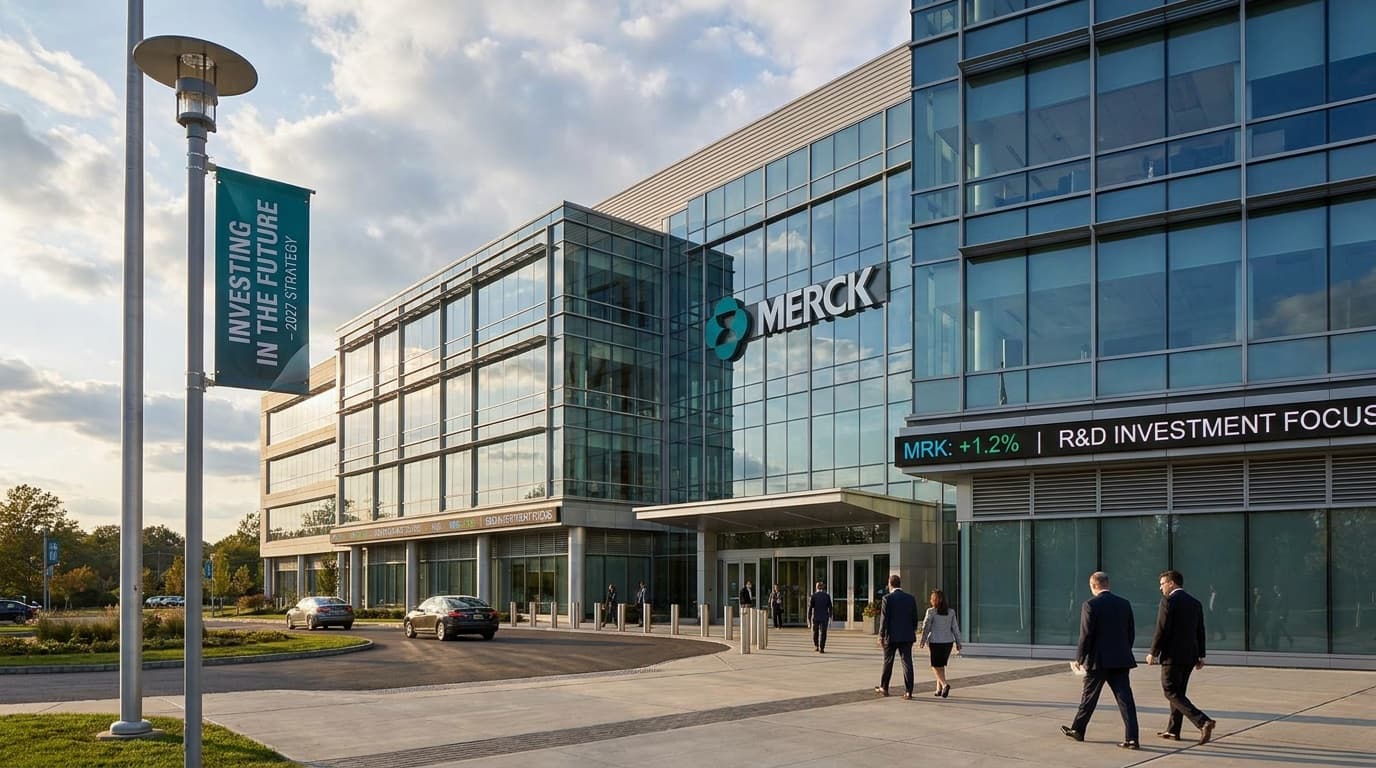
Merck used its third-quarter earnings call to make a forward-looking case for spending through the Keytruda transition, telling investors that 2027 will be “another year of investment” even as recent clinical trial wins strengthen confidence in the company’s pipeline. Chief Financial Officer Caroline Litchfield said Merck plans to invest behind its expansive pipeline and new product launches to drive long-term growth, while keeping business development as an important priority.
That framing is important because Merck is trying to manage two messages at once. One is that Keytruda, still a major earnings engine, gives the company time and resources. The other is that the period before loss of exclusivity is not the moment to harvest margins. Instead, Merck is signaling that the right response to the Keytruda cliff is more spending on replacement assets, not less.
The company reported third-quarter revenue of $18.1 billion, beating analyst expectations. One source said Guggenheim had projected between $17.44 billion and $17.34 billion.
The Data
Merck pointed investors to several clinical programs that could shape its next growth cycle. Among the most prominent was tulisokibart, the investigational anti-TL1A antibody that posted a Phase 3 win in ulcerative colitis in June. The company said more data details are expected soon, and it is also awaiting Phase 2 results in rheumatoid arthritis and axial spondyloarthritis.
In oncology, Merck highlighted sacituzumab tirumotecan, or sac-TMT, the TROP-2 directed antibody-drug conjugate partnered with Kelun-Biotech. At the 2026 European Society for Medical Oncology meeting in Madrid, the company presented data from a range of late-stage studies. CEO Robert Davis described the program as a source of “potential practice-changing advances.”
The clearest near-term result is in advanced or recurrent endometrial cancer, where Merck said sac-TMT delivered the first positive Phase 3 results and cut the risk of death by more than 30% in the TroFuse-005 trial, meeting all primary and secondary endpoints. Based on those data, the FDA has accepted an application for the indication for priority review with a target action date of June 15. Leerink said Merck is in discussions with the FDA and is hopeful for an earlier approval, adding that a Commissioner’s National Priority Voucher granted to the ADC last year could help.
Merck is also moving its PD-1xVEGF bispecific MK-2010, partnered with SBP Group, into Phase 3. Following what the company called productive discussions with the FDA and a review of the totality of data generated to date, Merck plans to start Phase 3 development in the first half of 2027, including combinations with sac-TMT in first-line non-small cell lung cancer.
The Commercial Picture
Litchfield said Merck expects underlying operating expenses to increase at a mid- to high-single-digit rate in 2027. She tied that spending outlook to confidence in the expanding pipeline and growing portfolio of new launches. For investors hoping recent R&D progress might let the company shift focus toward earnings growth, that was a clear answer: not yet.
There is also pressure building elsewhere in the portfolio. Litchfield said Merck expects more moderate growth partly because of more than $2 billion of negative impact from generic competition affecting Bridion, the Januvia family and Bayer-partnered Adempas. She also said Keytruda’s growth will moderate as the drug has reached peak penetration in several indications.
That context makes the company’s capital allocation message more strategic than defensive. Merck is effectively arguing that preserving financial flexibility for science-driven, value-enhancing transactions is part of the solution to the patent cycle, not an optional add-on.
What To Watch
The next six months carry a heavy readout schedule. Leerink said important Phase 3 data across oncology, immunology and infectious diseases are expected in that period. Merck also plans to present results from a Phase 2b trial in metabolic dysfunction-associated steatohepatitis at the upcoming American Association for the Study of Liver Diseases conference next month.
The signal from Thursday’s call is that Merck believes it can navigate the Keytruda loss of exclusivity if its current wave of programs keeps converting. The company is not presenting 2027 as a reset year for profitability. It is presenting it as the year it keeps paying to build what comes after Keytruda.