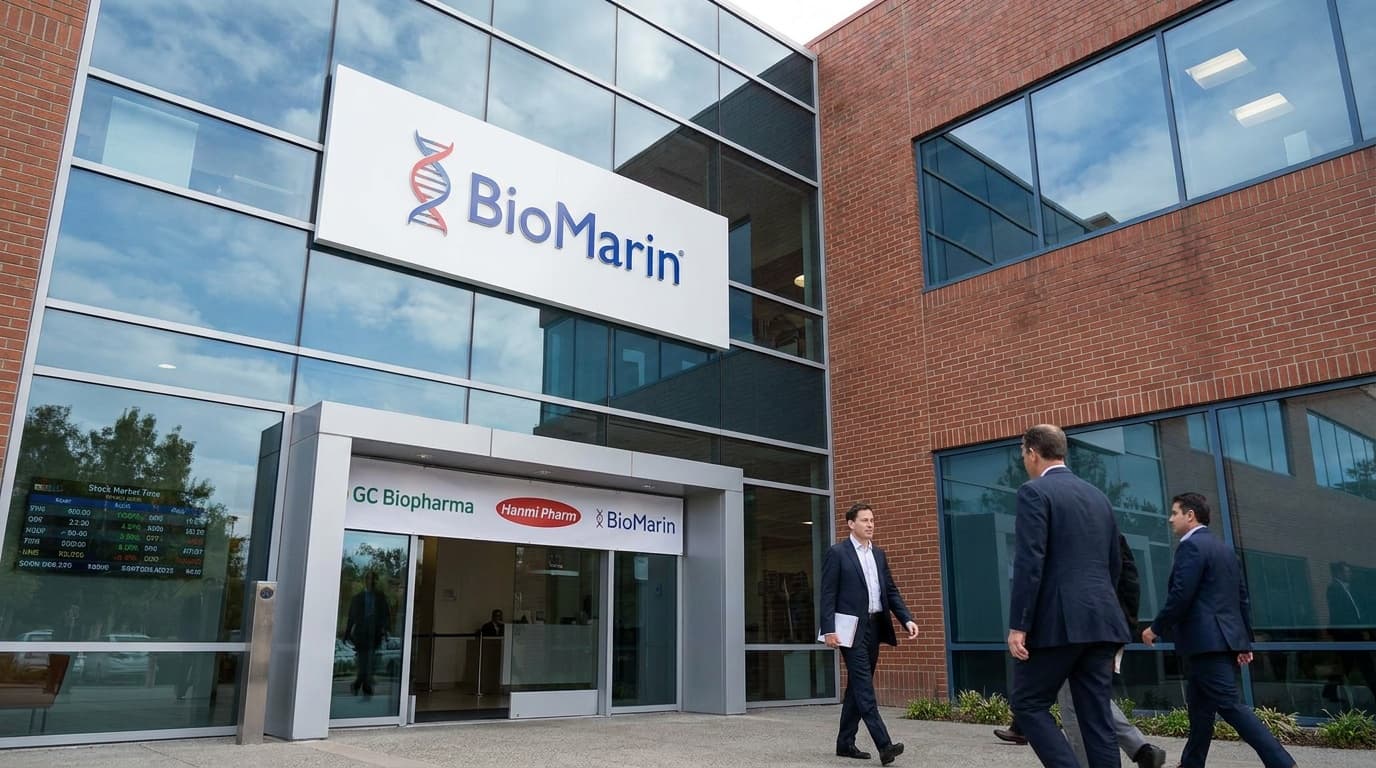
BioMarin has agreed to pay $70 million upfront to license HM15421/GC1134A from GC Biopharma and Hanmi Pharm, adding a phase 1/2 Fabry disease program to the franchise it picked up through its $4.8 billion acquisition of Amicus Therapeutics. The deal also includes up to $405 million in development and commercial milestone payments plus tiered royalties on sales.
The agreement gives BioMarin worldwide rights outside South Korea, where GC and Hanmi will retain commercialization rights. Strategically, the move extends BioMarin’s Fabry bet from a single approved oral product into a broader portfolio built around different patient segments and dosing preferences.
The Drug And Trial
HM15421/GC1134A is a long-acting enzyme replacement therapy in phase 1/2 development. GC and Hanmi began a first-in-human study last year in patients with Fabry disease in the U.S., Argentina and South Korea.
The study is evaluating safety, tolerability, pharmacokinetics and efficacy across three dose levels, with measures of kidney function and other outcomes followed for up to 48 weeks. The companies designed the candidate for once-monthly subcutaneous injection.
That dosing schedule is central to the commercial rationale. Existing enzyme replacement therapies include Sanofi’s Fabrazyme and Chiesi’s Elfabrio, both approved by the FDA, as well as Takeda’s Replagal in many international markets. All three are given by intravenous infusion every two weeks. If HM15421/GC1134A works, BioMarin could have a more convenient alternative for patients who need enzyme replacement therapy.
The Franchise Logic
BioMarin’s Fabry platform already includes Galafold, the oral treatment it acquired with Amicus. Galafold generated $521.7 million in net product sales in 2025. BioMarin is targeting peak annual Galafold sales of approximately $1.4 billion by the mid-2030s, with improved diagnosis rates a key part of that plan.
Galafold and HM15421/GC1134A are not interchangeable assets. Galafold is approved only for patients with certain genetic mutations because it works by binding to and stabilizing certain misfolded enzymes so they can reach lysosomes and function properly. The experimental enzyme replacement therapy could potentially serve a broader Fabry population.
That makes the deal more than a pipeline add-on. BioMarin is building a franchise that could cover both mutation-specific oral therapy and a wider enzyme replacement market, while using the same diagnosis push to feed both products if the new candidate succeeds.