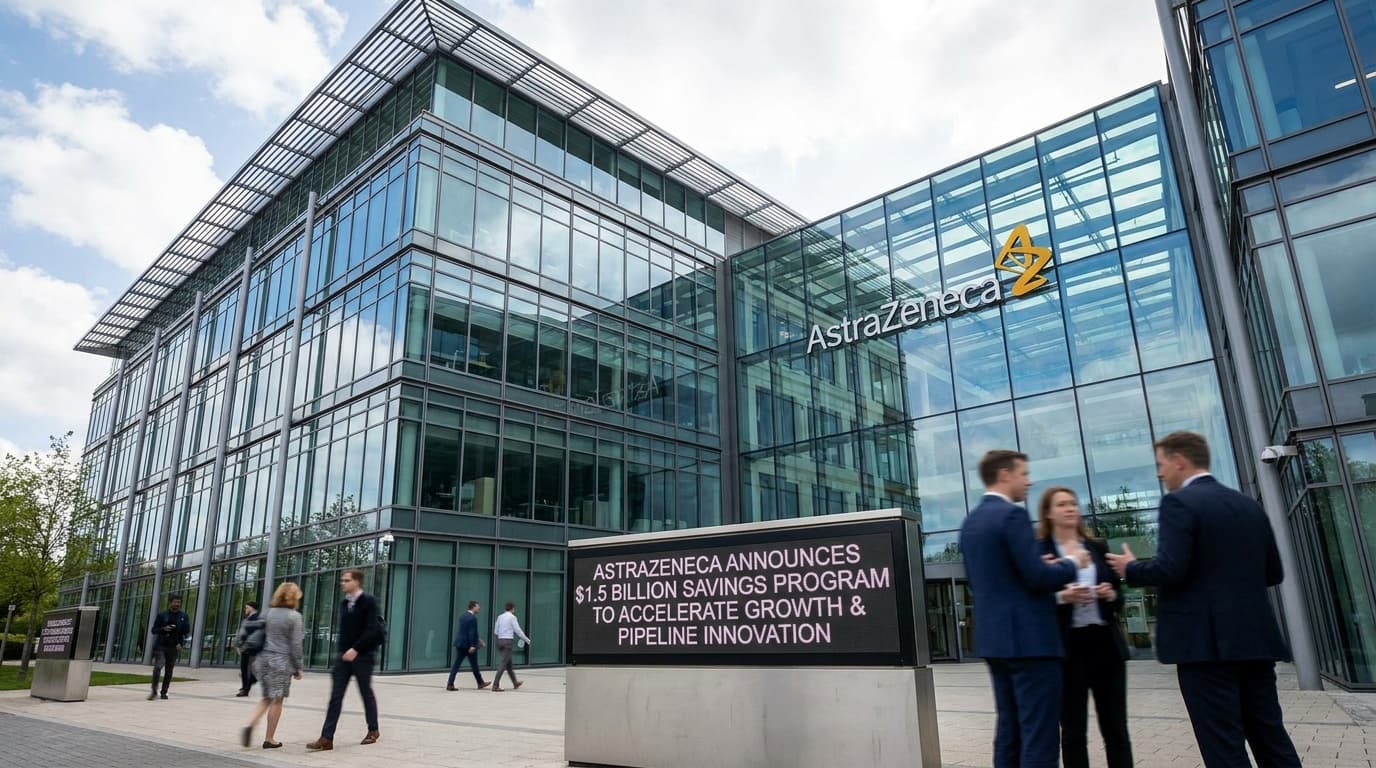
AstraZeneca used its third-quarter earnings call to lay out a $1.5 billion three-year cost savings plan that management says is designed to recycle resources into future growth rather than cut the company back. The company said no layoffs are expected, though executives said the initiative will affect all parts of the business and could involve shifting workers and resources toward emerging areas.
CEO Pascal Soriot said the idea is “not to shrink the company,” but to reallocate resources across the pipeline and across the world while remaining a growing business. CFO Aradhana Sarin said the effort, called the Reshaping for Sustainable Growth program, should be understood primarily as a reshaping exercise. AstraZeneca expects an initial cost of $2 billion and projected savings of $1.5 billion, with part of the approach involving upskilling or reskilling some employees, hiring new people and using technology to create efficiencies.
The Commercial Picture
The restructuring message came alongside a quarter that showed why AstraZeneca wants more organizational capacity rather than simply lower expense. The company reported $16.2 billion in total revenue, up 7% from the same period a year before, with Leerink Partners saying the figure was 8% above consensus. That total included $15.1 billion in product sales and $1.1 billion in alliance revenue.
Oncology remained the largest engine, contributing $7.1 billion and growing 15% versus Q3 2025. Rare disease revenue rose 10% to $2.63 billion. Tagrisso stood out within oncology, with worldwide sales of $2.2 billion, which Leerink said was a 4% beat on consensus. Leerink also described the medicine as the backbone treatment option for all stages of EGFR lung cancer.
That matters strategically because Soriot linked AstraZeneca’s future combination strategy to the playbook it used to expand Tagrisso. He said the company’s recent equity and clinical deals with Summit Therapeutics are intended to test different antibody-drug conjugate combinations with ivonescimab, the China-developed PD-1/VEGF bispecific antibody. In Soriot’s account, pairing ADCs with a PD-1/VEGF approach is part of maximizing the value of AstraZeneca’s platform while offering physicians more options.
The Road Here
Management also used the call to signal that internal savings are not a substitute for external dealmaking. Soriot said AstraZeneca is looking at potential business development activity in oncology, cardiovascular, rare disease, immunology and respiratory disease, while adding that the company already has a strong pipeline and can grow nicely beyond 2030. The read-through is that the savings program is meant to create room for expansion in franchises AstraZeneca already favors, not to fund a defensive retrenchment.
China remains part of that equation. Soriot said AstraZeneca is continuing to look to China despite recent efforts by the U.S. government to restrict collaborations. He noted that the new policy from the U.S. Department of the Treasury is not yet set in stone and argued for keeping scientific collaboration open. He also said that when AstraZeneca picks up an asset from China, it is developed, commercialized and even manufactured in the U.S., making it, in his words, for all intents and purposes a U.S. product. For investors and competitors, that positions the RSG program as more than a cost exercise: it is a way to preserve strategic flexibility while the company keeps feeding a growth model built on oncology scale, selective dealmaking and cross-border asset sourcing.