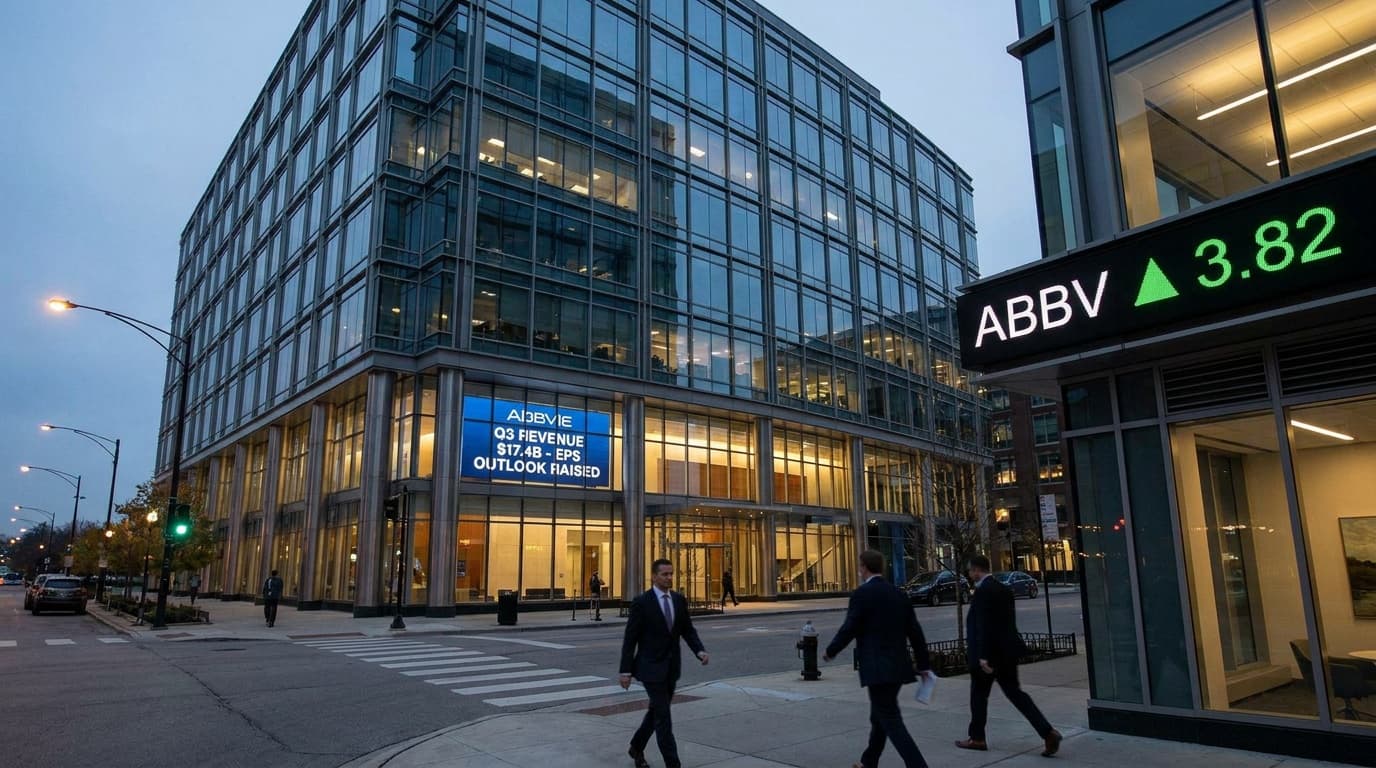
AbbVie posted a third quarter that beat expectations on both revenue and earnings, then used the results to sharpen its strategic message on acquisitions. Sales reached $17.4 billion and earnings per share came in at $3.82, prompting the company to raise full-year EPS guidance from $13.76–13.96 to $13.95–$13.99.
The operating beat was broad enough to support the stock’s existing momentum, but the more durable signal may be how management described capital deployment. CEO Rob Michael said AbbVie has ample financial capacity to pursue deals, while indicating the company is looking for bolt-on additions rather than another large transformational transaction like the $63 billion Allergan buy in 2020.
The quarter’s growth drivers
Immunology remained the core engine. The franchise generated $9.17 billion in the quarter, up 16% year over year and in line with consensus estimates. Skyrizi contributed $5.7 billion, growing 23% year over year, and Chief Commercial Officer Jeffrey Stewart said AbbVie raised its full-year Skyrizi guidance for the third time this year to $21.8 billion in sales.
Rinvoq added $2.7 billion, up 24% year over year and modestly above estimates, according to William Blair. That growth more than offset Humira’s 31% year-over-year erosion.
The most notable upside came from neuroscience, which William Blair identified as the strongest beat. The portfolio produced $3.4 billion in third-quarter revenue, up 19% year over year. Michael said the business is on track to deliver 20% growth this year. Vraylar led that performance with global sales topping $1 billion, up 14% year over year, while Vyalev rose 100% and migraine medicines Qulipta and Ubrelvy grew 38% and 27%, respectively.
Not all segments advanced. AbbVie’s aesthetics franchise came in slightly below expectations, with Juvederm filler sales down 12%.
The strategic read on M&A
AbbVie’s results support a specific argument from management: the company does not need a megadeal to repair a growth gap. Michael said existing products and the pipeline provide a clear line of sight to strong, durable growth into the 2030s, which shifts acquisition logic from scale to depth.
That matters because AbbVie is balancing operating strength against a large debt load. Leerink Partners noted the company has one of pharma’s highest net debt balances, at around $60 billion, but still sees enough leverage capacity for further transactions. Michael made a similar point in September at the Morgan Stanley Annual Global Healthcare Conference, saying AbbVie has “plenty of capacity” for deals spanning early-stage opportunities, late-stage assets or on-market products.
The company’s updated position narrows the likely profile of future business development. Rather than pursuing another broad reshaping of the portfolio, AbbVie is signaling that it can use current cash-generation strength from immunology and neuroscience to add targeted assets that extend established franchises.
Guggenheim analysts wrote before the earnings call that “another beat and raise quarter should keep the AbbVie train rolling.” The more important implication is that consistent execution is giving AbbVie the option to be selective: it can keep buying, but it no longer has to buy size for its own sake.