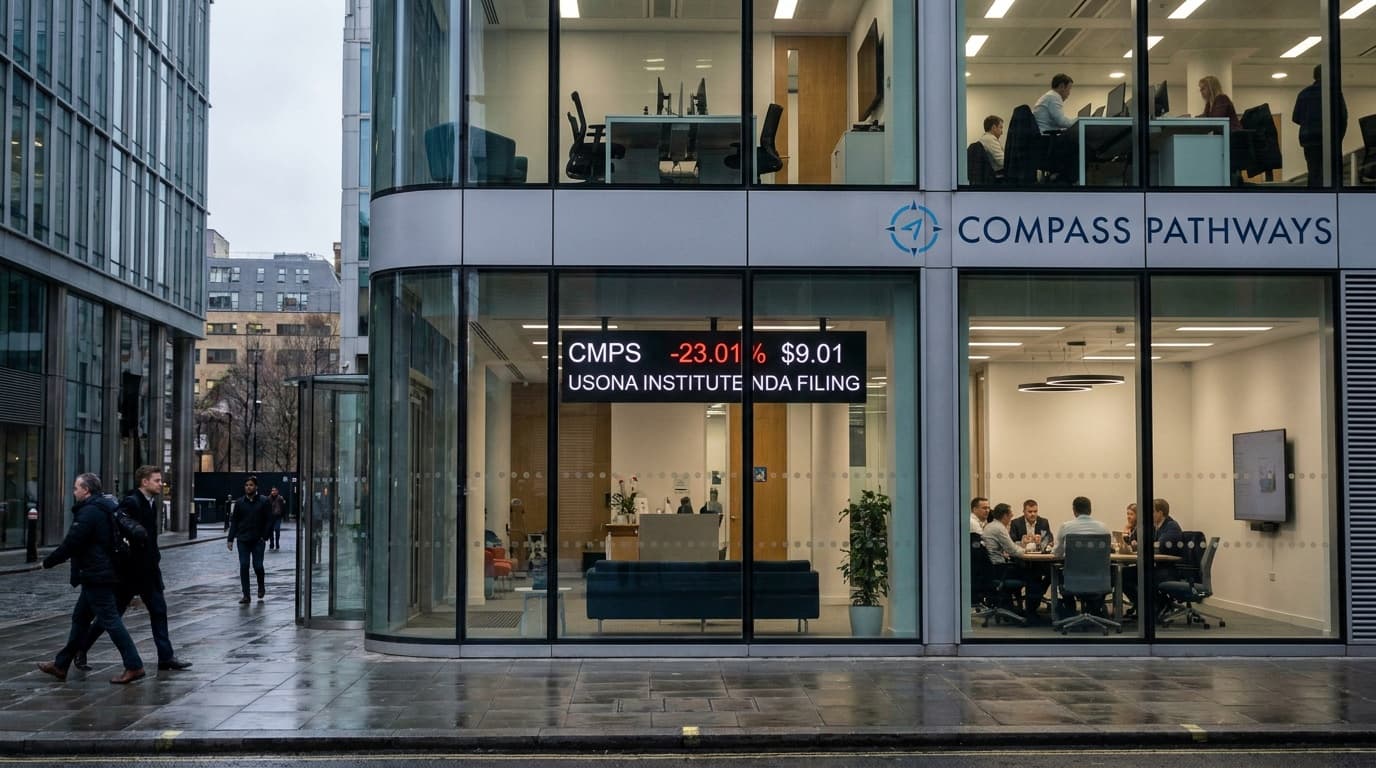
Compass Pathways said Tuesday that it expects to finalize its rolling submission for COMP360 in the next two weeks, an update that came after the company’s stock fell more than 35% Monday on reports that Usona Institute had submitted an approval application for PSIL201.
Both companies hold Commissioner’s National Priority Vouchers for their psychedelic depression candidates, which means both could be approved by the end of the year. Compass’ shares recovered somewhat after the company released third-quarter earnings, but were still 23% below where they started the week, at $9.01 as of publication.
The competitive picture
The market reaction showed how much investor sentiment is tied to filing order in a field that still lacks established commercial precedents. Stifel said confirmation that Compass expects NDA completion very soon was reassuring after Usona’s filing, while RBC Capital Markets argued the selloff created a buying opportunity because even modest commercial success did not appear to be priced into the shares.
RBC also said the size of the market leaves room for multiple competitors. That matters because the two programs are aimed at different indications: Compass is pursuing treatment-resistant depression for COMP360, while Usona’s PSIL201 targets major depressive disorder.
Stifel said that distinction may be more important than the timing gap. The firm noted that Usona’s phase 3 MDD data have never been disclosed, while Compass emphasized that its own dataset comes from a highly refractory TRD population.
The data and timing
Compass said it remains on track for an expected launch in the first half of 2027, subject to FDA approval. The National Priority Voucher shortens review periods from 10–12 months to 1–2 months, and Stifel said prior voucher timelines give it more confidence that approval for COMP360 should come within the first quarter of 2027, if not earlier.
The company’s current investment case still rests on its late-stage efficacy package. In the Phase 3 COMP006 trial, Compass reported in August that 39% of patients with TRD who received two fixed doses of COMP360 achieved a clinically meaningful reduction in depression severity by week six. Those patients maintained a durable response through week 26. Compass said the safety profile was comparable to previous studies, with treatment-emergent adverse events that were transient and typically occurred on the day of dosing.
Usona has disclosed earlier-stage evidence. In a six-week, Phase 2 placebo-controlled trial of 104 adult patients with MDD, a 25-mg dose of PSIL201 met the primary endpoint by delivering a rapid and sustained antidepressant effect compared with active placebo, according to a 2023 JAMA publication. There were no serious treatment-emergent adverse events.
The near-term signal is that Compass appears to be trying to close an investor confidence gap more than a regulatory one. If the filing arrives on the timetable the company gave Tuesday, the debate may shift from who filed first to whether TRD differentiation can support commercial uptake even in a market that may not be exclusive.