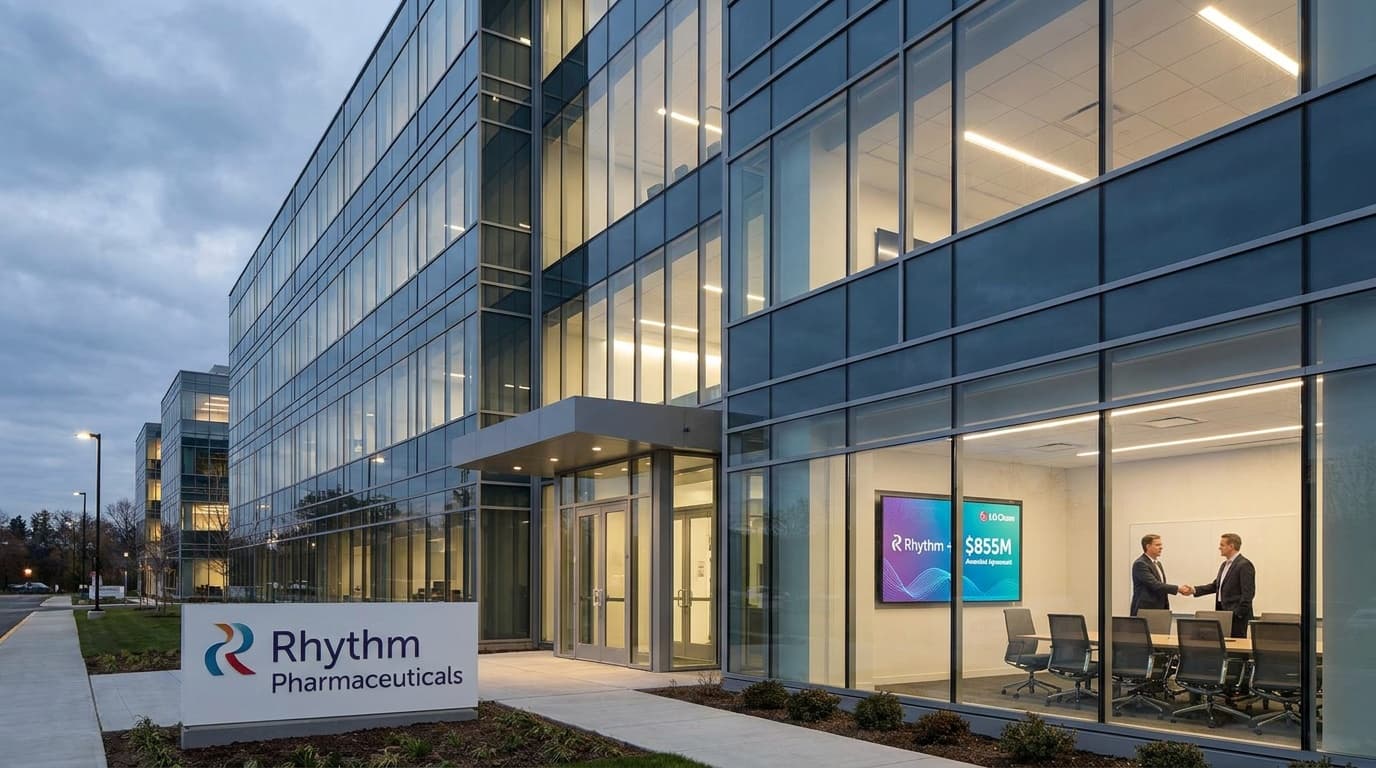
Rhythm Pharmaceuticals has amended its licensing agreement with LG Chem for bivamelagon, increasing the deal’s potential value to $855 million from an earlier cap of $305 million. The revised structure adds $350 million in new payments and lowers royalties to 1% beginning in 2029 or upon the first commercial sale of bivamelagon.
The move changes the balance of the original deal. Rhythm had initially licensed the oral melanocortin 4 receptor candidate, then known as LB54640, for $80 million in upfront cash, $20 million in Rhythm stock and milestones worth as much as $205 million, plus low-to-mid-single-digit royalties on global net sales. Under the new terms, Rhythm is taking on more fixed near-term cost in return for lower long-term running royalties and a clearer commercial framework.
The economics
The added $350 million will be paid in stages: $70 million this month, $100 million in September 2027, $100 million in September 2028 and $80 million in September 2029. The amended agreement also includes a potential $200 million payment to LG if the MC4R portfolio reaches $3 billion in sales.
William Blair analyst Alethia Young wrote in a Nov. 3 note that the revised arrangement reflects growing confidence in future sales. Young said the $3 billion threshold suggests both companies view that level as a realistic target and argued that Rhythm is effectively paying more up front to reduce long-term cost on a platform it believes has multibillion-dollar potential.
That matters because the economics now look more like a franchise optimization than a simple asset license revision. If bivamelagon expands the company’s MC4R business beyond the life of Imcivree, lower royalties could become more valuable than preserving near-term cash.
The operating case
Phase 2 results last year showed patients receiving bivamelagon lost 9.3% of BMI versus 2.2% in the placebo arm. The study also showed results comparable to Imcivree’s BMI reduction.
Rhythm’s existing MC4R product is already contributing commercial evidence for the franchise. Imcivree, which is marketed for hyperphagia and severe obesity, posted third-quarter sales of $92.1 million, up 29%, according to the company’s earnings report.
Rhythm plans to start a phase 3 trial of bivamelagon in hypothalamic obesity by the end of this year and a study in Prader-Willi syndrome in 2027. CEO David Meeker said LG Chem had developed the first oral MC4R agonist and pointed to clinically meaningful weight loss in patients living with acquired hypothalamic obesity.
To support the revised deal and ongoing commercialization and R&D, Rhythm entered a term-loan facility worth $750 million with KKR’s HealthCare Royalty in partnership with Blackstone, with $500 million committed. The financing suggests investors were willing to back not just a single trial plan, but Rhythm’s broader attempt to turn MC4R biology into a longer-duration commercial platform.