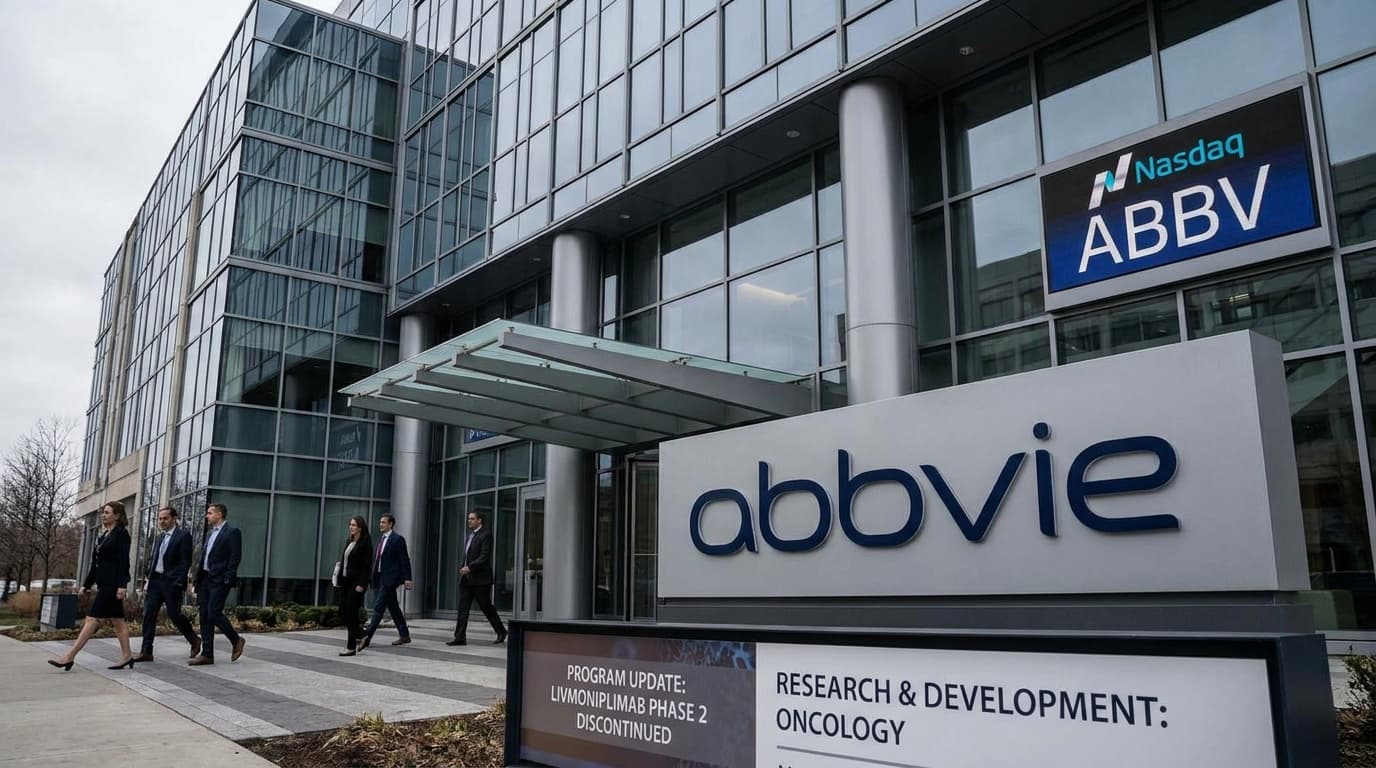
AbbVie has scrapped livmoniplimab, a phase 2 solid tumor monoclonal antibody, after deciding the drug was unlikely to outperform the current standard of care. In a statement to Fierce, an AbbVie spokesperson said the company discontinued clinical development because the therapy’s potential benefit appeared limited relative to available options for patients with several solid tumors, including colorectal cancer and lung cancer.
The decision stops a program that AbbVie had been testing across multiple oncology studies, including a phase 2/3 trial in non-squamous non-small cell lung cancer. That study began in 2024 and was set up to compare livmoniplimab plus AbbVie’s PD-1 blocker budigalimab against Merck & Co.’s Keytruda. It had been due to read out in 2031.
The road here
Livmoniplimab, also known as ABBV-151, was designed to bind the glycoprotein-A repetitions predominant-transforming growth factor (GARP–TGF)-β complex, block release of active TGF-β1 and promote immunoreactivity. AbbVie had previously argued the mechanism showed enough promise to justify broader development.
Back in 2024, the company reported that a phase 1 study in 12 patients with hepatocellular carcinoma showed an overall response rate of 42% for the livmoniplimab-budigalimab combination. That same year, AbbVie said there was “encouraging preliminary efficacy” across a range of solid tumors.
The current stop shows how often early immuno-oncology signals fail to hold up against the commercial and clinical bar set by established therapies. AbbVie’s public rationale was not that livmoniplimab lacked any activity, but that the expected benefit no longer looked strong enough versus existing care to justify continued investment.
The portfolio impact
For AbbVie, the cut appears to further shift its solid-tumor emphasis toward assets with clearer differentiation. Fierce reported that the company’s current offering in solid tumors consists of the antibody-drug conjugates Elahere and Emrelis, while development is led by phase 3-stage next-generation ADCs including Temab-A and ABBV-706.
That matters strategically because ending a program before a 2031 readout frees time and capital from a long-duration study that no longer fit AbbVie’s view of the market. In oncology, the signal from this move is less about one failed mechanism than about portfolio triage: when a candidate does not look likely to beat entrenched standards, large companies are increasingly willing to exit before confirmatory timelines run their course.