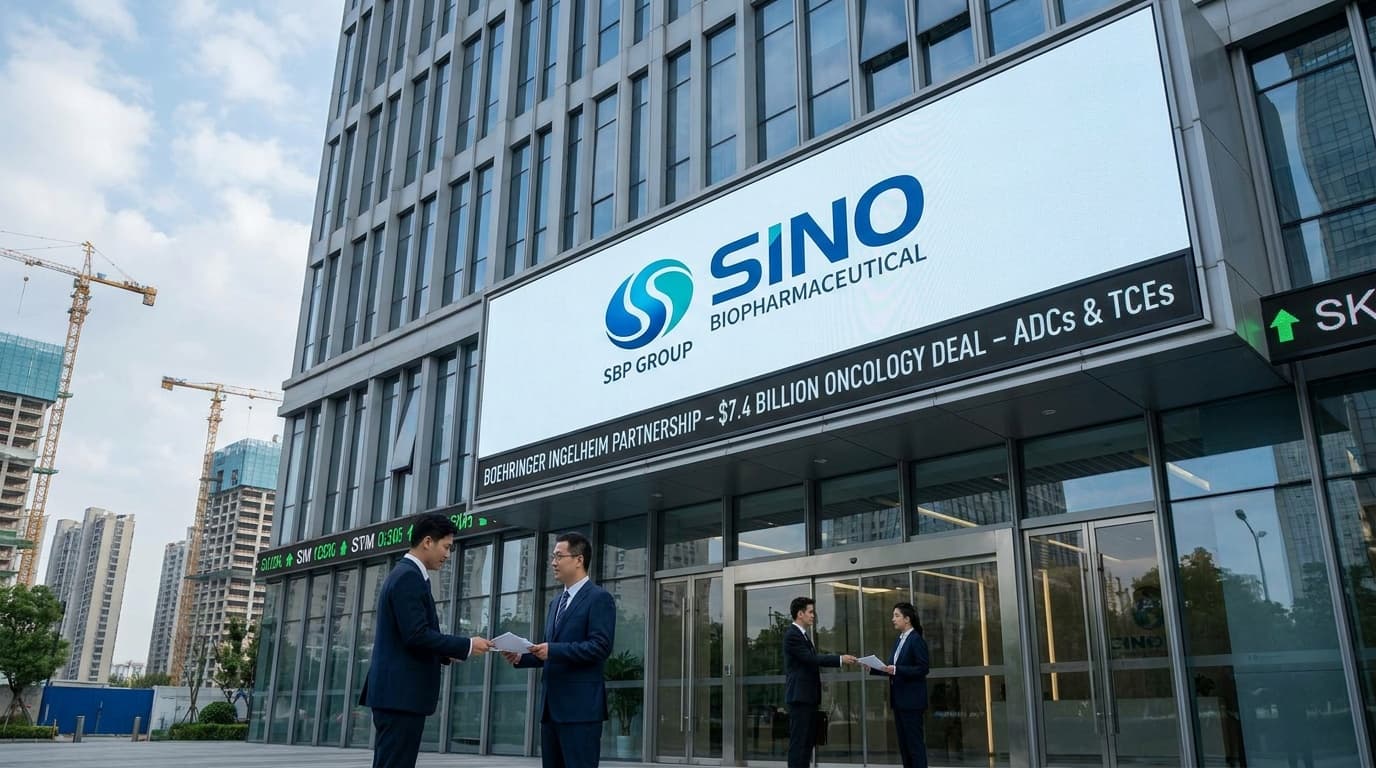
Boehringer Ingelheim has expanded its hunt for next-generation oncology assets with a new option and license agreement worth up to $7.4 billion with Sino Biopharmaceutical. The German drugmaker will pay $358 million upfront for access to six preclinical programs spanning antibody-drug conjugates and T-cell engagers, two modalities that Paola Casarosa, who oversees Boehringer’s innovation unit, identified in April as a key focus.
Under the structure announced Wednesday, Sino will oversee early development of the assets toward agreed clinical milestones. Boehringer then has the option to license the therapies, taking worldwide rights to two programs and ex-China rights to the other four. Sino said it could receive up to $7 billion in option-exercise fees and milestone payments, plus tiered royalties if any of the six programs reach market.
Deal structure and pipeline fit
Five of the six programs come from Sino’s LaNova Medicines subsidiary, while one originates from its Beijing Tide Pharmaceutical unit. That matters because the collaboration is not simply a broad discovery pact; it is a staged asset-acquisition model that lets Boehringer pay for early access while delaying larger commitments until programs hit predefined development points.
The move also looks consistent with Boehringer’s recent oncology positioning. Casarosa said in April that the company still sees ADCs as an exciting modality and is continuing to look at next-generation payloads and new mechanisms for linking them to antibodies. Wednesday’s deal suggests that interest has translated into a more systematic sourcing strategy rather than a one-off bet.
Boehringer already has a clinical T-cell engager in the clinic. Its DLL3/CD3 T-cell engager obrixtamig is in phase 3 trials for small-cell lung cancer and extrapulmonary neuroendocrine carcinoma. On the ADC side, the company licensed a candidate from South Korea’s AimedBio last year in a deal worth up to $991 million and committed around $31 million to a new R&D facility in Switzerland focused on ADC development.
Why the China angle matters
This is Boehringer’s second oncology partnership with Sino, which operates globally under the SBP Group brand, and it gives the company another way to connect its Shanghai External Innovation Hub with global oncology development. Casarosa said the new alliance “puts our China strategy into action by connecting innovation from China with our global research and development capabilities.”
The signal is broader than one deal. Rather than treating China mainly as a commercial market or manufacturing base, Boehringer is using it as a source of externally originated cancer assets in modalities that remain highly competitive across the industry. For Sino, the agreement supports its stated international innovation strategy while keeping it responsible for the value-inflecting early work before Boehringer decides which rights to pick up.