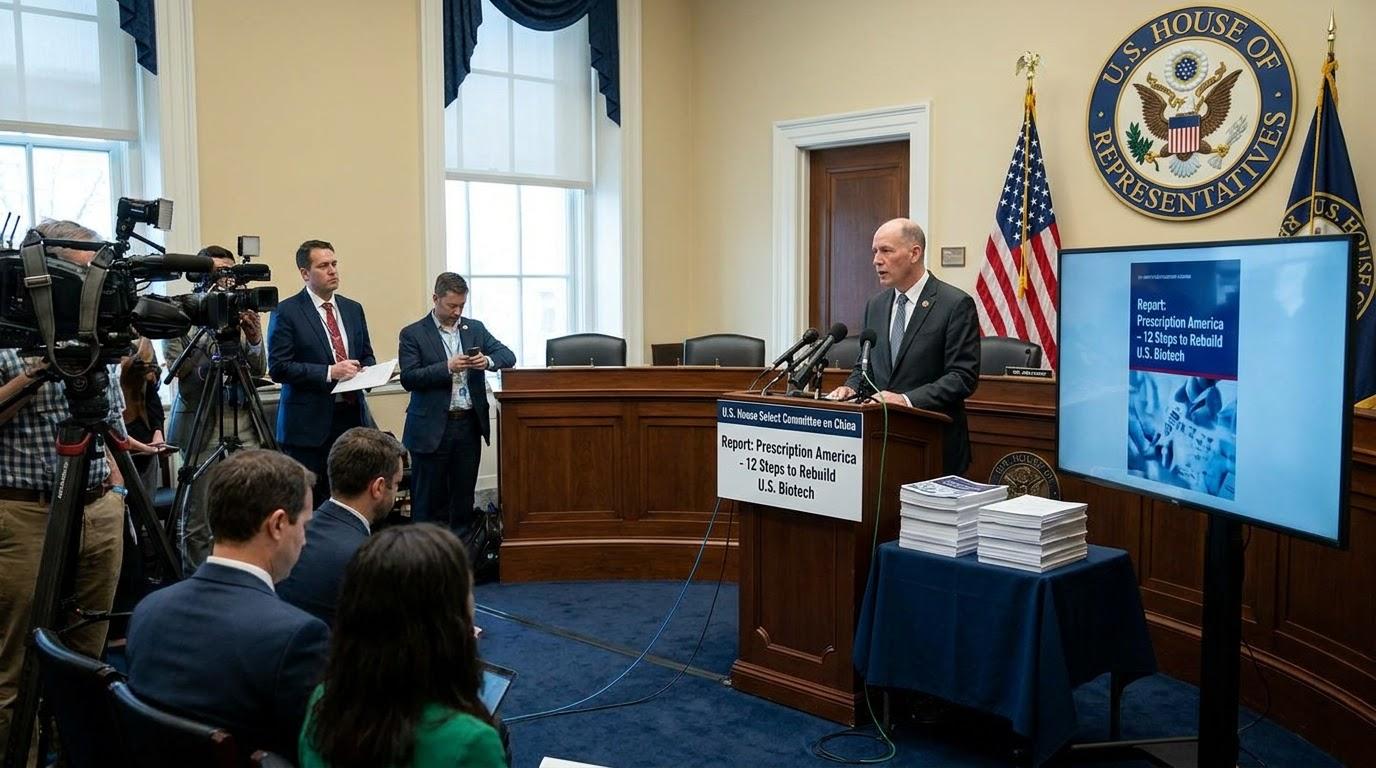
The U.S. House Select Committee on China has published a report titled Prescription America that argues federal policy should move to “reverse the hollowing out of the U.S. drug innovation industry.” The report packages 12 recommendations after an investigation that, according to the committee, included interviews with dozens of biotechnology executives, pharmaceutical companies, investors, researchers, clinical trial professionals and government officials.
Rep. John Moolenaar, the committee’s chairperson, said in a press release that the U.S. cannot allow China to get ahead and control drug development. The report frames the issue as both an industrial competitiveness problem and a national security concern.
The policy proposals
Among the recommendations are restricting the FDA’s acceptance of Chinese clinical trial data, banning the agency from accepting data from clinical trial sites in Xinjiang and Chinese military hospitals, and modernizing the U.S. clinical trial system. The report also calls for exploring centralized institutional review boards and creating a White House biotechnology coordinator.
The committee said the recommendations grew out of concerns about trial speed in China and the use of investigator-initiated trials, which it said can operate with weaker regulatory oversight. It cited multiple cases reported in the past four months involving undisclosed adverse events or deaths during investigator-initiated trials in China.
The broader Washington push
The report arrives amid a wider effort in Washington to respond to China’s growing role in biopharma. In June, Moolenaar introduced the Biotech Investment National Security Act, which would apply the review requirements of the Comprehensive Outbound Investment National Security Act to investments in Chinese biotechnology, and a companion bill was introduced in the Senate in August.
Fierce also linked the committee’s findings to a Nov. 19 analysis from the National Security Commission on Emerging Biotechnology, which detailed China’s strategy and progress toward dominating the global biopharmaceutical industry. Caitlin Frazer, the commission’s executive director, said in a press release that U.S.-China pharma deals are starting to favor Chinese startups, a shift she said risks eroding biotech R&D in the U.S.
The policy signal is that congressional concern is moving beyond rhetoric about competition and toward specific mechanisms that could change how companies source trial data, structure cross-border partnerships and think about U.S. development capacity. Whether those ideas become law will be up to the next Congress, which convenes in January with Democrats taking control of the House.