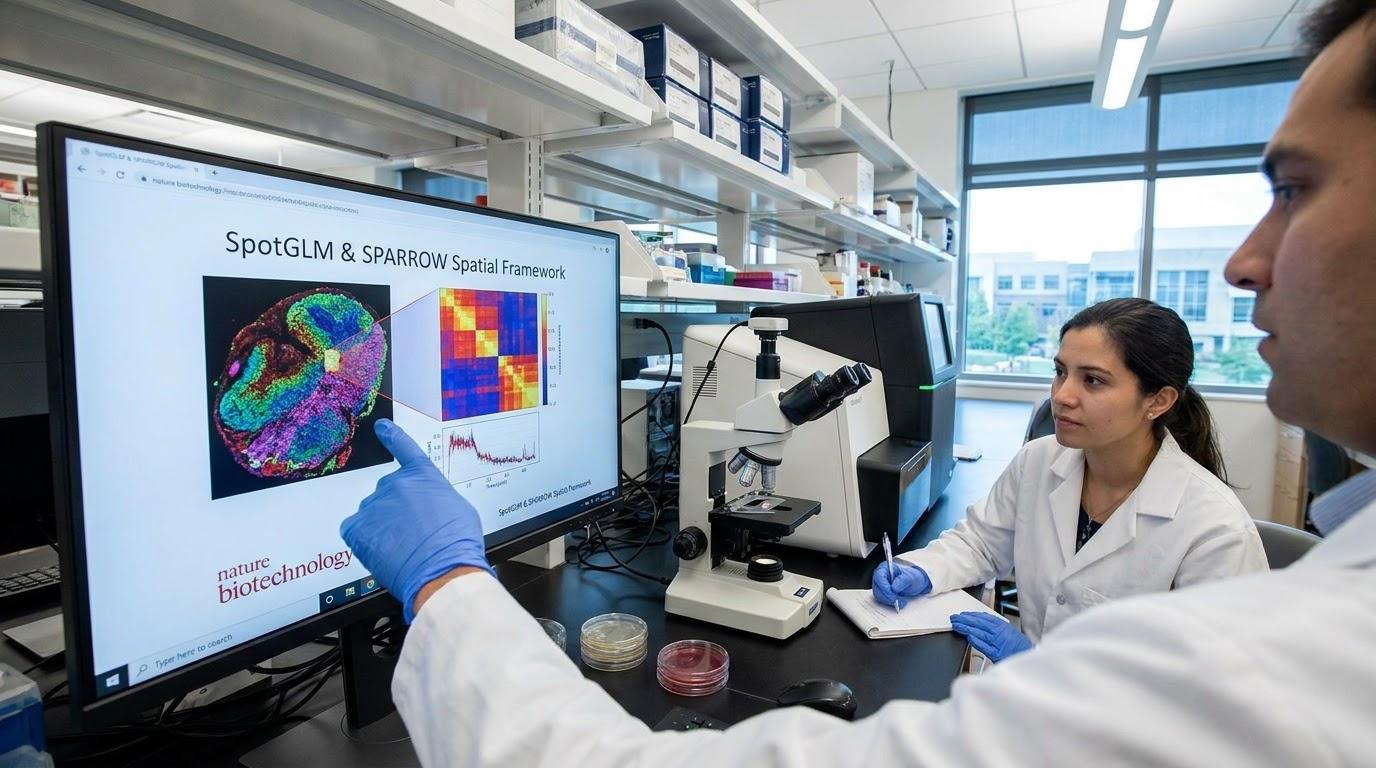
Spatial omics has advanced faster than the statistics used to interpret it, according to a Nature Biotechnology study that introduces two linked methods, SpotGLM and SPARROW, to address that gap. The paper focuses on a central problem in modern spatial data: identifying molecular features whose behavior depends on both cell type and local cellular niche when each measured coordinate often contains mixtures of multiple cell types.
The authors argue that existing approaches such as C-SIDE and NicheDE are mainly tailored to count-based RNA data, assume specific distributions, and do not naturally extend to other spatial modalities such as isoform proportions from long-read sequencing or motif accessibility scores from spatial ATAC-seq. They also say computational cost becomes prohibitive as high-resolution datasets move toward millions of coordinates.
The Method
SpotGLM is presented as a mixture-aware generalized linear model framework for cell-type-specific differential testing across spatial modalities. Rather than treating each spot as if it belonged to one dominant cell type, the model explicitly represents spot-level observations as mixtures of cell-type-specific exponential-family distributions. In the authors’ formulation, that allows one framework to cover count-based gene expression, binomial isoform proportions and approximately Gaussian chromatin accessibility scores.
The second component, SPARROW, is a scalable power-adaptive reduction for representative omics workflows. The paper describes it as a power-preserving data distillation strategy built to enable bounded-runtime inference. Instead of relying on heuristic downsampling, geometric sketching or rasterization, SPARROW uses optimal design principles and greedy subset selection to choose spatial coordinates that retain power for downstream inference.
The combined claim is not only flexibility but calibration. By deriving the likelihood, gradient and Fisher information for the mixture model, the framework is intended to support hypothesis testing of cell-type-specific niche effects from spot-level data while preserving feasibility at current dataset sizes.
The Data
The study demonstrates the framework across several applications. On Visium HD data from colorectal cancer and mouse kidney, the authors report recovery of cell-type-specific niche effects with serial-slice cross-platform validation. In the colorectal cancer setting, they validate against single-cell-resolved Xenium data to show that spot-level mixtures can still yield accurate cell-type-specific niche programs.
In mouse kidney, the framework is used to model a continuous physiological osmolarity gradient and identify spatially structured fibroblast transcriptional programs that were not captured by anatomical region labels alone.
The paper also pushes beyond conventional gene expression. On long-read spatial RNA-seq data from the mouse olfactory bulb, the authors report cell-type-specific isoform switching. On spatial ATAC-seq data from mouse brain, they report cell-type-specific spatial variation in regulatory motif accessibility.
Why It Matters
The practical signal is that spatial biology is becoming a multimodal data problem, not just a transcript counting problem. Methods that only work for one assay type or collapse mixed spots into simplified labels risk either false discoveries or missed cell-type-specific effects, according to the paper.
If SpotGLM and SPARROW prove broadly usable, the value is less about novelty for its own sake than about analytical standardization: one statistical framework that can travel across transcriptomic, splicing and chromatin readouts while still scaling to high-definition datasets. For labs and platform users, that would make spatial omics outputs easier to compare across technologies and more usable in biological interpretation.