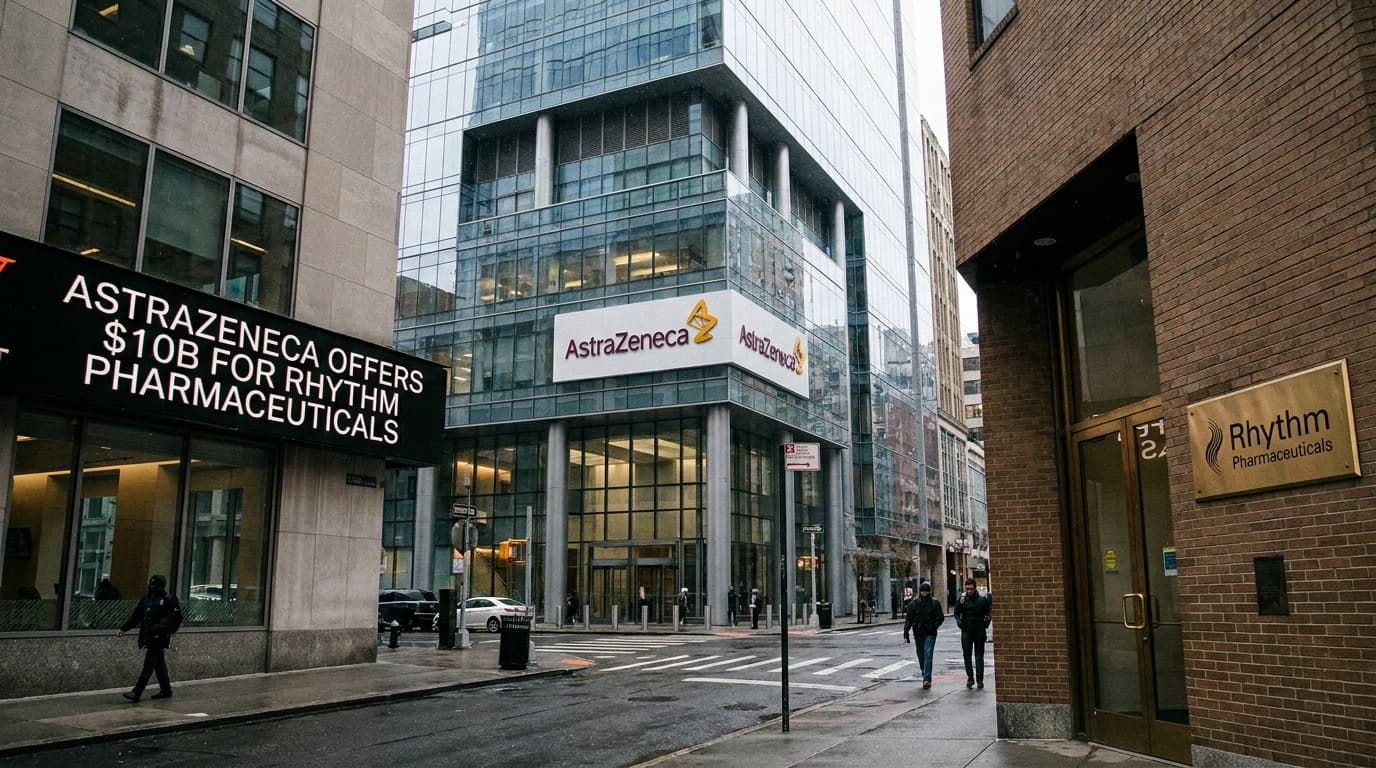
AstraZeneca has reportedly made a roughly $10 billion bid to acquire Rhythm Pharmaceuticals, putting a public price marker on one of the more sought-after rare-obesity companies in biotech. The Wall Street Journal report, cited by both Fierce Biotech and BioSpace, said AstraZeneca offered $124 per share for Rhythm last month.
Reuters, also cited in Fierce Biotech’s report, described the proposal as reaching as much as $134 a share including potential milestones. Even the lower figure would represent a 35% premium over Rhythm’s closing price before Wednesday’s report, according to Fierce Biotech. Rhythm shares ended Wednesday up 24% on the rumors, BioSpace reported.
The strategic fit is straightforward from the sources: Rhythm already sells Imcivree, a first-in-class weight-loss medicine for specific genetic conditions or rare brain injuries, and it is building a pipeline around the MC4R pathway in rare neuroendocrine diseases. AstraZeneca, meanwhile, has existing interests in obesity and rare disease, making Rhythm an asset that could strengthen both areas at once.
The Commercial Picture
Imcivree is the core of the reported deal logic. Rhythm posted $92 million in third-quarter sales in Fierce Biotech’s account and $92.1 million in global third-quarter sales in BioSpace’s account, which also said that figure was up 29% from the previous quarter. As of the end of September, the company had received more than 700 patient start forms from more than 500 prescribers, according to BioSpace.
The recent growth driver is acquired hypothalamic obesity, or aHO, which became Imcivree’s third approved indication in March, according to BioSpace. William Blair described aHO as the most lucrative near-term opportunity, estimating as many as 28,000 patients across the U.S., Europe and Japan, where the drug is being launched. The firm said it sees no competition immediately ahead of or behind Imcivree in that indication and argued that GLPs do not work there.
Forecasts in the sources vary, but all point to a materially larger product than current sales imply. Fierce Biotech said analysts currently foresee more than $2 billion in peak sales potential from the recently added hypothalamic obesity indication. BioSpace cited William Blair’s estimate that Imcivree could reach $3.6 billion in sales by 2032, excluding any contribution from a possible approval in Prader-Willi syndrome.
That spread matters because it helps explain why several analysts think AstraZeneca’s current pitch may only be an opening move. For large-cap acquirers, Rhythm is not just a rare-disease revenue stream; it is also an obesity-adjacent franchise with room to expand across indications where competition may be limited.
The Road Here
Rhythm has been seen as an acquisition candidate for some time. William Blair said earlier this year that the company was a likely takeout target and argued that any large-cap biopharma company with a metabolic business could be interested. “In our view, that is basically every biopharma company out there,” the firm said, according to BioSpace.
Leerink’s Basma Radwan said Rhythm “has long been an attractive M&A candidate” because of its scalable rare-obesity franchise and indication-expansion potential, according to Fierce Biotech. She characterized AstraZeneca’s price tag as “broadly fair,” while also saying she would not be surprised by negotiations for high milestone payments or by competing bids.
Not every part of the story is clean. BioSpace noted that a phase 3 basket trial in multiple genetic obesities failed earlier this year, with all four genetic sub-studies unsuccessful even though analysts had expected at least one to hit. Stifel had modeled $300 million in sales by 2034 for those genetic indications. That miss limits one part of the upside case, but it has not erased interest in the company.
What To Watch
The main negotiation issue in the sources is Prader-Willi syndrome. Jefferies analyst Dennis Ding said AstraZeneca’s offer implies “minimal valuation” for Rhythm’s PWS program, including MC4R-specific agonist bivamelagon, which is moving toward phase 3, according to Fierce Biotech. Ding added that Rhythm management has described PWS as a similar, if not bigger, market opportunity than hypothalamic obesity and has been frustrated that investors assign little credit to it.
BioSpace separately reported that Rhythm plans to start a phase 3 trial for Prader-Willi later this year. The company also said a phase 3 trial will be initiated for bivamelagon, enrollment for a phase 1/2 study of RM-718 should be completed by year-end, and a bivamelagon study in hyperphagia associated with Prader-Willi is planned in 2027.
That creates the central signal from this event: AstraZeneca appears to be bidding on a marketed rare-obesity product, but the resistance to the current offer reflects pipeline value rather than present revenue. If a transaction happens, the final price may depend less on Imcivree’s existing sales base than on whether bidders are willing to pay now for Prader-Willi and the rest of Rhythm’s MC4R expansion plan.