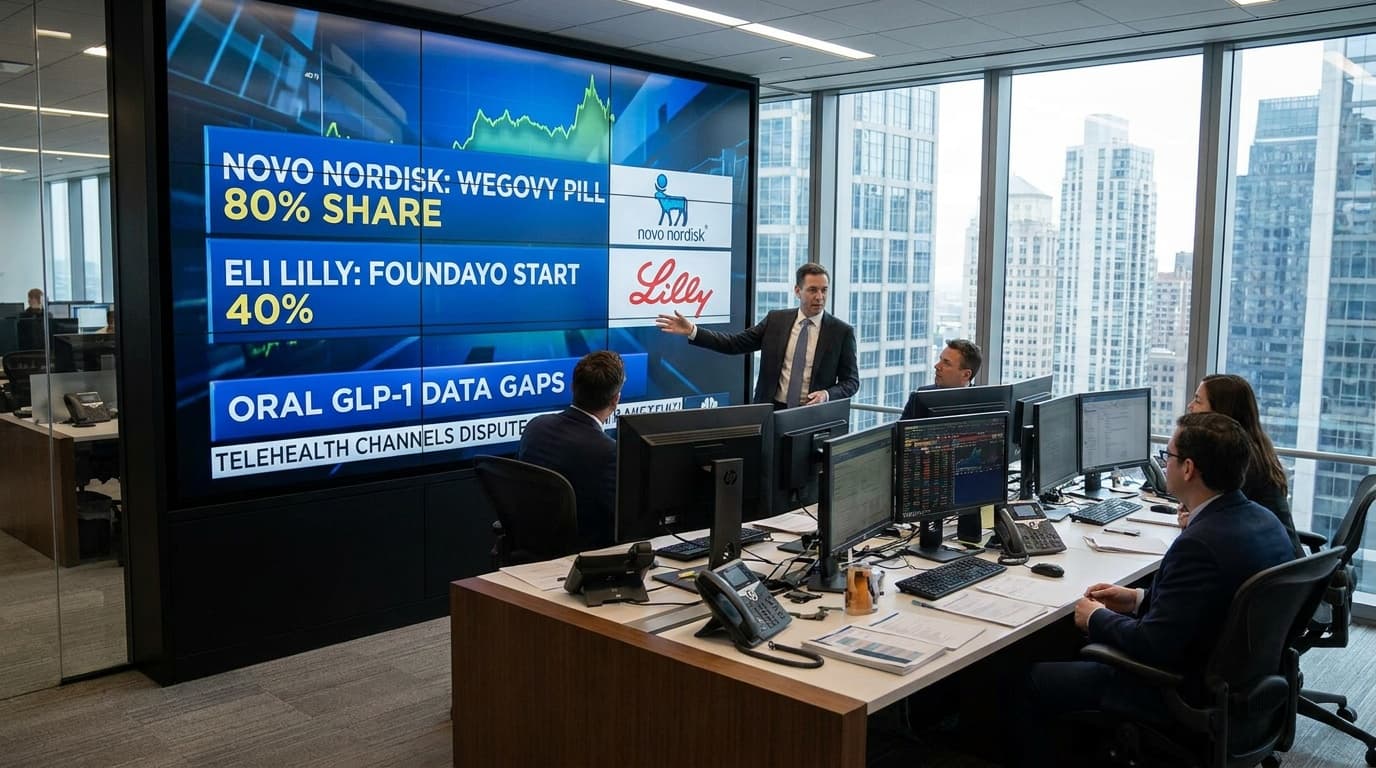
Novo and Eli Lilly are now publicly arguing over who is leading the early oral GLP-1 market, with the disagreement centered less on demand than on which prescription channels get counted.
Last week, Lilly said Foundayo had secured 40% of new patient starts since the oral GLP-1 entered the market in the second quarter. On Novo’s third quarter earnings call, CEO Mike Maziar Doustdar rejected that framing and said the Wegovy pill actually has 80% of the market, leaving Lilly with 20%.
The gap between those claims matters because it suggests the first phase of the obesity pill race is being measured through incomplete datasets. Novo’s argument is that Lilly is relying on IQVIA figures that cover 90% to 95% of Lilly’s scripts but only 65% of Novo’s, because Novo also sells through telehealth partners including Hims & Hers and Ro. Doustdar said those companies do not share their data with IQVIA.
The Commercial Picture
Novo reported that the Wegovy pill has reached 8 million cumulative prescriptions since launch, which Doustdar called the strongest pharma launch by volume in the U.S. in the last decade. For the third quarter, the company recorded 5.39 million DKK ($811.6 million) in sales from the product.
Doustdar tied Novo’s position to what he described as the Wegovy pill label’s competitiveness, including the highest proven weight loss for an oral obesity medication, ease of use and familiarity with semaglutide. Novo also has the broader Wegovy franchise, spanning the pill and an injectable at multiple doses, which lets it offer several formats built around the same molecule.
Lilly has acknowledged a different starting position. Novo said Lilly has admitted that launching a completely new drug like Foundayo put it at a slight disadvantage. Even so, Lilly reported last week that it captured 40% of new patient starts and separately posted a 39% revenue increase driven by weight loss demand.
What The Dispute Signals
The fight over market share is really a fight over channel strategy. If Novo is right that telehealth distribution materially changes the count, then leadership in oral GLP-1s is not just about prescription generation through traditional retail pathways. It is also about building access routes that standard commercial data services may not fully capture.
Novo said 80% of people starting the Wegovy pill are new to treatment, which Doustdar presented as evidence that oral GLP-1s are expanding the market rather than merely switching patients from injectables. That point aligns with Lilly’s own broader thesis that obesity demand remains far from saturated, even if the companies disagree on who is winning the first wave.
Novo’s quarterly results gave investors a supportive backdrop for that argument. The company reported 79.2 billion DKK ($11.9 billion) in net sales for the quarter, up 6% from the same period a year earlier, ahead of about $11.07 billion in net sales expected by analysts cited by Yahoo Finance. Adjusted operating profit reached 31.72 billion DKK ($4.77 billion), up 27% year over year, and shares rose more than 6% in pre-market trading to $42.69, though the stock remained down 21% year to date.
The next competitive readout may come less from headline share claims than from whether third-party data providers, telehealth channels and company-reported prescription figures start converging on a common picture of oral GLP-1 demand.