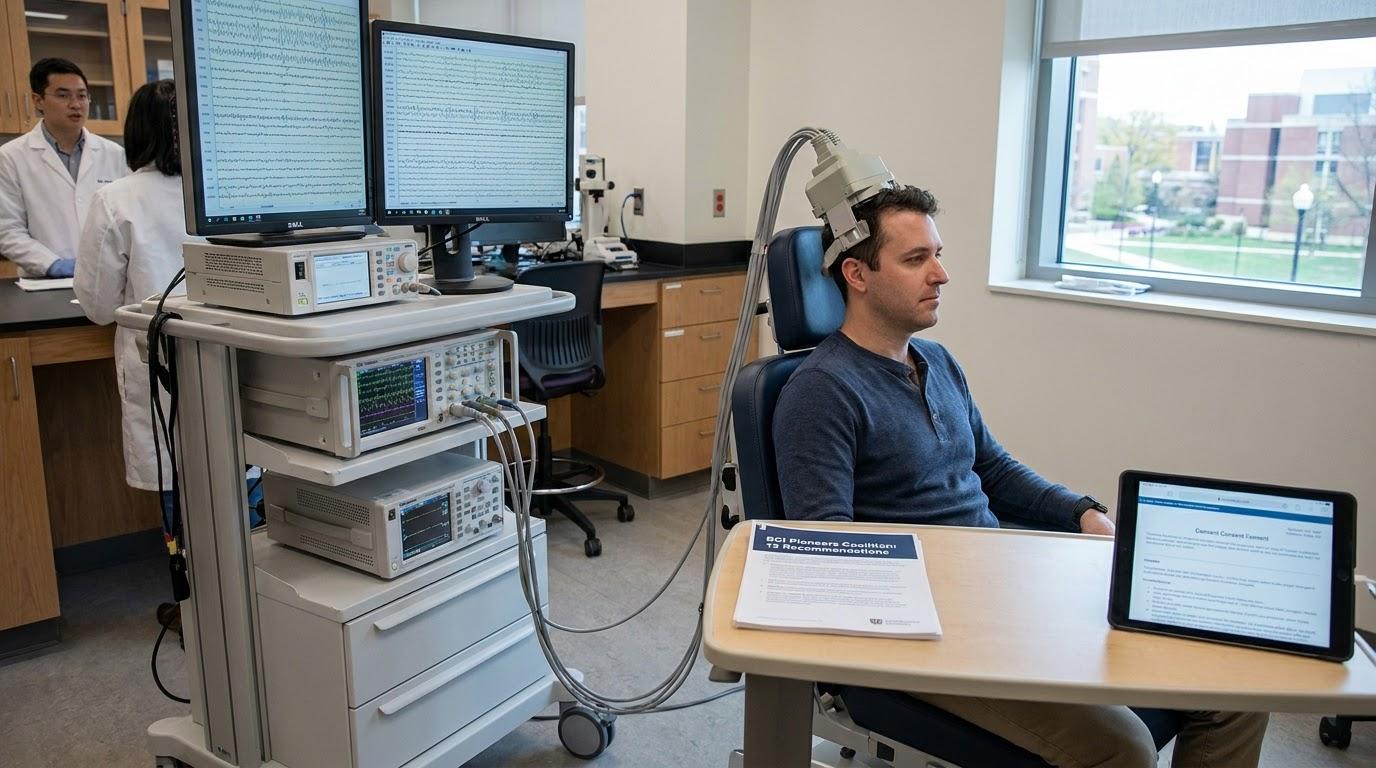
Implanted brain-computer interfaces are moving from a niche proof-of-concept field toward a more active neurotechnology startup market, but a new report argues that participant protections remain underdeveloped. Published last week by the BCI Pioneers Coalition, the report sets out 13 recommendations for startups, researchers, and regulators on informed consent, post-trial care, and neural data privacy.
The report is being pushed by people who have been inside these studies, including Ian Burkhart, who co-founded the coalition with other participants in early implantable BCI research. Their central claim is not that the technology lacks promise, but that participants often have very little say in how trials are conducted even though those studies can reshape daily life for years.
Burkhart told STAT that the recommendations grew out of discussions among participants who felt excluded from decisions about study expectations, access to data generated from their brains, and what would happen after a device was explanted. As he put it, “You want there to be as much agency from the participant as possible.”
The Trial Design Problem
The report arrives as multiple clinical trials test implanted devices for safety and efficacy and investors back a growing set of neurotechnology companies. That shift raises the stakes for operational details that may have seemed secondary in an earlier era of highly experimental academic projects.
Burkhart’s own experience illustrates the issue. He was implanted in 2014 with a device at Ohio State University that helped him move his arm. When the study began winding down because of funding issues, he said the institutional review board proposed that participants could have the device removed and then undergo another implantation later if funding returned. Burkhart said that approach minimized the participant experience by treating another experimental brain surgery as an administrative convenience.
His critique is that current consent structures are often one-sided agreements that protect the research team and institution more than the participant. He drew a distinction between deciding whether to join a study in the first place and being asked to re-consent after the device has already become part of everyday life, particularly in patient populations with limited treatment alternatives.
Post-Trial Care And Data Rights
The coalition’s focus on post-trial care reflects how personal these studies become. Participants may spend multiple days a week in the lab for multiple hours at a time, making the research protocol not just a medical intervention but a durable part of daily routine. Burkhart said that abrupt termination can be especially difficult when a device has restored some function after an acquired disability and that function is then taken away again for reasons that are administrative rather than technical.
He also said participants often do not know what the end of the study will look like, even though researchers can remove them from a trial within their rationale. That uncertainty extends to the fate of neural data collected during the study and to support after explantation.
Ethicist Anna Wexler of the University of Pennsylvania Perelman School of Medicine said during a recent brain-computer interface industry conference in New York that the field lacks good solutions. She cited ideas such as potentially mandatory insurance policies, escrows, and institutional commitments to support, but said that “right now we just don’t actually have solutions.”
Commercial Maturity Is Creating An Ethics Test
The signal for medical technology companies is that commercialization is forcing questions that prototype-era research could postpone. A field that wants longer studies, more participants, and more investor backing will also face more scrutiny over continuity of care, participant autonomy, and ownership or control of neural data.
Burkhart pointed to Nathan Copeland’s 11 years with a device as evidence that long-term use is no longer hypothetical in this fledgling industry. As that duration stretches, post-trial obligations start to look less like edge cases and more like core infrastructure for the business and clinical model around implanted BCIs.