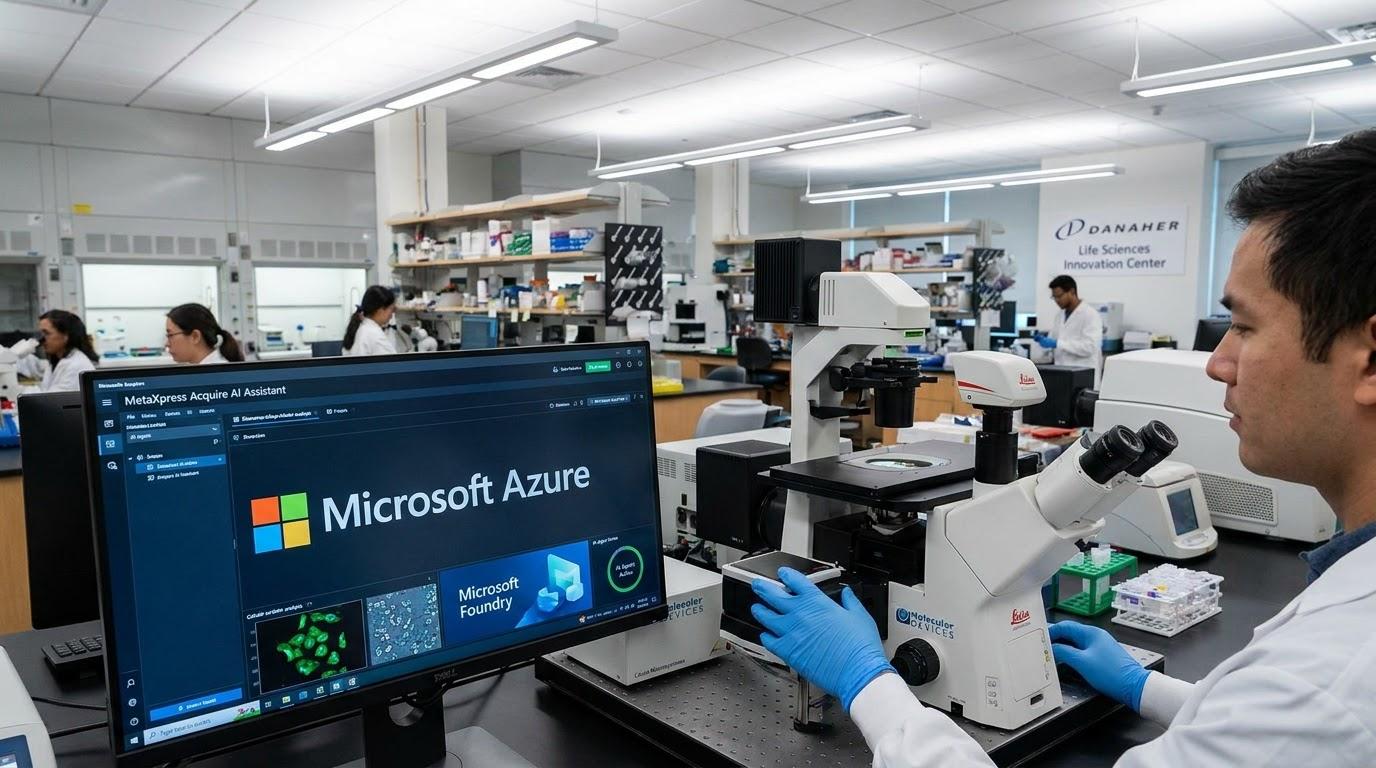
Danaher and Microsoft are entering a strategic partnership to develop smart scientific instruments and what Danaher described as an interoperable agentic ecosystem for laboratories. Danaher said the envisioned system will connect its technologies while staying open to the broader laboratory ecosystem, with the aim of helping scientists move from scientific questions to experimental evidence faster.
The partnership combines Danaher’s scientific, workflow and instrumentation capabilities with Microsoft’s AI stack. Danaher said the platform will use Microsoft Azure for compliant cloud infrastructure and Microsoft Foundry to power AI agents that interpret results and guide instrument control. The companies are still developing the platform, but Danaher said the first commercial applications will reach its customers this year.
Commercial rollout
The first named product is MetaXpress Acquire AI Assistant, Molecular Devices’ software for high-content cellular imaging systems, which Danaher said is designed to provide product support. Danaher also said additional next-generation, agent-enabled instruments from its businesses that use the platform are planned for 2027.
That timing matters more than the partnership branding alone. Medtech companies have spent the last two years attaching AI to software, analytics and automation claims; Danaher is now putting a release schedule behind those claims. The company is also framing the effort around shared infrastructure and interoperability, suggesting it sees value in making AI features portable across instrument lines rather than treating them as isolated add-ons.
What Danaher says the system will do
Danaher said smart, agent-enabled instruments being designed through the partnership are intended to translate scientific intent into experimental plans, instrument setups and methods; control instrument hardware; interpret results; identify quality issues in real time; and recommend corrective actions and next experiments for scientist review.
In preliminary internal testing data shared by Danaher, novice scientists running an AI-assisted experiment on a Leica microscope took up to 83% less time and up to 68% fewer steps than a novice working without the AI assistant, while producing high-quality data and finishing in a time comparable to an expert. Because those results are preliminary and internal, the stronger near-term signal is operational strategy: Danaher is positioning AI as a way to standardize execution and reduce friction at the instrument level, not just as a layer for post-experiment analysis.
The move also fits a broader pattern identified in the source article, which noted Eli Lilly and Thermo Fisher Scientific partnerships with Nvidia announced this year. For Danaher, the implication is that competition in laboratory tools is expanding beyond hardware performance toward control software, connected workflows and the ability to turn AI assistance into products customers can actually deploy.