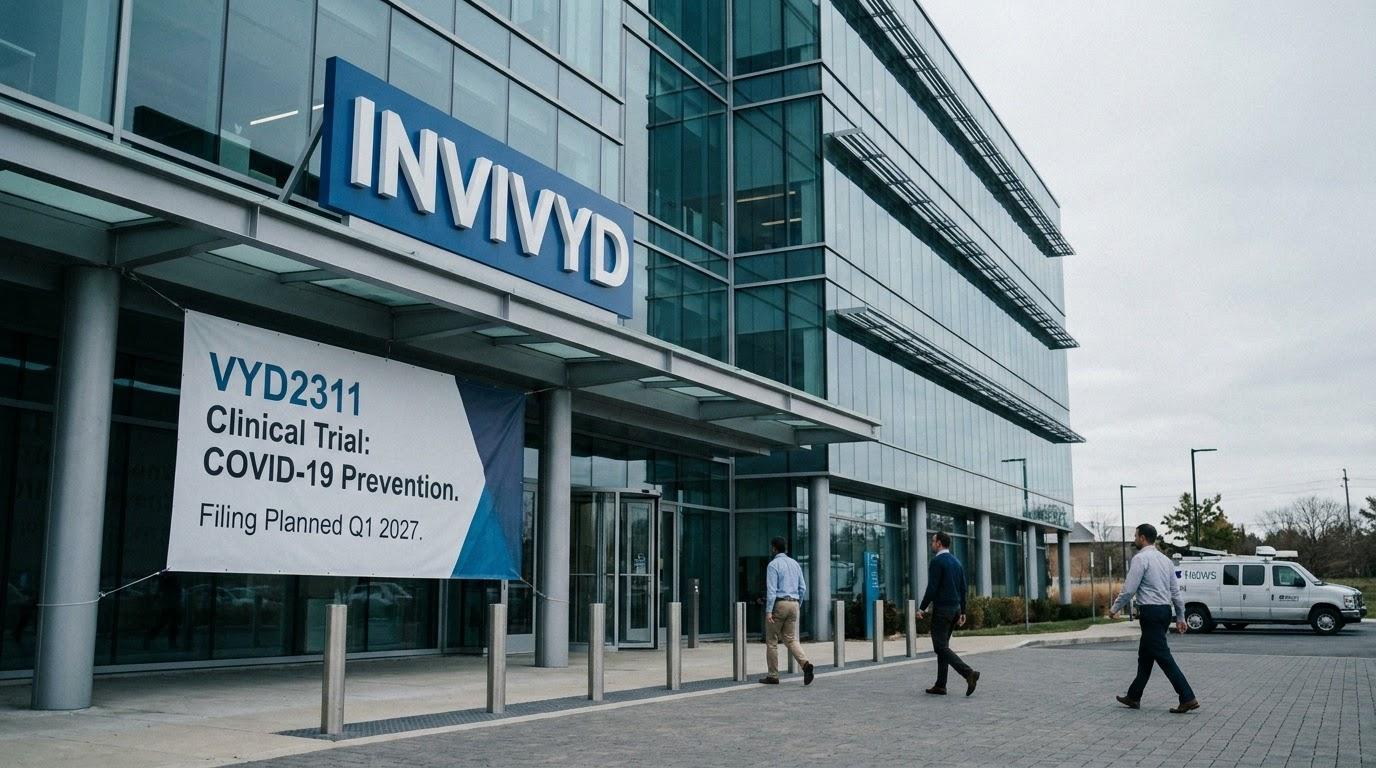
Invivyd plans to seek accelerated approval for VYD2311 in the first quarter of 2027 after reporting a phase 3 interim analysis that it said predicts 70% to 90% protection against symptomatic COVID-19 at 90 days. The company is presenting the candidate, also called ibramvibart, as a prophylactic monoclonal antibody that could extend protection without relying on the mechanisms associated with COVID-19 vaccines.
The strategic significance is broader than a single readout. Invivyd is trying to reopen a regulatory and commercial lane for COVID-19 antibodies after the category lost ground as variants changed and the market shrank. Its argument is that updated monoclonals can function as a repeatable prevention modality, but that case depends on whether regulators accept evidence and review processes more commonly associated with vaccines than with older antibody authorizations.
The data
The phase 3 Declaration study tested intramuscular VYD2311 against saline placebo in adults and adolescents at least 12 years old, including people with and without risk factors for progression to severe COVID-19. One report said the trial enrolled 2,359 people, while another described it as a study of around 2,400 participants. Patients received either a single dose, monthly doses spaced 30 days apart in one account, or placebo, with the interim analysis covering the 90-day response after the first injection.
Invivyd said both dosing groups generated durable antiviral activity consistent with expected clinical protection of 70% to 90% at 90 days versus placebo, meeting the trial’s primary endpoint. The company also said secondary endpoints were met and that safety and tolerability were similar to placebo, though it did not provide detailed figures in the materials summarized by the source reports.
The company contrasted those projections with what it estimated as a 30% to 35% reduction in medically attended COVID-19 for 90 days for traditional COVID-19 vaccines. One report added external context that efficacy estimates in the literature vary widely and cited a New England Journal of Medicine analysis finding pooled effectiveness against hospitalization of 46% for mRNA vaccines against the circulating variant. That comparison matters because Invivyd is selling VYD2311 on relative protection, but the current result remains an interim projection rather than a disclosed symptomatic case count analysis.
The regulatory path
Invivyd said it is keeping clinical COVID-19 events fully blinded to support a potential traditional approval application later, while using the interim analysis to support an accelerated approval filing. The company also said it will combine Declaration with phase 3 Liberty data reported in September, where VYD2311 was described as superior in safety and tolerability to an mRNA-based COVID-19 vaccine, and one source specifically named Pfizer and BioNTech’s Comirnaty.
According to the reports, Invivyd has been in talks with both HHS and the FDA about a regulatory framework for prophylaxis-focused antibodies like VYD2311. One source said the company expects biologics licensing application review to be conducted by or with input from the FDA’s Center for Biologics Evaluation and Research. Another said Invivyd anticipates the FDA may begin formalizing processes that would enable faster iteration on such antibodies once the filing is made.
That framing reflects the company’s earlier friction with regulators. The reports note that Pemgarda, the predecessor antibody, received emergency use authorization in 2024 for pre-exposure prophylaxis of symptomatic COVID-19 in certain immunocompromised patients, but that the FDA refused Invivyd’s effort to expand Pemgarda’s indications in early 2025.
The road here
VYD2311 uses the same antibody backbone as Pemgarda and is described as 99% structurally identical, with subtle but critical molecular changes designed to improve potency against contemporary virus lineages. Invivyd said its goal is for a single dose to protect against symptomatic COVID-19 for around a year, while multiple doses could provide higher protection for longer depending on individual choice.
The company’s confidence was reinforced publicly by Robert Redfield, the former CDC director from 2018 to 2021, who supported the program in Invivyd’s release. One report noted he does not have any public ties to the biotech.
For the industry, the key signal is that Invivyd is not just advancing a follow-on COVID-19 antibody. It is testing whether prevention antibodies can regain relevance if they are updated quickly, delivered intramuscularly and reviewed through a clearer pathway. The filing plan in the first quarter of 2027 will show whether that thesis has regulatory traction beyond the company’s own projections.