Novartis used the day of Anthropic’s Nasdaq IPO to make a more tempered case for artificial intelligence in drug development. Speaking in London, CEO Vas Narasimhan said the company sees AI as a practical tool for shrinking timelines and improving decision-making now, while treating biology-driven gains in success rates as a longer-term effort rather than a near-term breakthrough.
The target Novartis laid out is to improve the probability of success from first-in-human testing to approval from the industry average of 8% to 12% and to cut four years from the standard 12-year path from entry into research to the market. For investors, the key signal was not that AI can compress every part of development equally, but that Novartis believes the fastest returns are coming from data handling, trial operations and document-heavy workflows.
Where Novartis Says AI Is Already Working
Narasimhan divided drug development bottlenecks into information latency, operational latency and biological latency. Information latency, or the time it takes to gather data and make decisions, currently consumes roughly a year in the standard 12-year timeline, and he said AI should soon drive that down to zero. Operational latency, which includes trial design and setup, regulatory paperwork and running experiments, accounts for about another two-and-a-half years that AI can steadily compress.
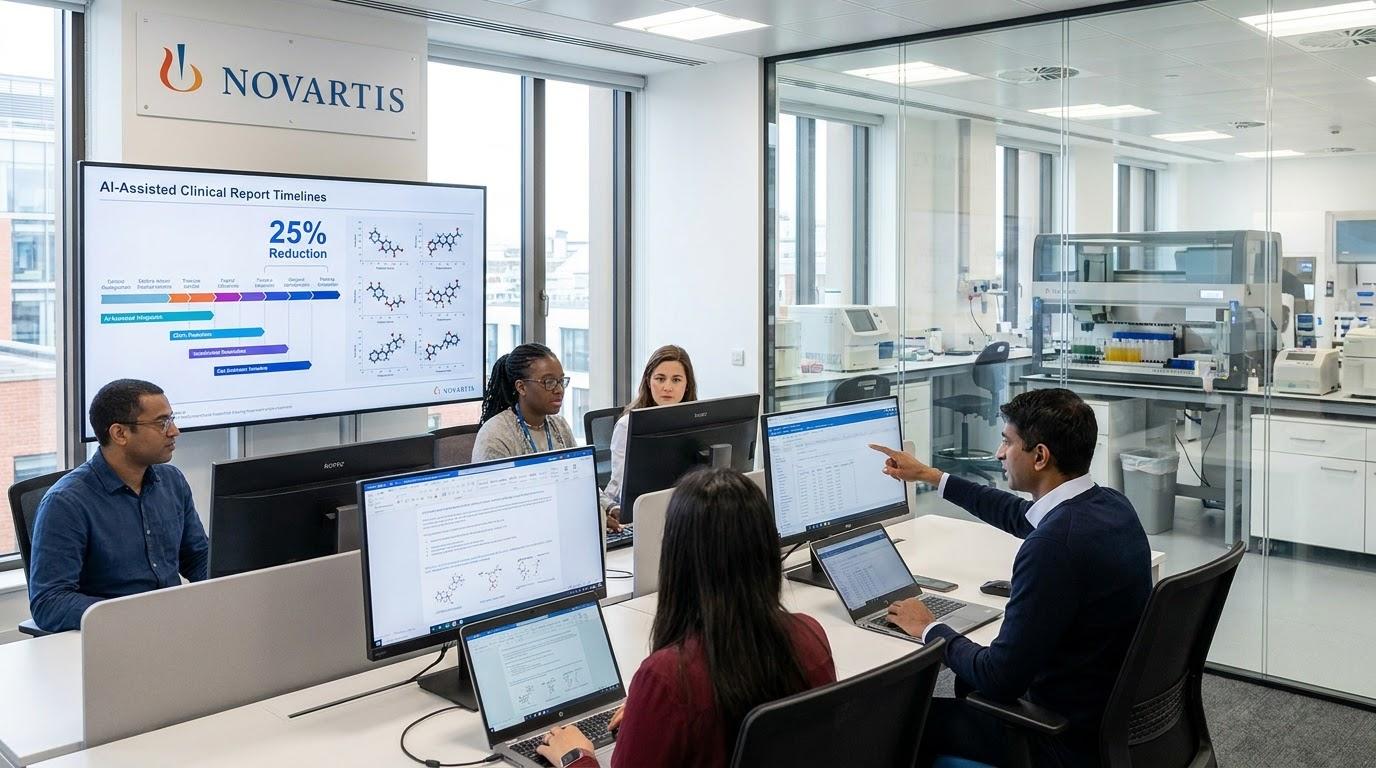
Novartis attached specific metrics to that argument. Narasimhan said about 90% of all content in Novartis development is now AI-assisted, helping cut clinical report timelines by 25%, while statistical programming in the company’s 2026 trials became 90% faster. He said statisticians can now analyze both positive and negative results in a day or days rather than months, citing recent readouts for remibrutinib, pelacarsen and del-desiran.
Max Lawson, head of AI in Novartis’ drug development, said the company’s in-silico trial planning platform can run thousands of enrollment simulations in minutes rather than a few scenarios in weeks. He added that the simulations were 50% more accurate in predicting enrollment timelines than Novartis’ prior process. Narasimhan also said AI has helped the company become more sophisticated in choosing clinical endpoints, starting with neurodegeneration and neuromuscular diseases.
Outside R&D, Novartis expects production to see the biggest profit improvements over the next three years as it scales AI in manufacturing units. On the commercial side, Narasimhan said almost all field representatives now use AI tools for faster patient enrollment, insurance verification and content creation.
The Harder Problem: Biology
The more ambitious promise for AI is not workflow efficiency but better drug success rates, and that is where Novartis sounded notably cautious. Narasimhan said AI drug developers are already good at designing better molecules with stronger pharmacological properties, but solving biological questions such as what happens in a cell and then across 40 trillion cells in a dynamic human system is likely a “10-year-plus journey.”
That view put Novartis closer to Eli Lilly CEO David Ricks than to Anthropic CEO Dario Amodei’s less-than-a-decade prediction for making major diseases relics of the past. Fiona Marshall, Novartis’ president of biomedical research, reinforced the same point, saying that even with advances such as AlphaFold, turning a promising molecule into an approvable medicine still requires navigating complex human biology that researchers are “still are not very good at even in the context of AI.”
Marshall did point to areas where AI is expanding what Novartis can discover. She said generative chemistry can take programs into wider chemical space than conventional approaches usually explore, and that combining datasets from cell-based multi-omic profiling through clinical data has helped Novartis identify three novel neurodegeneration targets that are advancing in its later-stage preclinical program. But she also said robust “lab-in-the-loop” profiling remains essential because many AI outputs do not translate even into cell models, let alone the clinic.
For the broader AI-in-biopharma market, that is the practical takeaway. Novartis is presenting AI less as a replacement for experimental science than as a system for reducing friction around research, development and commercialization while gradually improving the quality of biological hypotheses. That framing may be less dramatic than some technology-sector claims, but it is also closer to what large drugmakers can measure and defend in front of investors today.