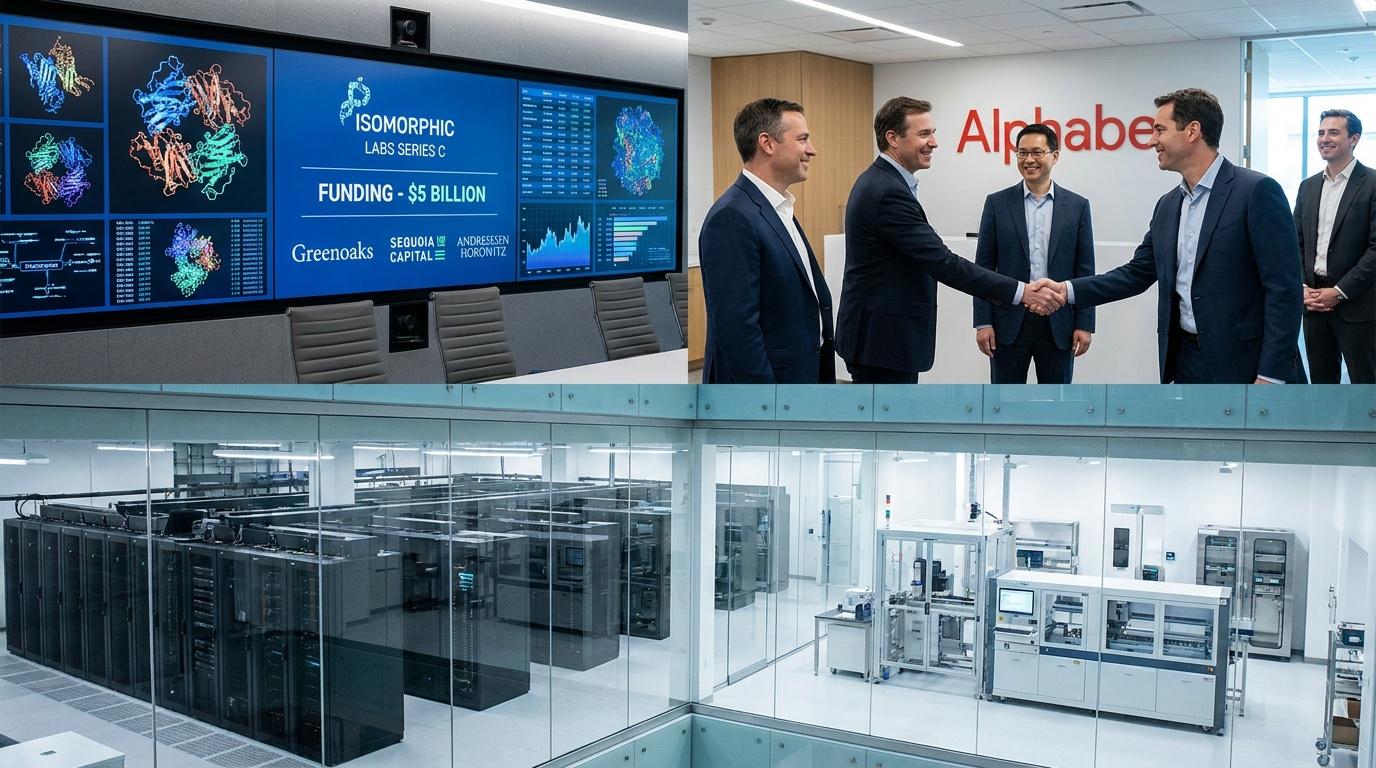
Isomorphic Labs has raised a $5 billion series C round, marking its second multibillion-dollar financing in six months and setting a new high-water mark for a single biotech venture round, according to BioSpace. The company had already drawn attention in May with a $2.1 billion series B.
The scale matters because Isomorphic still has not publicly disclosed a clinical program. Instead, the company is raising against a combination of platform claims, partner validation and the promise that its AI drug design system can generate a durable pipeline across oncology, immunology and multiple drug modalities.
Where The Money Is Going
Isomorphic said the new funding will back further development of IsoDDE, its drug design engine, and the preclinical programs generated from that platform. The company also said it is investing in translational and clinical development infrastructure to support moving programs into human testing.
BioSpace added that the cash is also intended to help Isomorphic scale a platform the company describes as a suite of foundational simulation AI models that works across multiple therapeutic areas and drug modalities. In parallel, the company is building what it called the global infrastructure and partner ecosystem required for AI-led bioengineering.
Greenoaks and Sequoia Capital co-led the series C, with participation from Andreessen Horowitz and several other new investors, according to Fierce Biotech. BioSpace separately highlighted continued investment from parent company Alphabet. Fierce also reported that all existing investors—Thrive Capital, MGX, GV, CapitalG, Temasek and the U.K. Sovereign AI Fund—returned for the round.
The Proof Gap
Isomorphic has shared only limited technical evidence publicly. Fierce reported that the company has said IsoDDE outperforms AlphaFold 3 on a protein-ligand structure prediction benchmark and can identify novel binding sites. The company has also said it has produced positive preclinical results in internal oncology and immunology programs, but it has not disclosed detailed preclinical datasets or named assets.
That leaves the company facing the core test for AI drug discovery platforms: not whether they can attract capital, but whether their molecules hold up in humans. Fierce noted that Isomorphic is still working toward that acid test, while BioSpace pointed out that the company has now raised at least $7.7 billion without ever disclosing a clinical program.
This is why the round is notable beyond its size. Investors are effectively financing speed, optionality and platform breadth before the market has seen clinical readouts. That is a strong vote of confidence in Isomorphic’s scientific team and commercial positioning, but it also raises the performance bar for its first disclosed therapeutic programs.
The Strategic Setup
Isomorphic emerged in 2021 as a spinoff from DeepMind, the Alphabet sibling behind AlphaFold. Since then, it has added external validation through alliances with large drug developers. Fierce reported that in 2024 the company disclosed alliances with Eli Lilly and Novartis with a combined value of about $3 billion, including milestones, and that it added Johnson & Johnson to its partner list at the start of 2026. BioSpace also cited Novartis, Lilly and Johnson & Johnson among its announced research partners.
The signal from this financing is that investors are still willing to fund AI drug discovery at exceptional scale when a company can pair technical pedigree with big-pharma partnering interest and a credible plan to become a clinical-stage developer. The unresolved issue is whether that model creates a defensible drug company or simply an expensive preclinical platform. Isomorphic now has the capital to try to answer that question on its own terms.