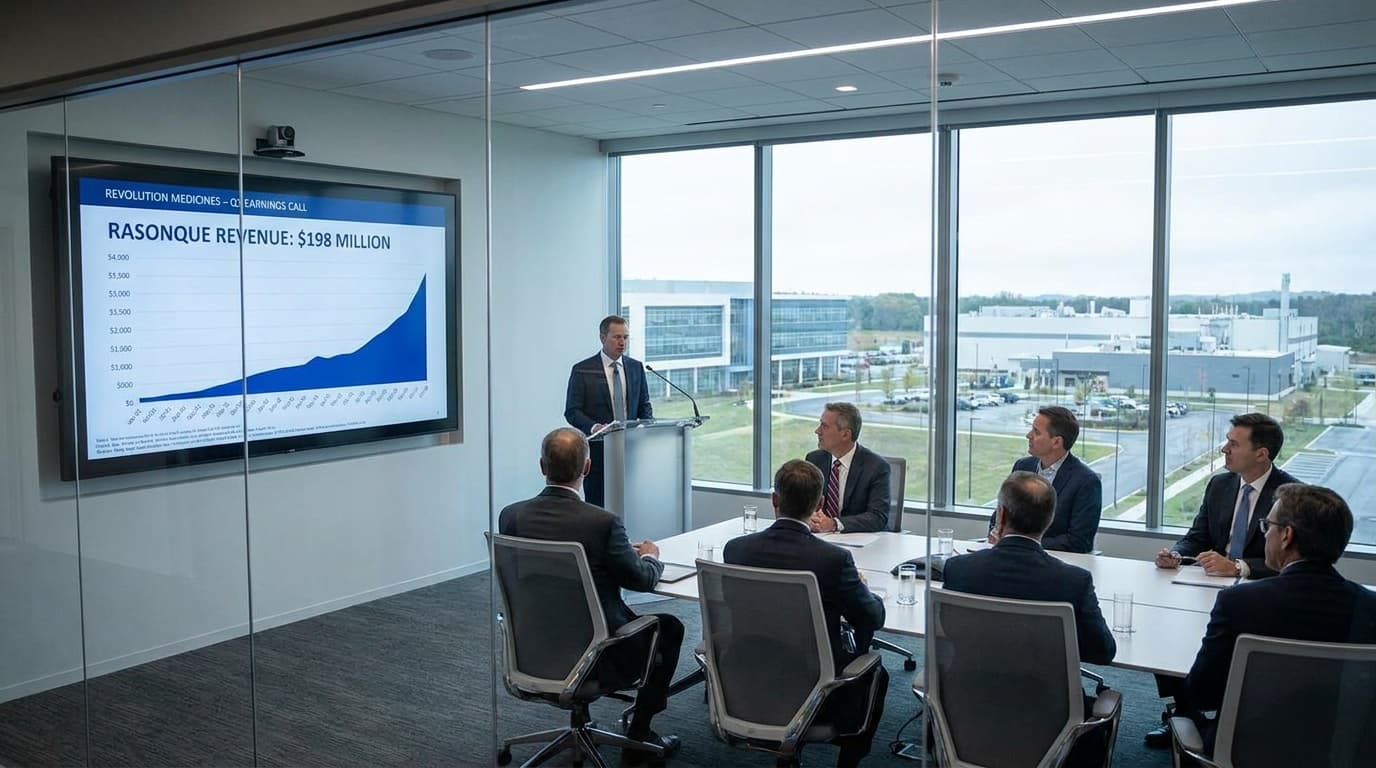
Revolution Medicines reported $198 million in quarterly revenue from Rasonque, despite having only five weeks of sales after the drug’s late August approval. BioSpace said that figure was 10 times Truist Securities’ $19 million estimate, turning the launch into one of the more forceful recent commercial debuts in oncology.
The company said Rasonque has so far reached more than 5,000 patients. Its approved use is in adults with metastatic pancreatic adenocarcinoma who have received at least one prior systemic therapy or are not candidates for multiagent systemic therapy, a setting where patients had few options before the drug’s arrival.
The Commercial Picture
On Revolution Medicines’ earnings call, Chief Global Commercialization Officer Anthony Mancini said demand came from three channels. The first was converting U.S. participants in the Early Access Program into commercial patients, which he said was completed in the quarter. The second was treatment-option-exhausted patients who had been waiting for a new therapy. The third was patients newly diagnosed with second-line disease, where the company said uptake was particularly strong.
Mancini also cautioned against treating the first five weeks as a steady-state run rate. He said it is too early to draw conclusions about the normalized trajectory of the launch, because Early Access Program patients and those who had been waiting for a new option represent a finite group. As commercialization matures, he said, revenue should increasingly reflect newly eligible patients and treatment duration rather than backlog conversion.
That distinction matters more than the headline number. A launch driven partly by pent-up demand can produce an outsized first quarter without guaranteeing the same pace later. Even so, Leerink revised its fourth-quarter sales expectation to $440 million from the prior high-end estimate of $330 million, suggesting some analysts now see the initial demand as more than a one-time release valve.
Mancini added that the company is still working on insurance coverage for Rasonque. At the same time, management pointed to payer engagement and patient support as being in line with expectations during the launch.
What Comes Next
Revolution Medicines reported a net loss of $407.5 million for the third quarter, compared with $305.2 million in the same period a year earlier. The company ended September 30 with $3.7 billion in cash on hand, excluding royalty payments from Royalty Pharma tied to Rasonque sales.
That cash position gives the company room to keep building around the drug. CFO Jack Anders said Revolution Medicines expects to invest further in its RAS(ON) inhibitor portfolio while supporting the Rasonque launch into 2027. Chief Development Officer Alan Sadler said U.S. enrollment recently wrapped in the Phase 3 RASolute 303 trial testing Rasonque alone and with chemotherapy in first-line metastatic pancreatic cancer, and dosing has begun in the Phase 3 RASolute 309 study pairing Rasonque with zoldonrasib in patients with RAS G12D pancreatic cancer.
The company is also running Phase 3 trials RASolute 304 in the adjuvant setting and RASolute 305 in first-line disease, alongside studies in non-small cell lung cancer. Strategically, the launch does more than validate one product: it gives Revolution Medicines commercial funding and clinical momentum as it tries to move Rasonque beyond later-line pancreatic cancer into broader treatment settings and combination use.