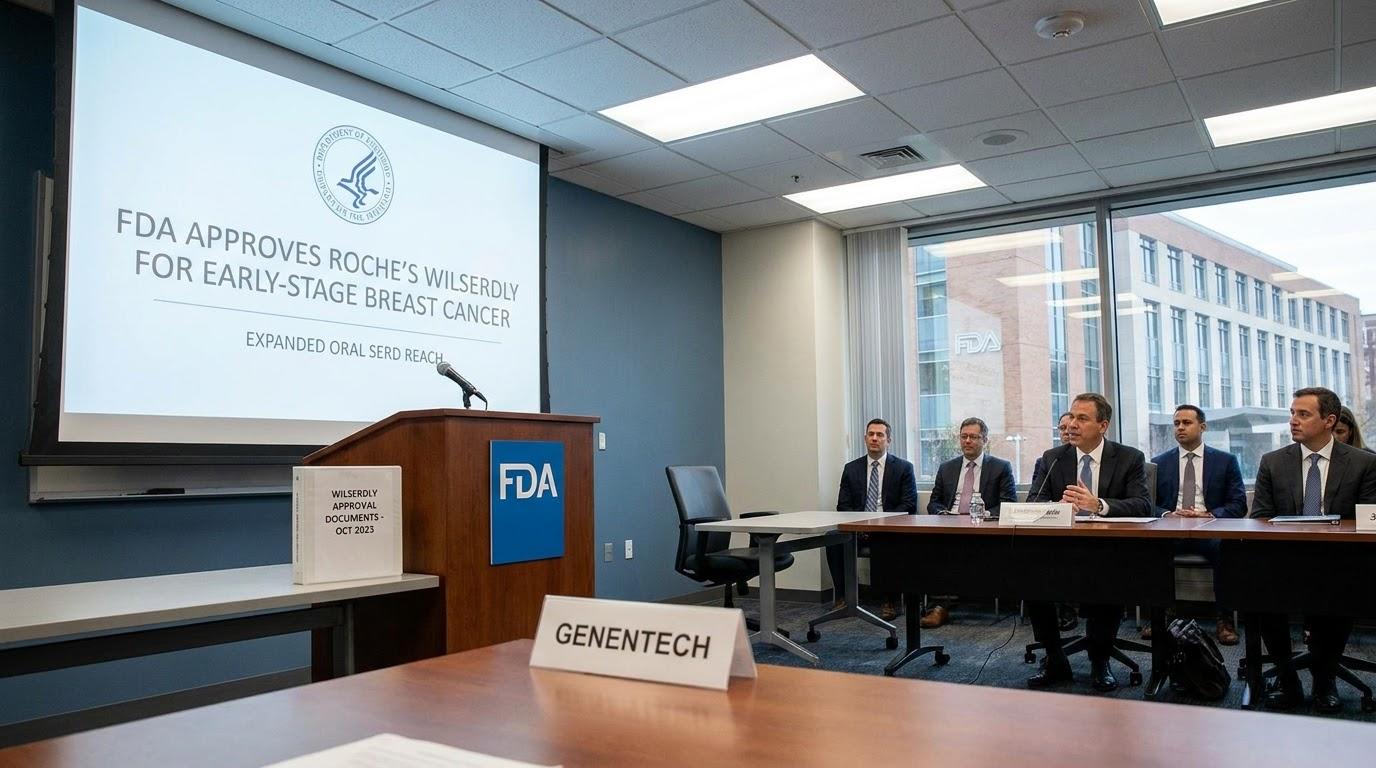
Roche’s Genentech has secured a second FDA approval for Wilserdly in seven days, this time moving the oral selective estrogen receptor degrader into early-stage breast cancer. The agency approved the drug Monday for use alone after surgery in adult patients with estrogen receptor-positive, HER2-negative breast cancer.
That matters because ER-positive, HER2-negative disease is the most common breast cancer subtype, accounting for around 70% of cases, according to the FDA announcement cited in the source report. Roche said Wilserdly is now the first and only SERD approved by the FDA in both early-stage and advanced ER-positive breast cancer, giving the company a differentiated label across two treatment settings rather than a single late-line niche.
The Data
The new approval was backed by the Phase 3 lidERA study. In that trial, Wilserdly, also known as giredestrant, reduced the risk of invasive disease recurrence or death by 30% versus standard of care endocrine therapy, meeting the primary endpoint.
The study enrolled 4,170 patients with ER-positive, HER2-negative breast cancer at intermediate to high risk of recurrence. Patients received either Wilserdly or standard hormone therapy, tamoxifen or an aromatase inhibitor, for up to five years. At three years, 92.4% of patients taking Wilserdly were alive and free of invasive breast cancer, compared with 89.6% of those on standard hormone therapy. The FDA also said patients treated with Wilserdly had a lower risk of cancer returning in another part of the body.
Roche is still following patients to determine whether the treatment extends survival, which is a secondary endpoint and now a post-marketing commitment. That leaves the approval resting on a recurrence-risk benefit rather than a demonstrated overall survival gain.
The safety profile was described by Roche as favorable. Side effects seen in at least 10% of trial participants included muscle and joint pain, hot flashes, tiredness, headache, nausea and slower-than-normal heart rate. The FDA also warned that the drug may harm a developing baby if taken during pregnancy and said pre-menopausal women should take an additional hormone-suppressing medicine along with Wilserdly.
The Road Here
This early-stage decision follows last week’s first FDA approval for Wilserdly in second-line ER-positive, ESR1-mutated advanced breast cancer in combination with the mTOR inhibitor everolimus. That approval was supported by the evERA Breast Cancer study, where the combination significantly prolonged progression-free survival, according to Roche. In the 373-patient trial, the Wilserdly combination delivered an 8.8-month progression-free survival result versus 5.5 months with standard endocrine therapy plus everolimus, a benefit of more than three months.
The one-week sequence gives Roche two usable narratives at once: Wilserdly has shown enough activity for a metastatic approval, but the larger strategic win is the move into earlier disease where treatment duration can run for years. It also helps offset the mixed record around the asset. In March, giredestrant failed to improve progression-free survival in the Phase 3 persevERA Breast Cancer study in first-line ER-positive, HER2-negative, locally advanced or metastatic breast cancer when combined with palbociclib.
Roche Pharmaceuticals CEO Teresa Graham said on a call with journalists, as cited by Reuters in the source report, that Wilserdly has the potential to become the most successful drug in the company’s history. Without giving exact estimates, she said she expects peak sales to be similar to those of Ocrevus, which generated $8.3 billion in 2025. That forecast now depends less on last week’s advanced-disease entry than on whether Roche can convert an early recurrence benefit into durable use in a broad adjuvant market.