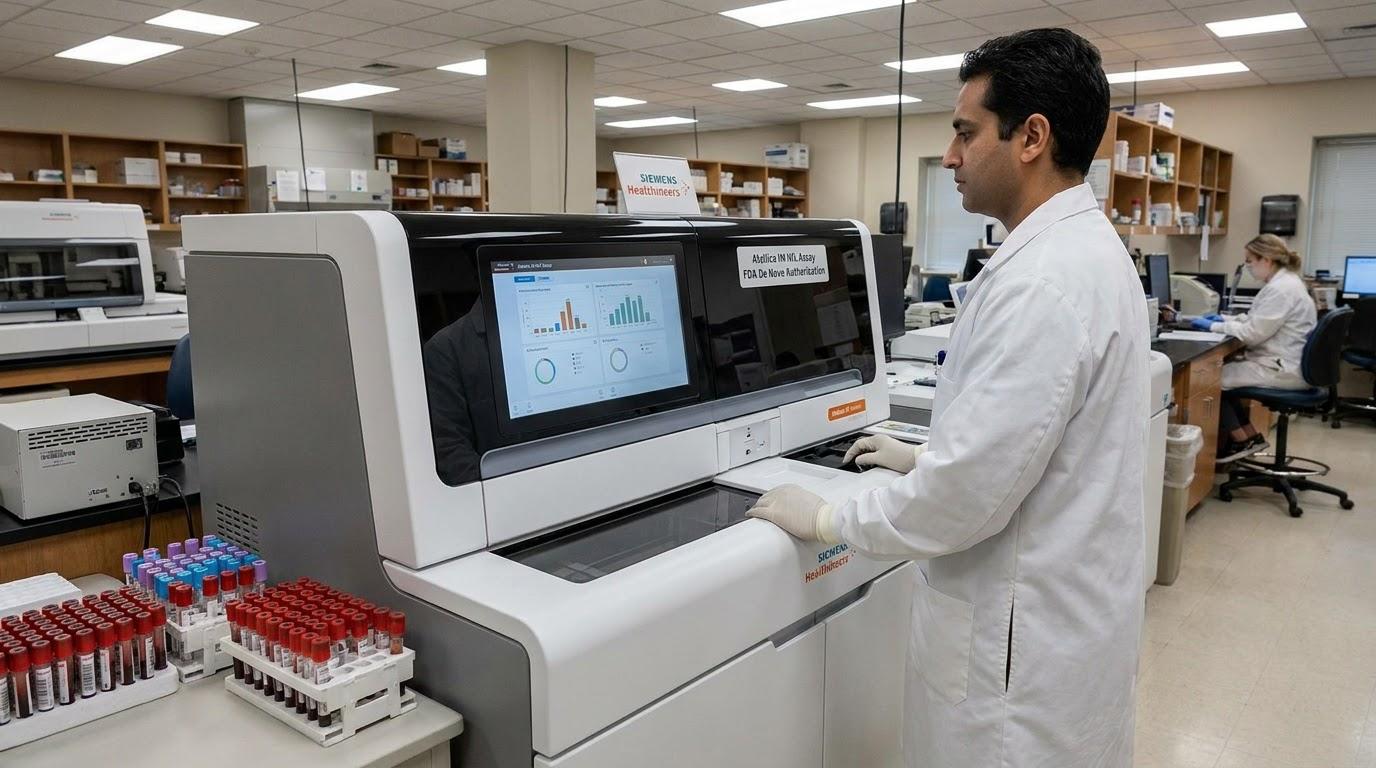
The FDA has given de novo marketing authorization to Siemens Healthineers’ Atellica IM Neurofilament Light Chain, or NfL, assay, clearing a blood test intended to help evaluate ongoing disease activity in patients aged 18 to 55 years with relapsing-remitting multiple sclerosis.
The authorization matters less as a one-off clearance than as a commercial validation of automated neurological biomarker testing in routine lab settings. Siemens Healthineers said the test is already used by clinicians outside the U.S. under CE mark, and the FDA decision extends that model into the U.S. market with a non-invasive tool that can be used alongside other parts of disease assessment.
The test and its use case
Multiple sclerosis monitoring is difficult because important changes are not always visible through clinical observation alone. According to National Multiple Sclerosis Society research cited in the report, MS affects about 1 million people in the United States, and relapsing-remitting multiple sclerosis accounts for 85% of initial diagnoses.
The Atellica IM NfL assay detects and measures neurofilament light chain in blood. When neuroaxonal injury occurs, NfL is released into cerebrospinal fluid and then into the blood, giving clinicians a biomarker tied to ongoing damage. Siemens Healthineers said the assay is intended for use in conjunction with clinical, imaging and laboratory findings rather than as a standalone decision tool.
Technically, the product is a fully automated chemiluminescent sandwich immunoassay run on the Atellica IM Analyzer. It measures NfL in human serum and EDTA plasma. That automation is part of the business case: neurological biomarker testing can be incorporated into an existing laboratory workflow instead of being handled as a specialized manual process.
Why it matters for Siemens Healthineers
The company described the assay as first of its kind for MS. If adoption follows the pattern seen in other automated lab tests, the commercial advantage is not just novelty but placement inside installed analyzer infrastructure, which can lower friction for use in disease monitoring.
The timing also intersects with a corporate transition. After issuing a weaker-than-expected financial outlook for FY2027, Siemens Healthineers recently said it is carving out its underperforming diagnostics business into a standalone company called Olyrian Diagnostics, and that it will change its name to "Healthineers." Sharon Bracken, head of Siemens Healthineers Diagnostics and soon to be Olyrian Diagnostics, said in a statement that the company sees the NfL test as a way to expand access to automated neurological biomarker testing.
The signal from the authorization is that neurology diagnostics can support a broader move toward blood-based monitoring tools that fit standard lab operations. For Siemens Healthineers and its future diagnostics spinout, that is a more durable commercial proposition than a narrowly specialized assay with limited workflow fit.