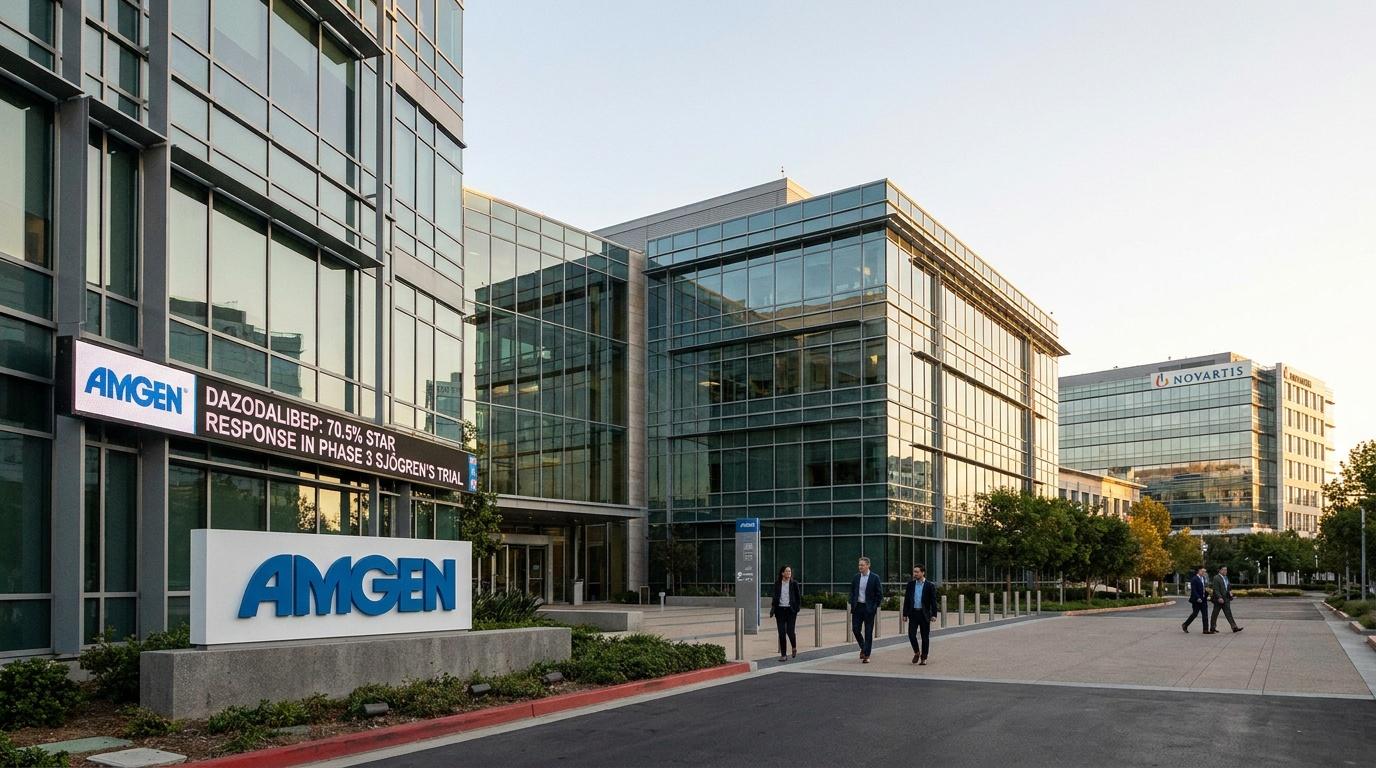
Amgen has released additional phase 3 data on dazodalibep in systemic Sjögren’s disease, expanding on the win it first reported in September. The drug, a CD40L antagonist acquired through the Horizon Therapeutics takeover, had already drawn a strong reaction from TD Cowen, which said the earlier data raised the possibility that Amgen could meet or exceed its $1.8 billion peak sales forecast.
The new detail matters because Sjögren’s remains an area of high unmet need, but it is no longer a blank space. Novartis is already advancing ianalumab with phase 3 data of its own, so Amgen is not only trying to prove efficacy against placebo; it is building the case that dazodalibep can compete in a market where physicians may have more than one option and may cycle between therapies.
The Data
At Week 48, 70% of patients in the monthly dazodalibep cohort achieved at least a three-point improvement on the EULAR Sjögren’s Syndrome Disease Activity Index, compared with 52.8% on placebo. For at least a five-point improvement in ESSDAI, the figures were almost 58% for monthly dazodalibep and 38% for placebo. For a seven-point improvement, the rates were 53.3% and 34.8%, respectively.
Amgen also reported broad domain-level improvement. According to the company’s ACR Convergence presentation, responses in the monthly cohort were at least 10 percentage points higher than placebo across constitutional, lymphadenopathy, glandular, cutaneous and biological domains. Articular and hematological results also favored dazodalibep, although the gap versus placebo was smaller.
On the Sjögren’s Tool for Assessing Response, or STAR, Amgen reported another separation from placebo. At Week 48, 70.5% of patients on monthly dazodalibep were STAR responders, compared with 42% on placebo.
The Commercial Picture
The updated readout deepens the setup for a direct rivalry with Novartis. One year ago, Novartis reported phase 3 data on ianalumab in Sjögren’s, and this week it shared updated Week 108 findings at ACR Convergence showing that ESSDAI reductions deepened over time.
Fierce Biotech reported that, after adjusting for placebo, Amgen’s Week 48 ESSDAI reductions were numerically larger than what Novartis has reported. Even so, Guggenheim Securities said this week that unmet need could still give ianalumab “a strong launch base.” Guggenheim also said Novartis expects some cycling between therapies, especially given disease heterogeneity. That framing suggests the market may support multiple entrants if efficacy holds up across different patient subsets rather than rewarding only the first launch.
What To Watch
A key missing piece is Amgen’s phase 3 dataset in symptomatic Sjögren’s disease, which is due this year. On an earnings call last week, Jay Bradner, M.D., executive vice president of R&D at Amgen, said it is difficult to define what success in the systemic trial means for the symptomatic study because the patient populations differ.
TD Cowen took a more confident view, saying the data in the ACR abstract increased its confidence in the upcoming readout. That next dataset may determine whether dazodalibep is seen as a strong single-indication asset or a broader franchise contender in Sjögren’s.