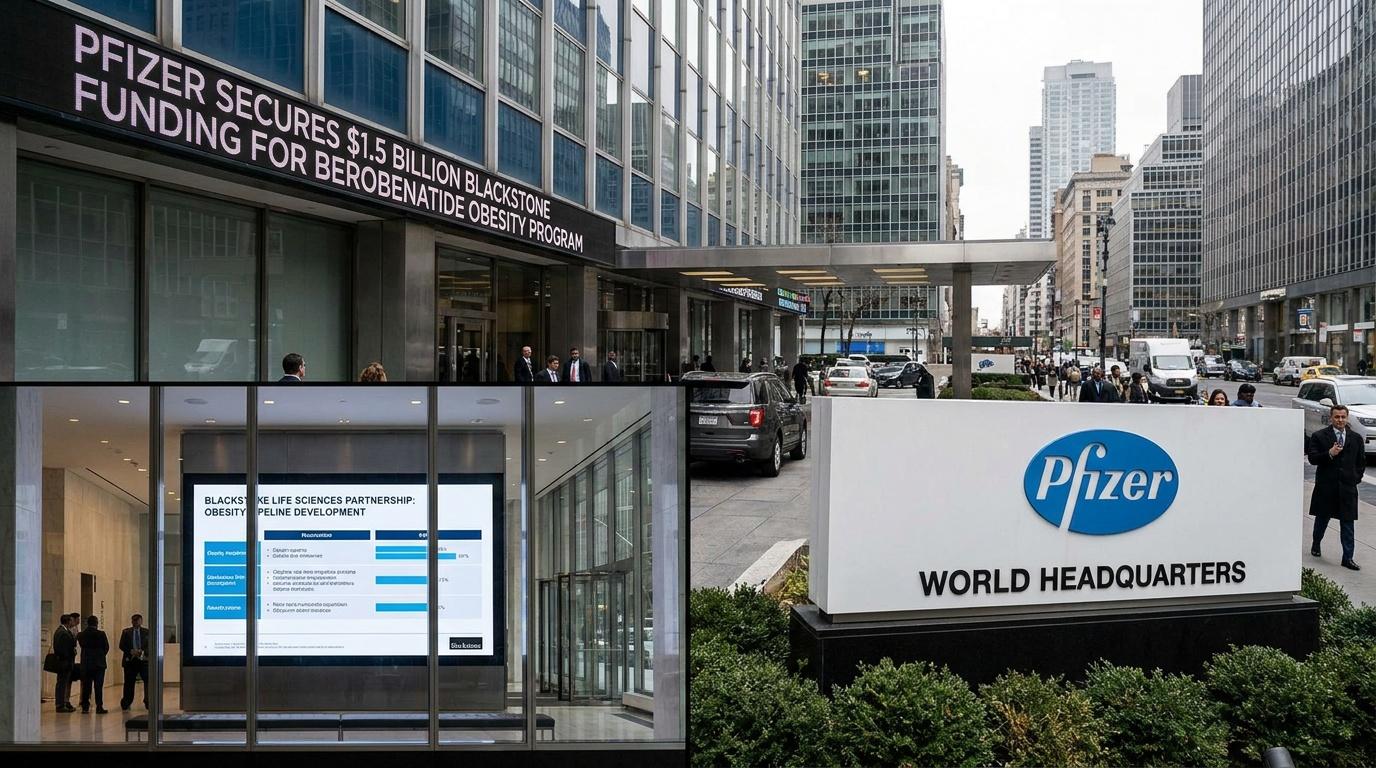
Pfizer has secured up to $1.5 billion from Blackstone Life Sciences to support development of berobenatide, its monthly GLP-1 receptor agonist for obesity, with Blackstone agreeing to fund development costs through 2028.
In return, Blackstone could receive milestones tied to U.S. approval of monthly monotherapy berobenatide for chronic weight management and to the achievement of commercial sales targets. Neither company disclosed the size of those milestones. Pfizer retains full operational control and decision-making for the program.
The deal is a financing move as much as a development one. Pfizer has already committed to a broad late-stage push in obesity, and bringing in outside capital lets it keep that bet in place while reducing the immediate burden on its own cash flows. That matters because the company is trying to build a meaningful obesity franchise as it also prepares for loss of exclusivity on key products.
The Development Program
Berobenatide is the asset Pfizer acquired in its $9.8 billion takeover of Metsera. Formerly called MET 097i, it is now being advanced in a 10-trial phase 3 program.
Pfizer began the first of those 10 phase 3 trials in December and aims to launch the product in 2028. The company is racing to close the gap on Eli Lilly and Novo, making development speed and balance-sheet capacity tightly linked strategic issues rather than separate ones.
Blackstone’s commitment specifically covers development costs through 2028, which lines up with Pfizer’s stated launch objective. The structure suggests Pfizer wants to avoid slowing the program even as R&D spending rises.
The Financial Rationale
Pfizer said adjusted R&D expenses increased 18% operationally in the third quarter as it invested in priority oncology and obesity programs. The company also added $300 million to both ends of its forecast full-year R&D spending range this month.
BMO Capital Markets called the agreement “a modest positive for Pfizer” and said the structure “meaningfully offsets near-term development spending.” The firm added that the timing is attractive because of cash-flow pressure associated with Pfizer’s approaching patent-expiration cycle, while still allowing the company to keep investing behind what BMO described as a potentially important obesity franchise.
The tradeoff is that some future economics may now be shared if berobenatide succeeds. BMO said the undisclosed milestone terms make it hard to quantify the impact on Pfizer’s longer-term cash generation if the drug becomes a successful commercial product.
A Familiar Funding Model
Drugmakers have repeatedly used Blackstone financing to shift part of development spending off their books. Last year, Pfizer also partnered with Blackstone to receive up to $326 million through 2028 to co-fund development costs for specified treatments. One year ago, Merck & Co. tapped Blackstone for up to $700 million to test sacituzumab tirumotecan, and in February, Johnson & Johnson secured funding for bleximenib.
That history makes the berobenatide agreement notable less as a one-off capital raise than as another sign that large, expensive late-stage programs can be financed with private capital without changing who controls the asset. For Pfizer, that is the core benefit: it keeps the obesity program moving at scale, but does not require the company to surrender operational authority to do it.