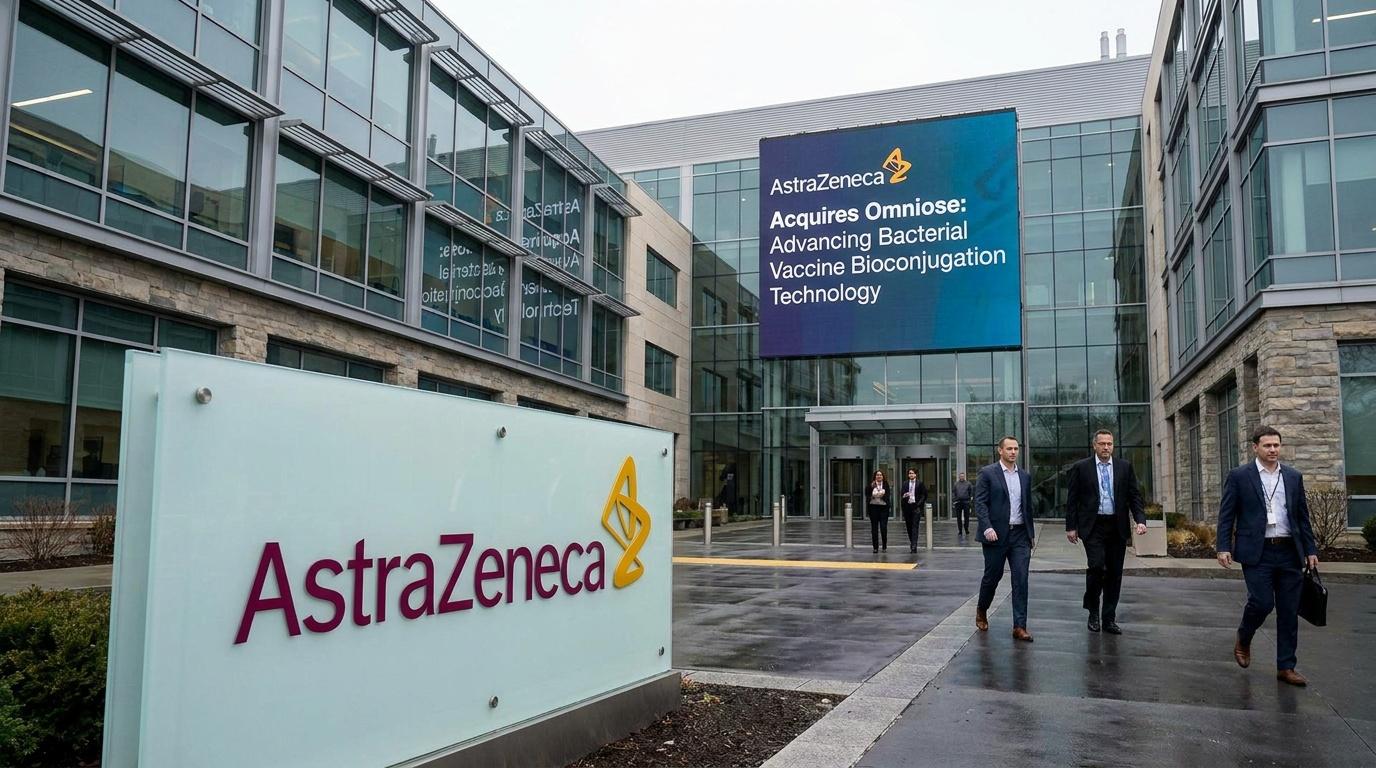
AstraZeneca has acquired Omniose, a vaccine bioconjugation specialist it has worked with since January 2024, and will make the company a wholly owned subsidiary within its infectious disease unit. Financial terms were not disclosed.
The two companies had been collaborating under a three-year pact focused on vaccines against bacterial pathogens, including multidrug-resistant “superbugs.” By buying Omniose as that alliance draws to a close, AstraZeneca is moving from partnership access to full ownership of the underlying technology and expertise.
Why The Platform Matters
Conjugate vaccines are an established approach, with the first glycoconjugate vaccine reaching the U.S. market in 1987. They work by linking a polysaccharide to a protein carrier and have been effective against pathogens including Haemophilus influenzae.
The problem, according to the source report, is production complexity. Standard chemical methods for attaching bacterial polysaccharides to engineered carrier proteins can be difficult to execute. Bioconjugation aims to simplify that process by coupling the components inside bacterial cells.
AstraZeneca said Omniose’s platform represents a differentiated approach to engineering conjugate vaccines. Omniose has designed the technology to be more versatile than other bioconjugation systems and has applied it to pathogens including Klebsiella pneumoniae, where it reported durable responses in mice.
Strategic Context
This acquisition fits an area where large drugmakers have previously paid for enabling vaccine technology rather than only individual assets. GSK bought bioconjugation technology through its $190 million acquisition of GlycoVaxyn in 2015. Sanofi also paid Johnson & Johnson $175 million upfront in 2023 to co-develop a bioconjugate vaccine, though that program stopped in 2025 after an interim analysis of phase 3 data showed insufficient efficacy.
That mixed precedent makes AstraZeneca’s move notable. The company is not buying into a proven commercial outcome for every bioconjugate effort, but into a production and design approach it believes can strengthen its ability to develop novel vaccines against serious bacterial infections.
Omniose’s prior funding history also suggests AstraZeneca is taking over a platform that was still relatively grant-backed rather than heavily financed through private capital. The National Institutes of Health provided $3.6 million in 2022 for Klebsiella pneumoniae vaccine research and development and committed up to $3 million to a Group B Streptococcus project in 2023.
The signal for the industry is that vaccine competition against bacterial threats still depends heavily on platform control. AstraZeneca appears to be betting that owning a manufacturing-enabling technology can improve the odds of generating differentiated bacterial vaccine candidates, especially in areas where resistance and pathogen complexity make conventional approaches harder to scale.