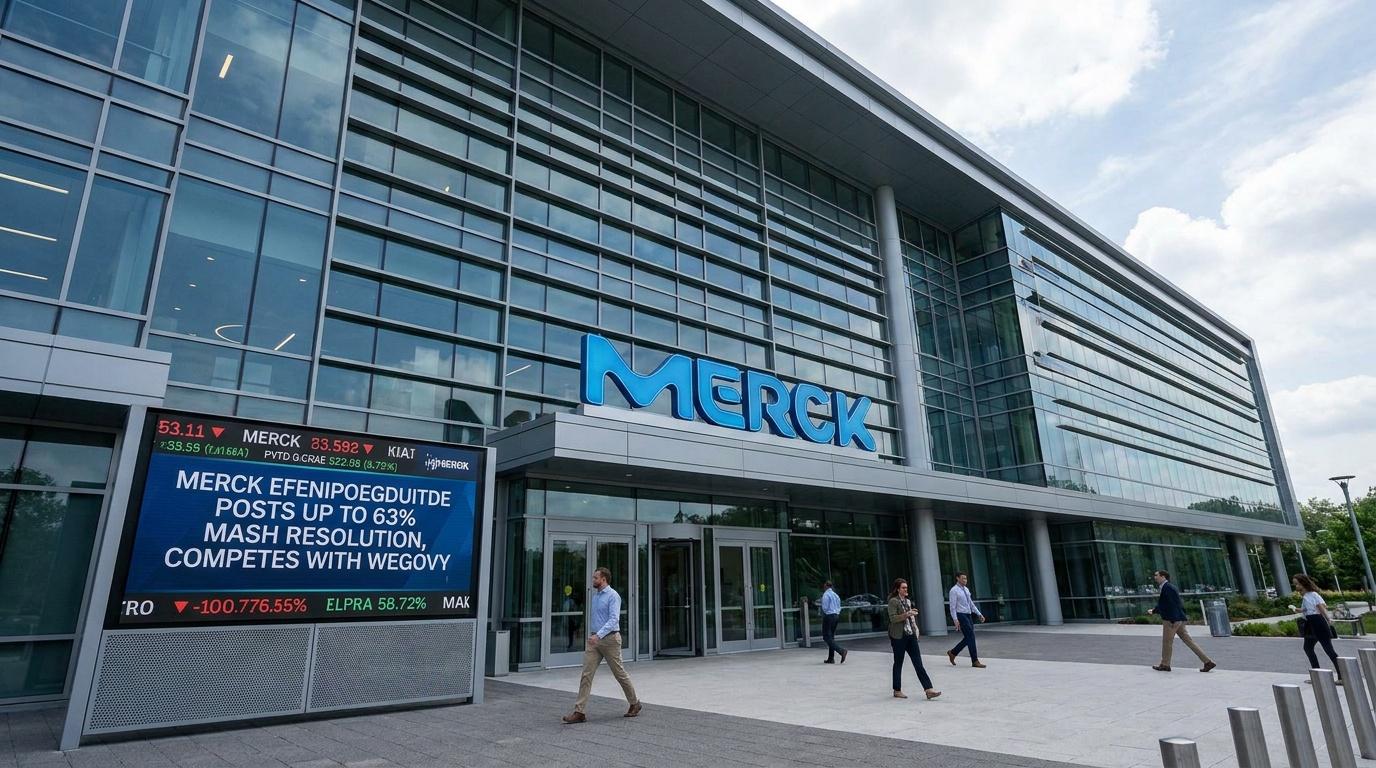
Merck & Co. reported a mid-stage win for efinopegdutide in metabolic dysfunction-associated steatohepatitis, adding clinical support to a program that could give the company a differentiated entry into the GLP-1 market through liver disease rather than obesity alone.
In the phase 2b MK-6024-013 trial, efinopegdutide resolved MASH without worsening liver fibrosis in 56% of patients at 4 mg, 63% at 7 mg and 61% at 10 mg after 52 weeks, versus 13% on placebo. The study enrolled 386 patients with MASH and stage F2 or F3 fibrosis.
The Data
Efinopegdutide is a subcutaneously injected GLP-1 and glucagon receptor co-agonist. Merck said the study met its primary endpoint using the Non-alcoholic Steatohepatitis Clinical Research Network scoring system.
The company also reported meaningful improvements in fibrosis without worsening of MASH. Response rates were 43%, 52% and 34% across the three efinopegdutide doses, compared with 21% for placebo.
Merck included a research arm in which patients received Novo’s semaglutide at 2.4 mg. In that arm, 53% achieved the MASH resolution endpoint without worsening of fibrosis.
On safety, Merck said efinopegdutide looked similar to semaglutide. The source described nausea, diarrhea and vomiting leading to single- to low-double-digit discontinuation over the year-long study.
The Commercial Picture
The strategic value of this readout is that MASH offers Merck a more specific competitive lane inside the crowded GLP-1 category. While blockbuster GLP-1 products such as Novo’s Ozempic and Wegovy and Eli Lilly’s Mounjaro and Zepbound have been built on weight loss, a liver disease label could help efinopegdutide stand apart if later-stage data hold up.
Novo’s Wegovy is the only GLP-1 approved for MASH, having received FDA approval last year. Merck is therefore not first to market, but the new data suggest it still sees room to compete on efficacy in a defined patient population.
That positioning builds on Merck’s earlier 2024 phase 2 data, when the company said efinopegdutide reduced liver fat content by 72.7% over eight months compared with 42.3% for Ozempic in patients with MASH, then referred to as nonalcoholic fatty liver disease.
The Road Here
Merck licensed efinopegdutide from Hanmi Pharmaceutical in 2020 for $10 million. Hanmi had previously acquired the asset from Johnson & Johnson in 2015 for $105 million after it had been dropped from J&J’s pipeline.
That history matters because it shows how far the program has moved from a discarded asset to a mid-stage contender in one of biopharma’s busiest metabolic categories. For Merck, the latest data do not settle the competitive hierarchy in MASH, but they do make efinopegdutide more credible as a liver-focused growth bet.