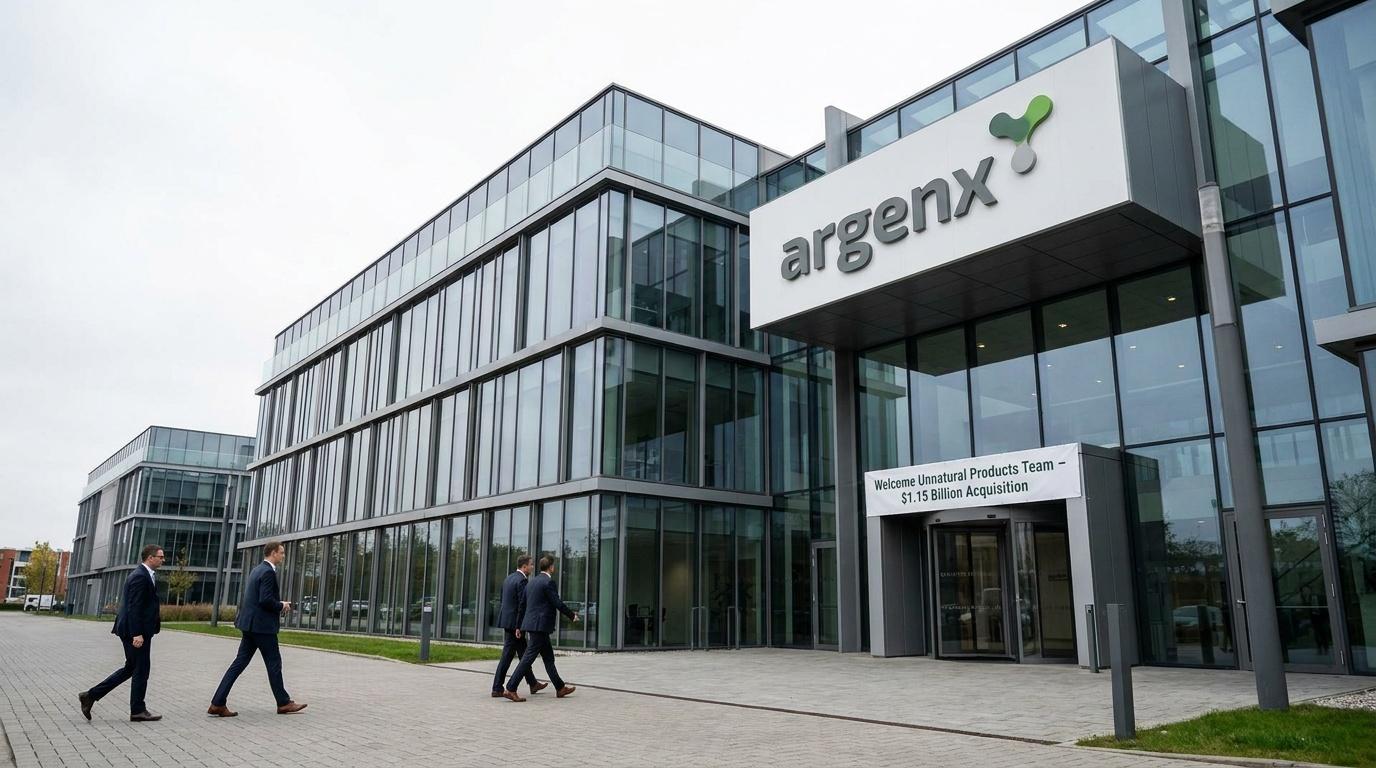
Argenx is acquiring Unnatural Products, or UNP, in a deal worth $550 million upfront and up to $1.15 billion including development and regulatory milestones and contingent value rights tied to certain milestones. The buyer already held a minority stake in UNP and had been working with the biotech for more than two years before deciding to bring the platform in-house.
The companies said the rationale is to pair argenx’s immunology antibody engineering capabilities with UNP’s macrocyclic peptide discovery engine to develop oral or long-acting therapies for serious immune-mediated diseases. That matters strategically because argenx is best known for antibody work around Vyvgart, and this transaction adds a modality aimed at targets that have been harder to drug with conventional approaches.
The Deal Structure
Argenx said UNP’s team will continue to operate from Santa Cruz, California, which will become the company’s macrocyclic peptide discovery hub. The existing UNP organization will continue to lead discovery work within argenx, while the parent company adds clinical development and commercialization support. Fierce Biotech reported that UNP employs more than 50 people.
The acquisition follows a July 2025 partnership between the companies worth up to $1.5 billion in future milestones. Under that alliance, UNP used its macrocyclic peptide delivery platform to generate candidates against undruggable targets selected by argenx. Buying the company now converts a large external collaboration into internal platform capacity, which can give argenx more control over how quickly it moves from target selection into candidate creation.
Why UNP Drew Multiple Suitors
UNP was founded in 2016 by researchers at the University of California, Santa Cruz, and originally operated out of Chief Scientific Officer Joshua Schwochert’s garage, according to BioSpace. Led by CEO Cameron Pye, the biotech built a platform designed to repeatedly engineer drug-like macrocycles at scale. Fierce Biotech described the engine as combining AI-guided design, massively parallel synthesis and direct-to-biology screening.
The company had already attracted several large partners before the sale. Earlier this year, Novartis agreed to pay $100 million upfront and up to $1.7 billion in milestones to develop medicines for undruggable cardiovascular targets. In 2024, Merck agreed a $220 million oncology collaboration with UNP, and BridgeBio also has a long-term partnership with the biotech. UNP additionally raised $45 million in a series B financing in March, with participation from Merck’s venture capital arm and argenx.
That history suggests argenx was not buying an untested platform concept. It was buying an asset that other drugmakers had already validated through partnership dollars, while moving to secure differentiated peptide capability before it became even more expensive or strategically unavailable.
The Broader Buildout
The transaction fits a wider business development push at argenx. Fierce Biotech noted that in July the company agreed to buy Forte Biosciences for $2.2 billion, gaining anti-CD122 antibody FB102, which is in mid-phase development for vitiligo and celiac disease. Read alongside the UNP deal, argenx appears to be using its Vyvgart foundation to expand both pipeline breadth and technology breadth rather than staying narrowly centered on antibody lifecycle management.