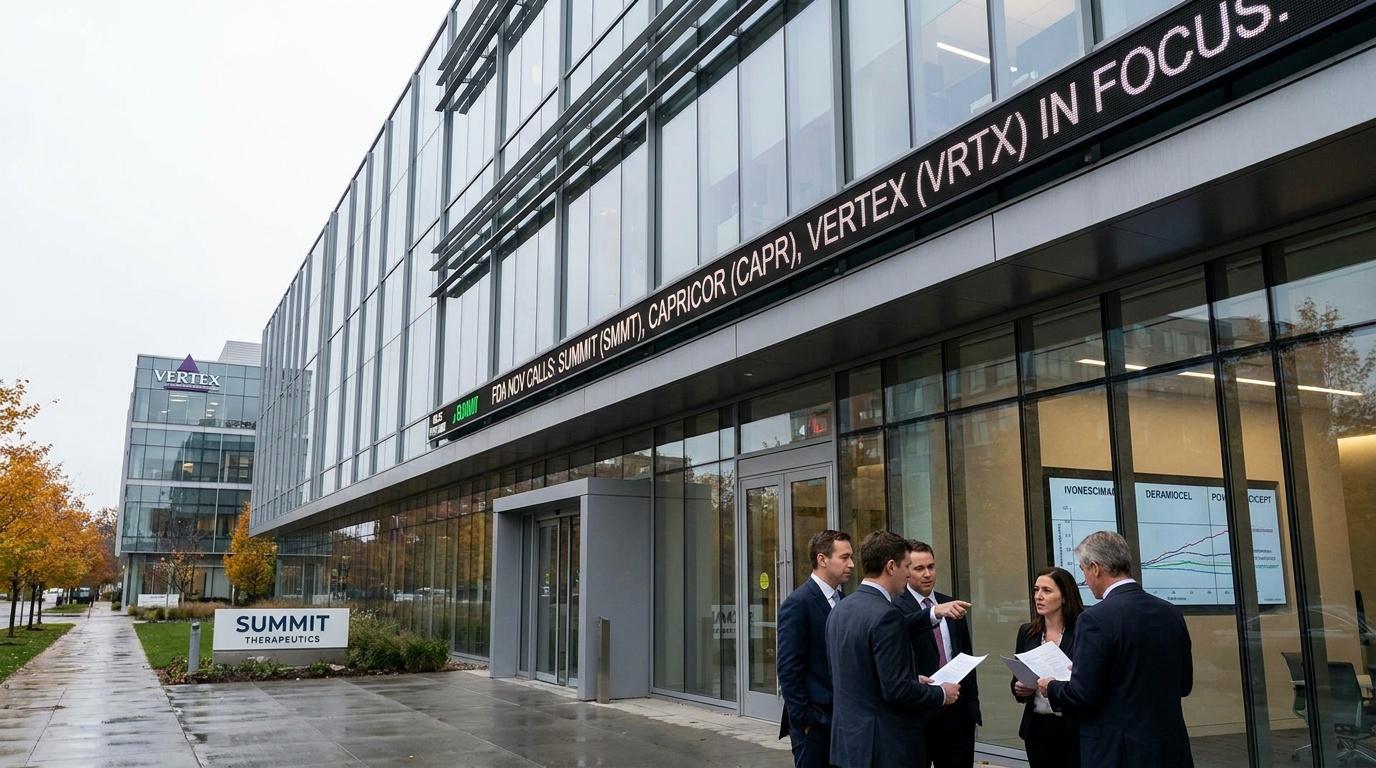
November is set to be a heavy decision month for the FDA, with BioSpace reporting at least 11 target action dates in the coming weeks. Among them, three stand out for the strategic range they represent: Summit Therapeutics and Akeso’s ivonescimab in non-small cell lung cancer, Capricor Therapeutics’ deramiocel in Duchenne muscular dystrophy, and Vertex Pharmaceuticals’ povetacicept in IgA nephropathy.
The setup is not just a calendar story. Each application tests a different part of the late-stage playbook: whether a high-profile oncology asset can get through despite earlier concern about overall survival, whether a company can recover from a bruising and prolonged review path, and whether a large-cap biotech can enter a market after rivals have already helped validate it.
The Road Here
Summit and Akeso are awaiting an FDA decision by Nov. 14 on ivonescimab for EGFR-mutated NSCLC. If approved, the drug would become the first PD-1xVEGF bispecific antibody on the U.S. market. Summit, which holds U.S. rights, is supporting the filing with data from the global Phase 3 HARMONi trial.
Capricor faces a Nov. 22 decision on deramiocel in Duchenne muscular dystrophy after what BioSpace characterizes as a regulatory rollercoaster. The company first sought approval in DMD cardiomyopathy, but the FDA rejected that application in July 2025 after a canceled advisory committee meeting. The rejection letter cited manufacturing issues and the need for additional data. Capricor resubmitted after generating Phase 3 HOPE III data, and the FDA accepted the filing in March.
Vertex is under review through Nov. 30 for povetacicept in IgA nephropathy. For Vertex, approval would mark entry into the renal category, extending the company beyond its established base and into a market where competitors have already been building physician awareness.
The Data
Ivonescimab’s main support comes from the HARMONi study. Data released in May 2025 showed that ivonescimab plus chemotherapy significantly improved progression-free survival versus placebo plus chemotherapy, meeting one of the trial’s primary endpoints. At that time, overall survival fell short of statistical significance, which raised questions because the FDA had previously told Summit that a significant OS benefit would be needed for approval. An additional analysis presented in September showed a nominally significant OS benefit in the overall global population.
For deramiocel, Capricor has relied on the Phase 3 HOPE III trial, which in December 2025 showed improvement in upper-limb function on the primary endpoint. Capricor also said deramiocel met a key secondary endpoint on slowing deterioration of cardiac function decline, though the FDA later disputed that claim. Earlier this year, the company added 24-month open-label HOPE-3 data and narrowed the proposed indication to focus on upper limb function rather than cardiac function. Those amendments triggered a three-month delay, moving the action date from Aug. 22 to Nov. 22.
Povetacicept is backed by the placebo-controlled Phase 3 RAINIER study. In March, RAINIER showed a significant reduction in urine protein-to-creatinine ratio at 36 weeks, the trial’s primary outcome and a biomarker of kidney function. BioSpace cited BMO Capital Markets calling those results “strong” in a May 4 note.
Competitive And Strategic Readthroughs
The three cases differ sharply in how much regulatory risk now sits outside the headline efficacy result. Dara Azar, associate vice president of Biotech Equity Research at Stifel, told BioSpace earlier this month that he does not expect ivonescimab to run into major regulatory snags, and the drug is already approved in China for various NSCLC indications. Even so, the asset’s U.S. review has been shaped by the tension between progression-free survival success and the FDA’s previously stated overall survival expectation.
Capricor’s challenge is more procedural and interpretive. The company has already been rejected once, then took a 9–3 negative vote from FDA advisors in July after what BioSpace described as a contentious discussion. The panel called the efficacy evidence “very fragile,” while CEO Linda Marbán said the dispute centered on the statistical analysis plan the agency used in reviewing deramiocel. That makes this a test of whether indication narrowing and added follow-up can overcome an unfavorable advisory read.
Vertex enters a different setup: not first, but potentially better positioned because the category now has more commercial groundwork. BioSpace notes that recent IgAN approvals include Novartis expanding Fabhalta into IgAN in July and Vera Therapeutics winning approval for atacicept, now named Trutakna, just days earlier. BMO argued in a July 17 note that those approvals strengthen its conviction in povetacicept because competing manufacturers are increasing education and awareness.
The signal across all three is that November’s FDA slate is not just about binary outcomes. It is about how much residual uncertainty companies can carry into review and still convert strong or promising datasets into approvals that alter their next phase of growth.