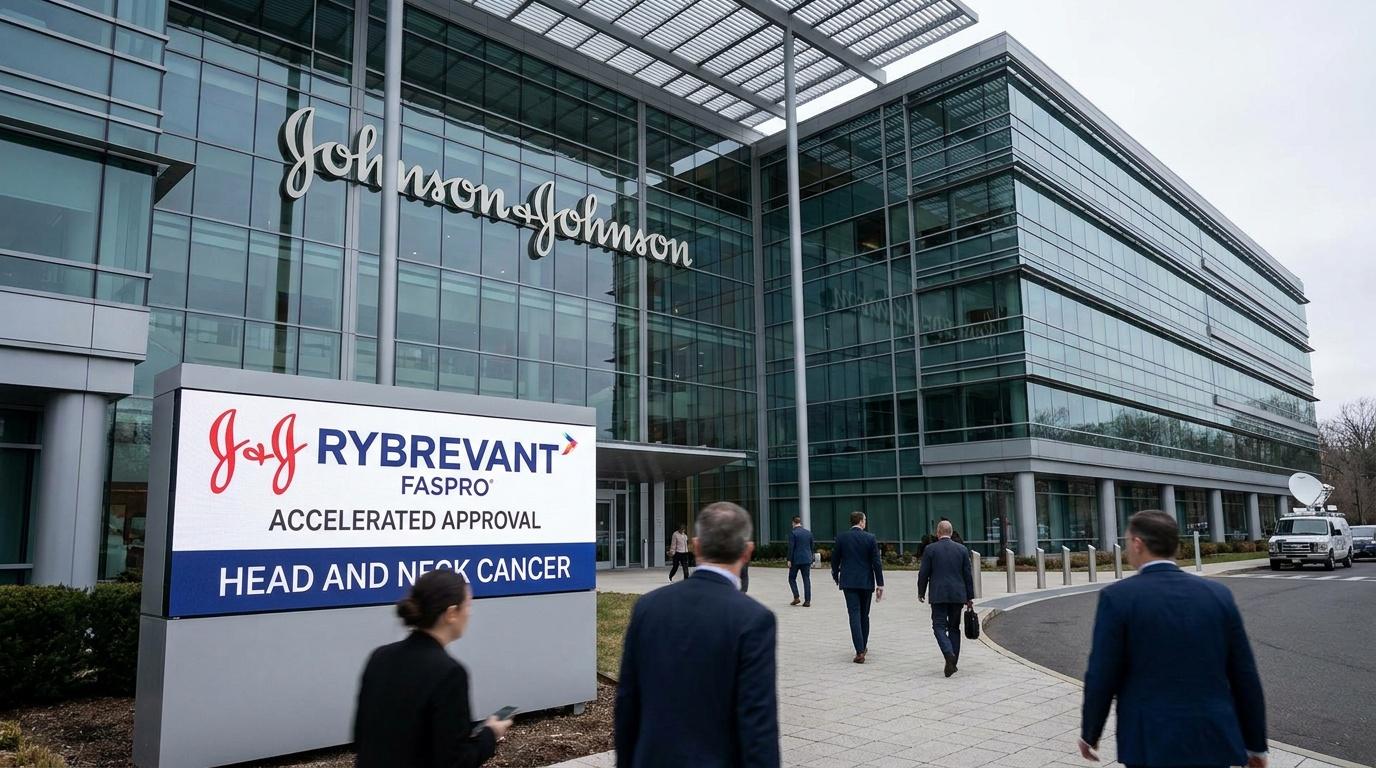
Johnson & Johnson has secured FDA accelerated approval for Rybrevant Faspro in head and neck squamous cell carcinoma, adding a new use for a bispecific antibody franchise the company has already established in lung cancer. The approval covers use as a single-agent treatment for adults whose cancer has progressed on or after receiving the chemotherapies and immunotherapies that currently make up the standard of care.
The decision matters beyond a simple label addition. Head and neck squamous cell carcinoma remains an aggressive cancer with limited treatment options, and J&J is now extending one of its core oncology assets into a setting where a differentiated mechanism and a faster administration format could matter operationally as well as clinically.
The data
Rybrevant is designed to block EGFR and MET, two receptors overexpressed in some cancers. The strategy behind the bispecific approach is to address resistance that can develop when only one of those targets is inhibited.
The head and neck cancer approval is based on Phase 1b/2 results showing a 42% overall response rate. Those results also included a complete response in 15% of patients, while 56% of patients who responded maintained that response for more than six months.
FDA said the approval in head and neck cancer does not include treatment of patients with oropharyngeal squamous cell carcinoma associated with human papillomavirus, which the agency described as a known driver of cancers in the mouth and throat.
Because the decision is an accelerated approval, the current label rests on an earlier-stage efficacy package rather than a completed confirmatory program. That keeps some execution risk in place, but the response profile was strong enough to move the drug into the market now.
The product and franchise picture
Rybrevant Faspro is the subcutaneous formulation of Rybrevant, made with technology from Halozyme that enables antibody delivery by injection rather than intravenous infusion. According to the source report, the injectable version takes about five minutes to dose, versus two to five hours for a Rybrevant infusion.
That difference is commercially relevant because administration time can affect clinic workflow and patient throughput, especially for oncology products that compete not only on efficacy but also on treatment burden. In practice, J&J is no longer just broadening Rybrevant by tumor type; it is also packaging the franchise in a format that may be easier to use.
The company had already won FDA approval last December for Rybrevant Faspro across all then-existing indications for IV-infused Rybrevant. This latest decision adds a new disease setting to that subcutaneous version rather than merely converting patients from infusion to injection.
Rybrevant was initially approved in 2021 for non-small cell lung cancers harboring an EGFR mutation. In 2024, the FDA approved J&J’s Lazcluze, an oral small molecule EGFR inhibitor, for use together with Rybrevant, a combination intended to provide better EGFR coverage to help prevent drug resistance.
J&J has already tied the franchise to its broader growth strategy in oncology. For the first nine months of 2026, the company reported $866 million in global Rybrevant/Lazcluze sales, up 67.4% from the same period in the prior year. J&J has previously projected that Rybrevant could reach $5 billion in peak sales.
What to watch
A Phase 3 trial is ongoing. In addition to serving as the confirmatory study required for the accelerated approval, the trial could also support expansion into first-line treatment of head and neck cancer.
That gives this approval two layers of significance. Near term, J&J gets a new commercial foothold in a difficult cancer setting. Longer term, the company now has a chance to move the asset earlier in treatment and further validate whether its EGFR/MET bispecific strategy can travel beyond the lung cancer base where the franchise was built.