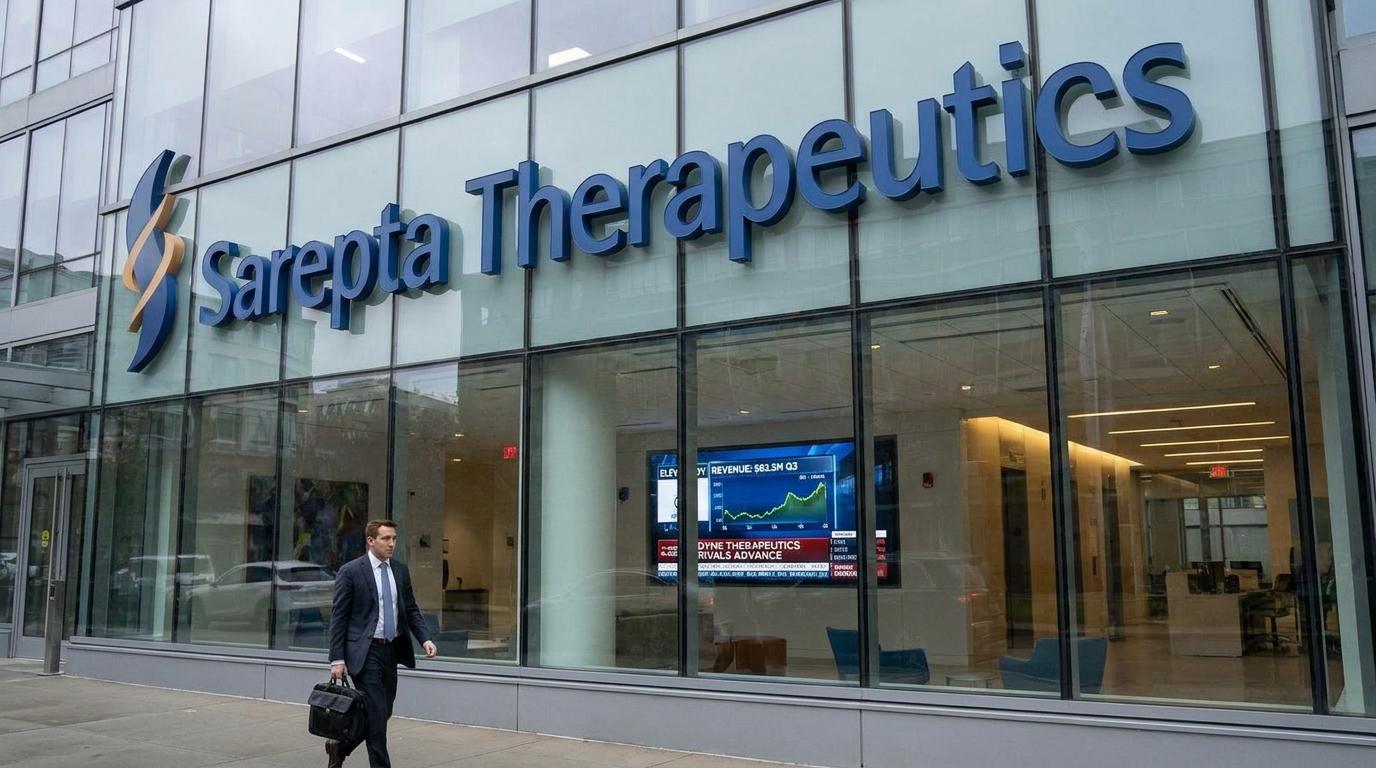
Sarepta Therapeutics used its latest earnings call to make a strategic case that better clinical execution, not just new assets, is central to restoring confidence in the business. New CEO Michael Severino said the company’s emphasis on larger effect sizes and more experienced clinical trial sites has improved its ability to run studies in Duchenne muscular dystrophy and other neuromuscular diseases.
That argument arrives as Sarepta is still working through the fallout from 2025 safety controversies in its gene therapy programs and as competition in DMD is getting closer. It also comes with financial pressure: Elevidys generated $83.5 million in net revenue for the quarter, above William Blair’s $81.5 million estimate but below consensus of $95.4 million, and down from $131.5 million in Q3 2025 and $181 million in the same period a year earlier.
The Commercial Picture
Severino said Sarepta believes it can compete even if Dyne Therapeutics wins approval for zeleciment rostudirsen, or z-rostudirsen, by January 21, 2027. The exon skipper is under review for patients with DMD who are amenable to exon 51 skipping and would compete directly with Sarepta’s Exondys 51.
Oppenheimer said in July that z-rostudirsen is likely to be approved and is poised to capture the majority of market share. Sarepta’s response is to lean on its installed commercial infrastructure and long history in the category. Severino said the company has a very long track record of safety and demonstrated functional improvements based on long-term, real-world data, and argued that broad switching of stable patients is not likely early on because commercial footprint, reimbursement codes and reimbursement navigation take time to establish.
He did, however, acknowledge that a competitor could begin eroding Sarepta’s market share in the second half of 2027, depending in part on the eventual label.
On Elevidys, William Blair said key leading indicators and enrollment forms were in line with the second quarter, which the firm interpreted as evidence that the franchise is stabilizing. The company also said physician willingness to treat has increased and that families are resuming treatment journeys after pausing them. About 1,500 patients have been treated.
The Road Here
Severino inherited a company emerging from a difficult stretch. In 2025, multiple deaths were linked to Sarepta’s gene therapy programs, including Elevidys, and sales fell as the therapy’s benefit-risk profile came under scrutiny.
Before Severino arrived, then CEO Doug Ingram had already started reshaping the pipeline. In November 2024, Sarepta signed a major deal with Arrowhead Pharmaceuticals that brought in an siRNA modality and shifted much of the company’s focus away from gene therapy.
Sarepta is also still in front of the FDA with Vyondys 53 and Amondys 45, seeking full approval for the DMD exon skippers after both had previously received accelerated approval. Both failed confirmatory trials in November 2025, but Sarepta resubmitted the package and expects a decision in February 2027.
What To Watch
Severino expressed confidence in the Arrowhead-derived siRNA programs, with Sarepta preparing to start registrational studies for SRP-1003 in myotonic dystrophy type 1 and SRP-1001 in facioscapulohumeral muscular dystrophy. Multiple ascending dose data for both are expected by the end of this year.
The broader signal is that Sarepta is trying to reposition itself from a company defined by gene therapy turbulence to one defined by operational discipline across modalities. Whether that holds will depend on three things the sources tie directly to execution: the durability of Elevidys stabilization, the FDA outcome for Vyondys 53 and Amondys 45, and whether the siRNA programs produce data strong enough to support the company’s claim that it now knows how to run cleaner, more effective registrational studies.