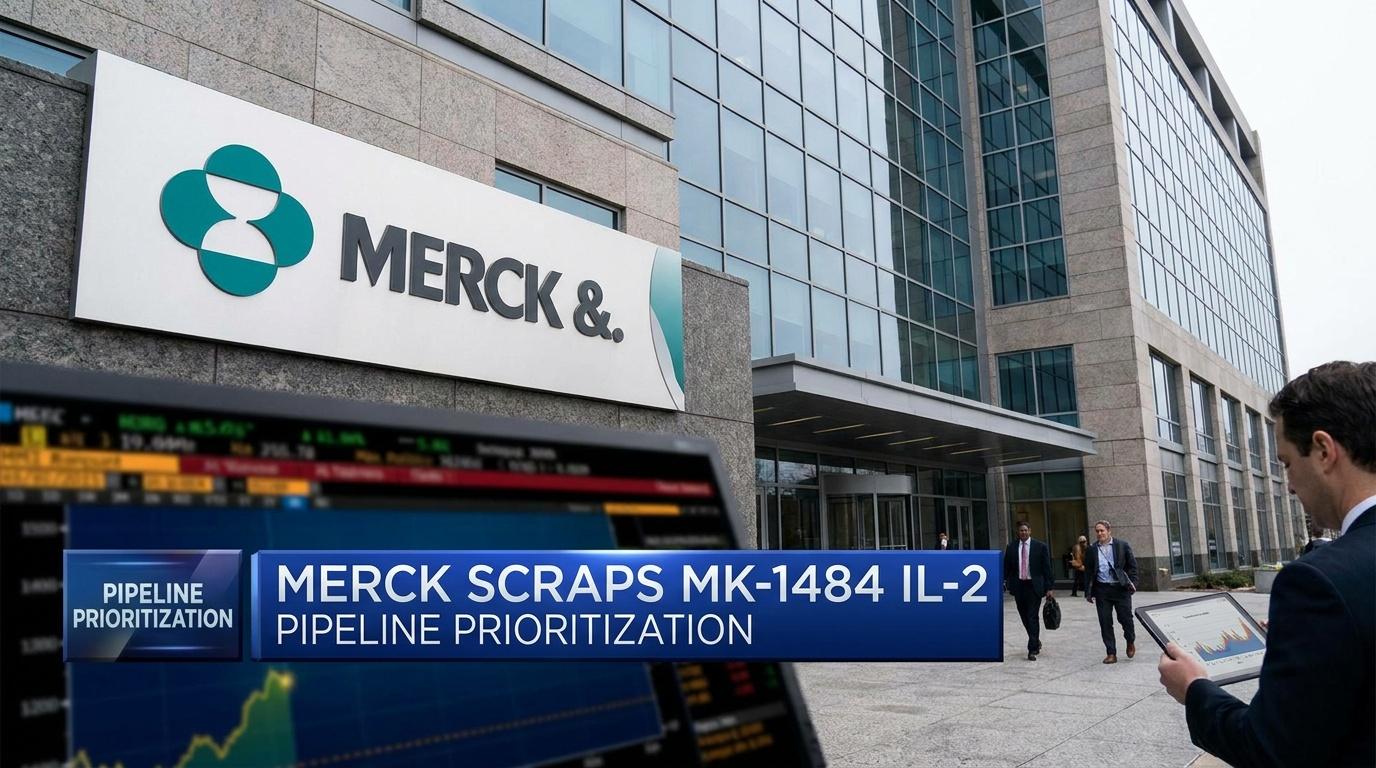
Merck & Co. has dropped MK-1484, an IL-2 agonist developed through its collaboration with Sutro Biopharma, ending a solid-tumor program that had been expected to identify a dose for a planned phase 2 trial this year.
Fierce Biotech reported that Merck confirmed the decision this week and described it only as part of a “routine pipeline prioritization.” The company did not provide further detail on why MK-1484 was cut, and it did not specifically address what the move means for its broader work on interleukin-2 in cancer.
That limited explanation still carries a clear strategic signal. With Merck having already dropped an autoimmune-focused IL-2 mutein last year that came from its Pandion Therapeutics acquisition, the company no longer lists any IL-2 assets in its pipeline. For a target that has attracted repeated investment across the industry, Merck’s withdrawal suggests the bar for staying in the field remains high even for large immuno-oncology players.
The Program That Ended
MK-1484 emerged from a 2018 collaboration in which Merck used Sutro’s cell-free protein synthesis and site-specific conjugation platforms to develop immune-modulating therapies for cancer and autoimmune disorders.
The candidate entered the clinic in 2022. Merck tested it both as a monotherapy and in combination with Keytruda in patients with advanced or metastatic solid tumors. The stated aim was to complete the study this year and select a suitable dose for the next stage of development.
Instead, the program has been discontinued before reaching that point.
What The Cut Says About IL-2
Merck’s latest decision adds to a broader record of difficulty around IL-2. Fierce noted that multiple companies have tried to use the cytokine to make cancer immunotherapies more broadly effective, with Bristol Myers Squibb’s Nektar Therapeutics deal standing out as a prominent example that did not realize that potential.
The source also pointed to a different approach from Takeda and Innovent, which presented phase 1 data in June for a PD-1/IL-2 alpha-biased bispecific. That mention matters because it suggests the retreat is not necessarily from immune stimulation as a concept, but from specific IL-2 designs that have struggled to show enough differentiation or clinical benefit.
For Merck, the practical result is simpler: a therapy class once worth multiple bets is no longer represented in its disclosed pipeline. Pipeline prioritization is routine language, but when a company exits both oncology and autoimmune IL-2 programs within a relatively short period, it also reads as a narrowing of confidence in that mechanism’s risk-reward profile.