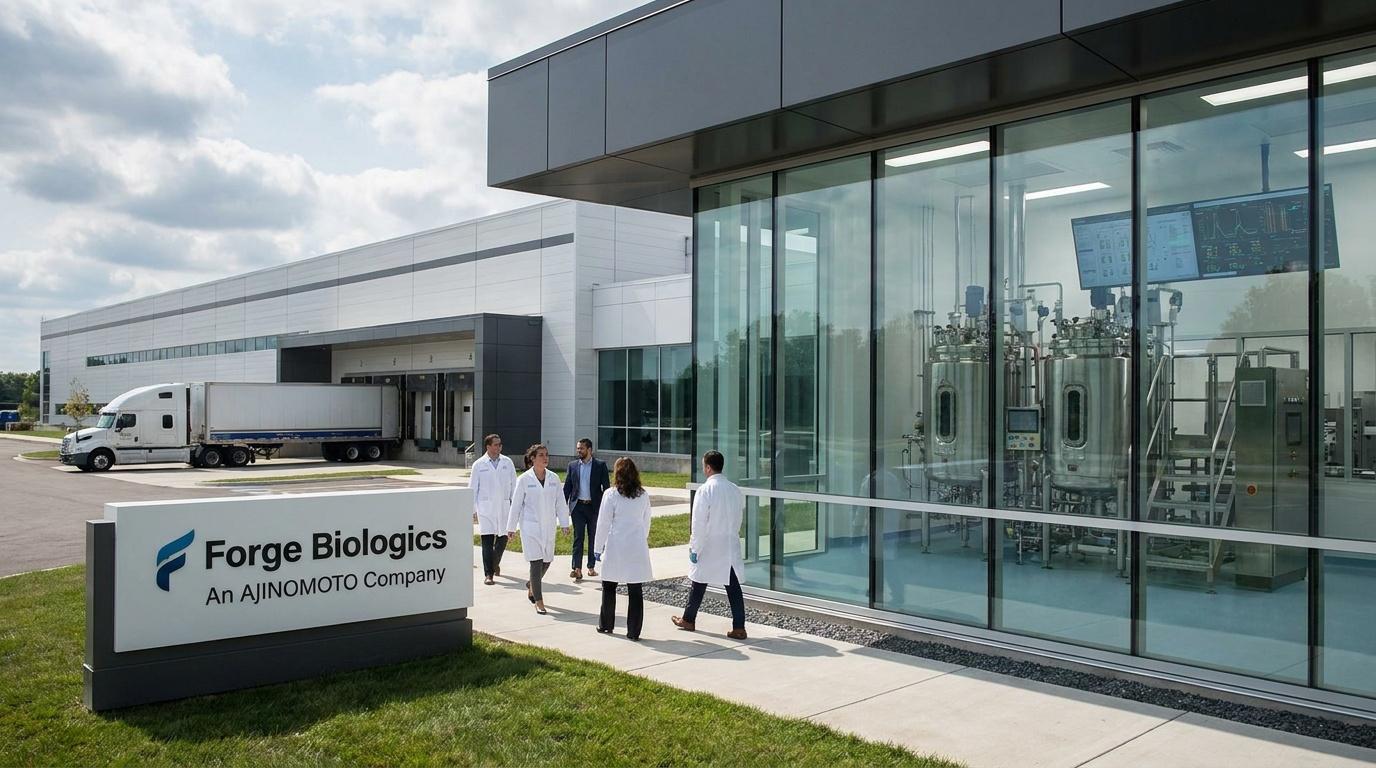
Forge Biologics is using its post-acquisition period to make a specific case about where gene therapy manufacturing can still improve: not through broad claims about the sector, but through tighter execution in data analysis, workforce specialization and domestic operations.
Samantha Piteri-Molina, vice president of business and strategy at Forge, told BioSpace that the company’s focus is ultimately on getting gene therapies to patients. Since Ajinomoto acquired Forge for $620 million in late 2023, the adeno-associated virus gene therapy manufacturer has operated as a subsidiary of the Japanese food and biotechnology company while expanding its commercial manufacturing ambitions. Piteri-Molina said Forge has grown to more than 425 employees and maintained a retention rate above 92%.
That matters because cell and gene therapy manufacturing has matured enough that the constraint is no longer only whether companies can produce vectors at all. According to Piteri-Molina, more programs are moving through the clinic and more drugs are being approved, but manufacturing efficiency still has room to improve. Her argument suggests the next competitive edge for manufacturers may come from how well they interpret and act on process data, rather than from adding capacity alone.
Where Forge Sees AI Value
Piteri-Molina drew a clear distinction between AI that addresses technical bottlenecks and the proliferation of general-purpose bots. In her view, gene therapy manufacturing already generates large volumes of data, creating a near-term opportunity to improve how that information is collected, analyzed and interpreted.
She said those gains could create efficiencies as manufacturers work to produce more vectors while also needing faster and more sophisticated product understanding and quality checks. In that framing, AI is less a replacement for scientific work than a tool for improving decision quality around manufacturing and analytics.
Piteri-Molina also said AI could matter on the drug development side, citing construct optimization and the development of unique assays as areas worth watching based on her earlier experience at PTC Therapeutics and Agios Pharmaceuticals. But she was skeptical that the most visible chatbot-style tools currently offer the best return for this part of biopharma.
Why Columbus Matters
Forge’s case for Columbus, Ohio, is both talent-driven and logistical. A 2023 Alliance of Regenerative Medicine report identified Columbus as one of 10 U.S. hubs for cell and gene therapy, citing the city’s education system, lower cost of living and relatively cheap land.
Piteri-Molina said the local ecosystem grew out of research at Nationwide Children’s Hospital and that work from the area contributed directly to four FDA-approved gene therapies: Sarepta’s Elevidys, Novartis’ Zolgensma and Itvisma, and Ultragenyx’s Fayuvi for Sanfilippo syndrome type A. She said that history helped attract specialized talent that understands the complexities of gene therapy development and manufacturing, which Forge has been able to use as it scales.
The geographic argument is more operational. Piteri-Molina said Forge is within a one-day drive of most major U.S. cities and sits on major transportation and distribution networks. For gene therapy manufacturing, where specialized raw materials often require temperature-controlled shipping and tight timelines, that supply chain position can be commercially meaningful.
The Strategic Read
The broader signal is that gene therapy manufacturing is moving into a phase where execution detail may matter more than sector enthusiasm. Forge is still talking about growth, and Piteri-Molina pointed to recent blockbuster products in cell and gene therapy including Breyanzi, Carvykti and Elevidys. But her comments put more emphasis on disciplined process improvement than on a generalized boom narrative.
She also cautioned against letting the case for domestic manufacturing become too narrow. While she said there are strong reasons to invest in domestic capabilities, she added that rare disease patient populations are distributed globally rather than concentrated in one country. That leaves manufacturers with a balancing act: build resilient local operations without losing sight of globally dispersed markets and patient groups.
For CDMOs serving AAV programs, that combination of analytics, workforce density and supply chain practicality may become the more durable differentiator than scale by itself.