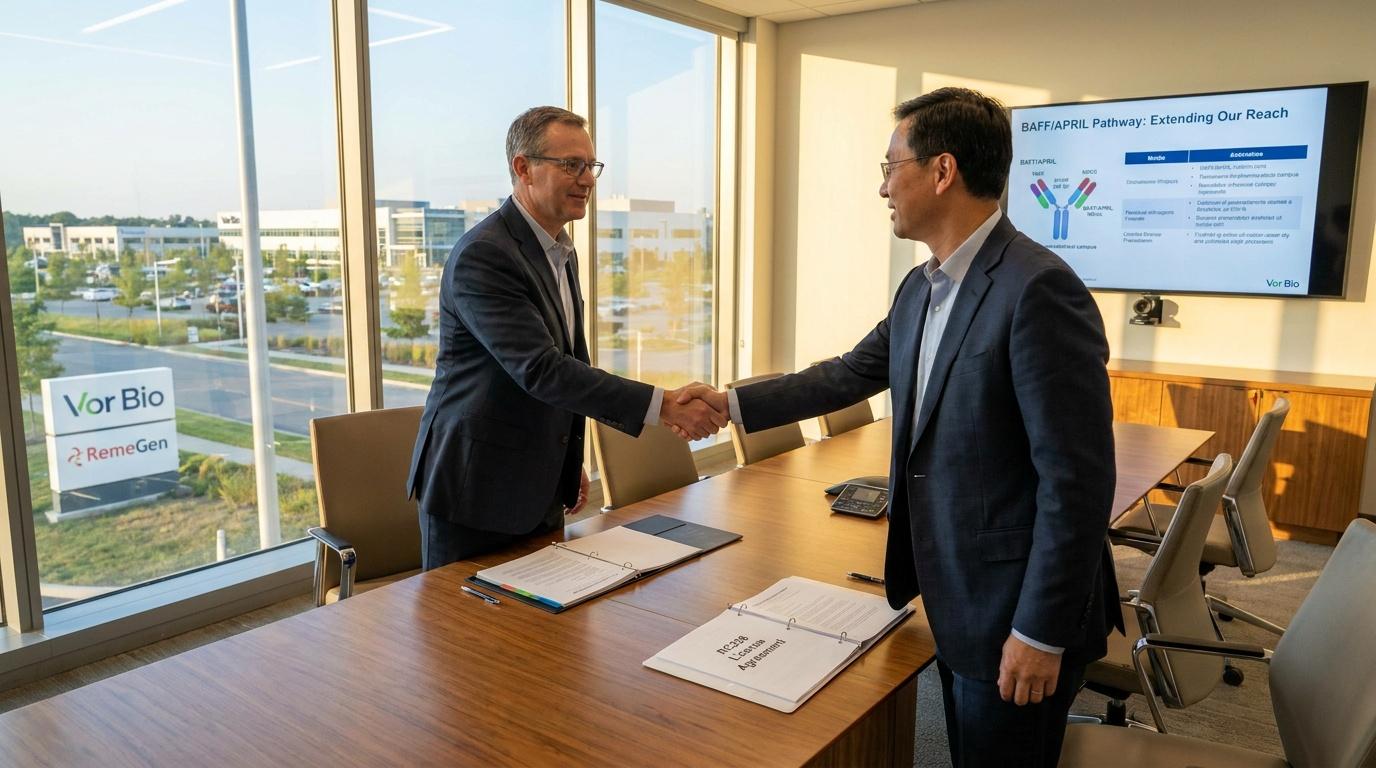
Vor Bio is paying RemeGen $10 million upfront in cash and issuing pre-funded warrants valued at approximately $46 million for rights to RC298 outside Greater China. The deal adds a long-acting candidate to Vor’s BAFF/APRIL franchise and deepens a partnership the companies began last year.
Vor is already focused on telitacicept, a BAFF/APRIL inhibitor in phase 3 development for generalized myasthenia gravis and Sjögren’s disease. It licensed that asset from RemeGen last year for $45 million upfront, a month after laying off 95% of its staff and pursuing strategic alternatives. Returning to the same partner for a follow-on molecule indicates Vor is concentrating its recovery around a single immunology thesis rather than rebuilding through diversification.
Why RC298 Fits
Like telitacicept, RC298 is designed to inhibit BAFF and APRIL to reduce autoreactive B cells and autoantibody production in autoimmune diseases. The differentiating feature, based on Vor’s description, is dosing potential.
Telitacicept is administered weekly by subcutaneous injection. Vor has not reported the dosing frequency for RC298, but it described the asset as a long-acting candidate designed to enable extended dosing intervals. That could matter strategically because a less frequent regimen may create openings in additional autoimmune diseases and treatment settings where weekly dosing is a limitation.
Vor CEO Jean-Paul Kress said the candidate is the next step in a broader campaign to create opportunities with a long-acting, next-generation molecule across new diseases and treatment settings. He also said telitacicept remains the company’s clinical foundation and near-term priority.
Deal Structure And Next Steps
Beyond the $10 million cash payment and the approximately $46 million in warrants tied to Vor’s Nov. 11 closing share price, RemeGen is eligible for up to $300 million in development milestones. That includes $20 million payable upon the achievement of initial clinical development and technology transfer goals.
RC298 is in IND-enabling development. RemeGen plans to submit an investigational new drug application in China in the first half of 2027 and will lead preclinical and phase 1 development there. After phase 1, Vor will take over subsequent clinical trials, regulatory activities and commercialization outside Greater China.
For Vor, the signal is less about immediate pipeline expansion than about franchise design. The company is trying to turn one licensed autoimmune asset into a mechanism-based platform, with longer-acting follow-ons positioned as the way to broaden disease reach after the first program establishes the category for the company.