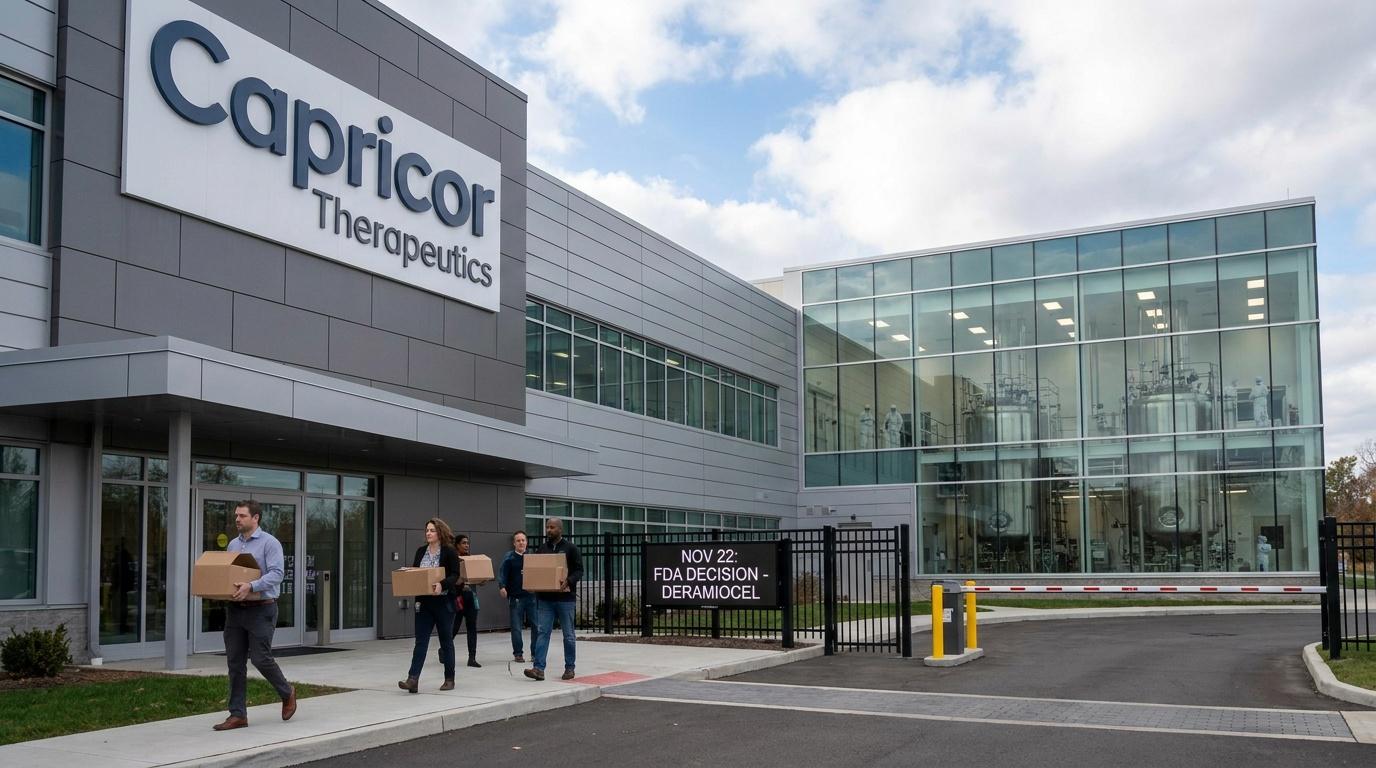
Capricor Therapeutics has cut around 10% of its workforce as it concentrates spending and operations around deramiocel, its Duchenne muscular dystrophy cell therapy, ahead of an FDA decision expected by Nov. 22. The company disclosed the reduction in its third-quarter earnings materials, saying the move was made to reduce operating expenses and align resources with its priorities.
Capricor had 231 full-time employees as of Dec. 31, 2025, according to the sources, implying the layoffs may have affected about 23 people. At the same time, the biotech is still spending aggressively on launch preparation: third-quarter operating expenses rose to $44.7 million from $26.3 million a year earlier, a 70% increase tied mainly to precommercial activities and manufacturing scale-up.
The road here
Deramiocel’s regulatory path has been unusually difficult. The FDA rejected Capricor’s first approval application in 2025, a filing based on phase 2 data. Manufacturing issues contributed to that complete response letter, which cited deficiencies related to chemistry, manufacturing and controls.
Capricor later reported that the phase 3 HOPE-3 trial hit both its primary endpoint, showing statistically significant benefits in upper-limb function, and its secondary endpoint of slowed decline in cardiac function as measured by left ventricular ejection fraction. But the FDA questioned the therapy’s success on those endpoints. In July, after debate over the FDA’s use of what Capricor said was an outdated statistical analysis plan, the Cellular, Tissue, and Gene Therapies Advisory Committee voted 9-3 against approval of deramiocel for Duchenne muscular dystrophy cardiomyopathy.
The company then returned to the FDA in August with additional data and a refined indication focused on upper-limb function. Capricor also submitted two-year open-label extension data from the phase 3 program, and that package moved the agency’s target action date from Aug. 22 to Nov. 22.
Manufacturing And Launch Readiness
Even with the workforce reduction, Capricor is continuing to build commercial and manufacturing capacity around a potential approval. CEO Linda Marbán said the company’s San Diego facility is operational and ready to support an initial launch if deramiocel is approved.
According to Marbán, a first-floor cleanroom at the site has undergone a pre-license inspection and can produce enough doses for 250 patients per year. Capricor is also adding second-floor capacity, which Marbán said should support about 2,000 to 2,500 patients a year once the expansion is complete. She said the second-floor production plant is pretty much built out and is scheduled for validation during the first half of next year, with additional cleanrooms to be completed in sequential order as demand implies.
That manufacturing push matters because Capricor’s first filing was derailed in part by CMC issues. The company is now trying to show the opposite message heading into the Nov. 22 decision: that supply and launch execution are not the bottleneck if the product clears review.
Strategic Implications
Capricor’s quarter shows a company compressing around a single regulatory event rather than broadening its pipeline risk. The biotech said it has slowed programs not directly related to deramiocel, including its exosome-based platform, to prioritize the DMD cell therapy pending further regulatory clarity.
That is a notable choice because not all shareholders had been pushing for a tighter deramiocel focus. BioSpace reported that Kaos Capital, which described itself in an August letter as a significant and growing shareholder, had urged greater emphasis on efforts outside deramiocel. Capricor instead appears to be making the opposite bet: cut staff, narrow internal attention, keep manufacturing spending elevated, and be ready for commercialization if the FDA reverses course.
Financially, the company said it had $198.5 million in the bank at the end of September. The signal from this quarter is that Capricor is managing for an approval outcome while trying to preserve enough flexibility if it does not get one. For a company with one near-term asset dominating the story, the Nov. 22 decision now carries implications well beyond deramiocel’s label.