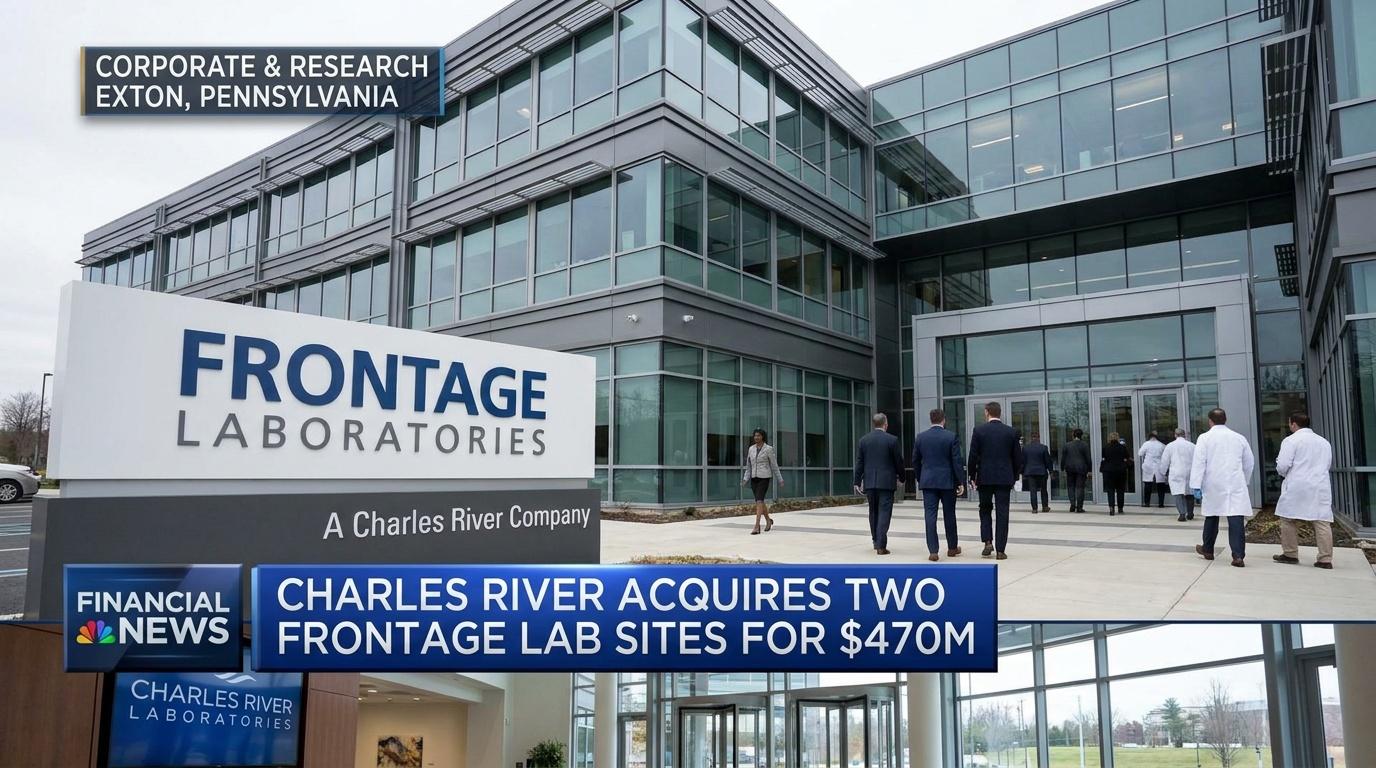
Charles River Laboratories has acquired two of Tigermed’s Frontage laboratory sites in Pennsylvania for $470 million upfront, adding clinical bioanalysis capacity to a broader push to offer more continuous support from early development into the clinic.
Frontage may receive additional payments of up to $75 million contingent on future performance. The acquired sites are both in Exton in southeastern Pennsylvania, span a combined 150,000 square feet and employ around 340 people.
The Deal
The two laboratories provide testing services for large and small molecules, including bioanalysis, biomarker work and drug metabolism and pharmacokinetics, or DMPK. Those capabilities fit with Charles River’s stated aim of broadening its regulated testing footprint across the R&D continuum.
Charles River CEO Birgit Girshick said during the company’s 2026 investor day in September that its “pathway to purpose” strategic vision was meant to reinforce the CRO’s leadership position in early-stage drug development. The acquisition directly supports that strategy by expanding the company’s presence in clinical bioanalysis.
Why It Matters
The industry signal is about workflow integration. As biologics and increasingly complex modalities take a larger place in development pipelines, CRO clients are looking for scientific partners that can manage more of the transition from preclinical work into clinical testing. Charles River is using M&A to fill in that handoff rather than leaving bioanalysis as a separate outsourced step.
Girshick said the combined bioanalysis and DMPK offering should provide a more integrated solution that accelerates development timelines and improves continuity from preclinical through clinical testing. If Charles River executes on that promise, the acquisition could strengthen its position with sponsors that want fewer external transfers across development stages.
For Tigermed, the sale trims part of the Frontage footprint that it had added in 2014 to expand its global clinical trial network. For Charles River, the bet is that denser scientific infrastructure in one geography can translate into a stronger long-term growth profile, not just more square footage.