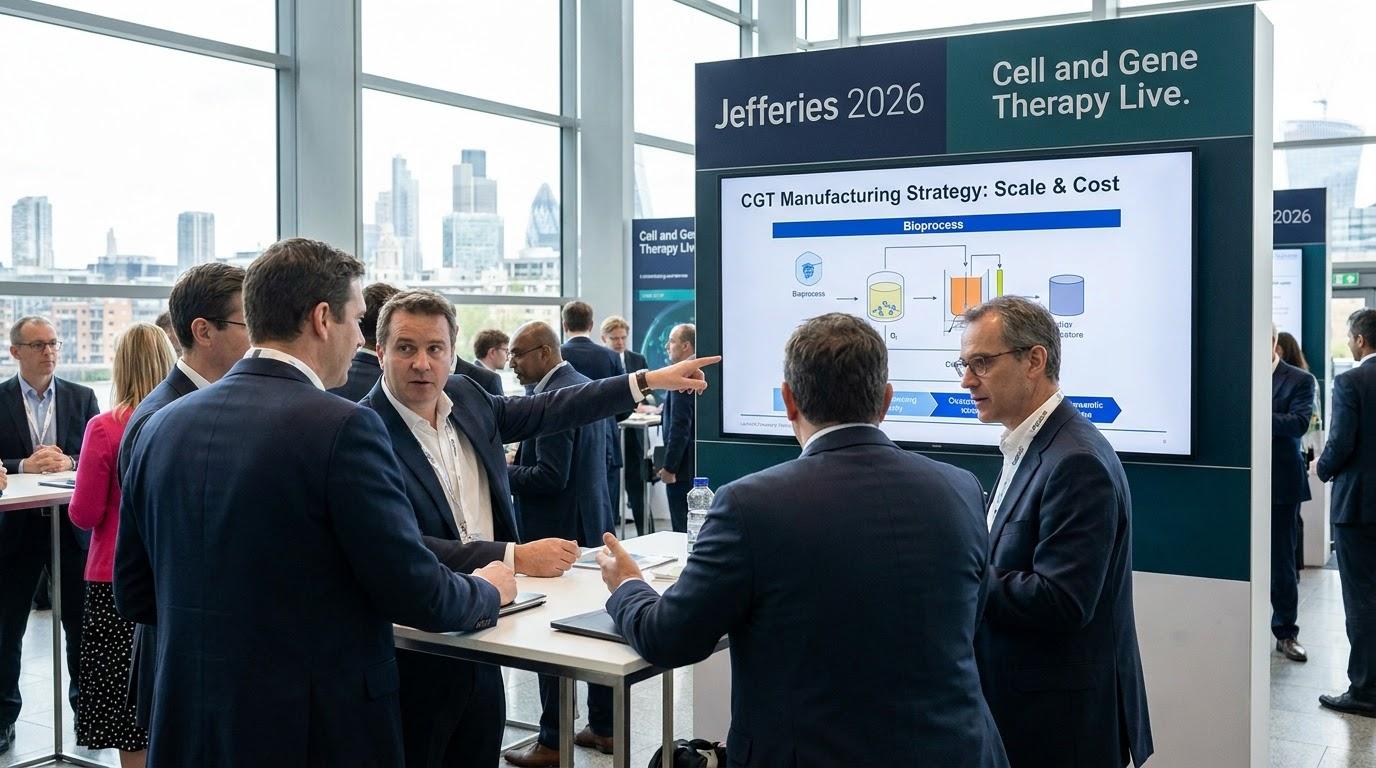
Cell and gene therapy investors are putting manufacturing strategy under heavier scrutiny, with the question moving beyond whether a product can be made in Good Manufacturing Practice to whether it can be scaled in a cost-effective way. That was the message from investors, CDMOs, service providers and biotechs speaking to BioSpace at Jefferies and Cell and Gene Therapy Live, an ancillary event to London Life Sciences Week.
Sven Kili, partner at Saisei Ventures, said manufacturing capability has always mattered to investors active in cell and gene therapy, but the emphasis has changed. The current test, he said, is not only manufacturability but also how much a therapy can be scaled and at what cost. That shift makes manufacturing a capital-allocation issue earlier in development, rather than a problem to solve closer to launch.
Why Investors Are Digging Deeper
According to BioSpace’s reporting, manufacturing, Chemistry Manufacturing and Controls and facility inspection deficiencies have become a leading cause of FDA Complete Response Letters for cell and gene therapy programs. Stuart Lowe, head of advanced therapies at TTP, said those setbacks are expensive and time consuming to fix, especially when a company is preparing for commercial launch.
That risk is pushing investors to ask for a derisked manufacturing strategy before first-in-human studies, Lowe said. When companies introduce a new manufacturing process or equipment, investors also want to see regulatory alignment and comparability data. In practical terms, that means the funding conversation now extends into process design, validation strategy and the path to scale long before revenue is in sight.
Jason Foster, CEO and executive director at CGT CDMO Oribiotech, said the older biotech financing model of backing strong science alone is less relevant in cell and gene therapy. Because these modalities are inherently complicated to manufacture, investors have concentrated on cost of goods and throughput as programs move toward scale-up and market readiness.
What Biotechs Now Have To Show
Bruce Culleton, CEO of ProKidney, said biotechs need to explain to investors not just the manufacturing process but why that process was chosen. He added that the tech transfer path to a CDMO also needs to be well described when scale-up is part of the plan.
Kili said that as an early-stage investor, Saisei Ventures does not require a scale-up process to be fully mandated at the outset, but it does want a rational and reasonable path to Good Manufacturing Practice and scale-up that is aligned with market assessment. Even at the seed stage, he said, manufacturing considerations are expected. Saisei also evaluates whether a company has the staff, either in-house or through consultants, to manage CDMO work across quality, speed, cost and timeline.
Lowe said a biotech does not need a commercial-ready platform on day one, but it does need to show that the eventual manufacturing process is derisked enough to reach the desired scale. That can involve decisions on automation, process closure, personnel and facility specifications.
The Sector Signal
The pressure on manufacturing reflects a harder commercial reality for the field. Despite billions of dollars invested in cell and gene therapy, only about 50,000 patients worldwide have received commercial CAR-T therapy since the first approval in 2017, according to the BioSpace report. Foster said the industry has not scaled manufacturing fast enough in the past five years, and biotechs can no longer assume that larger pharmaceutical partners will absorb those risks for them.
Lowe said cost-of-goods projections have therefore become a key investor metric, but those economics are influenced by decisions made as early as the preclinical stage. Companies that underthink where to invest in automation can lock themselves into labor- and facility-intensive processes that are not commercially viable. Companies that overinvest may create payback periods that do not fit the indication. The investment signal from Jefferies was that, in CGT, manufacturing strategy is no longer support work around the science; it is part of the core thesis investors are underwriting.